Celebrating 75 Years of Gill Coliseum
December 09, 2024 | Men's Basketball
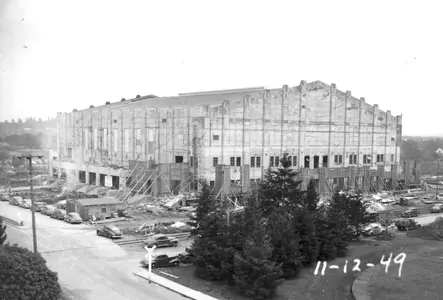
The folding bleachers for the floor level had yet to be installed. The scoreboards the manufacturer sent were the wrong model. The building's office areas and locker rooms would remain unfinished for months and its exterior still had the look of a construction site.
But on December 16, 1949, it was time for Oregon State to move into its new basketball home.
This winter marks the diamond anniversary of Gill Coliseum's opening, 75 years since the Beavers left the crowded confines of the Men's Gymnasium (now Langton Hall) for the finest arena west of the Rockies.
"Those who were here for the dedication game were astonished by the size and comfort of this massive arena," wrote The Oregonian's Don McLeod of the 10,200-seat, $1.8 million ($23.8 million in 2024 dollars) building after its debut. "Even those who have watched the sport unfolded in such pavilions as Madison Square garden and the municipal auditorium in Kansas City agreed that the OSC coliseum compares favorably with any of these ultra-modern emporiums."
Oregon State made it a happy opening night, beating national power Utah 53-41 before a crowd of 5,995 – more than twice as many fans as had been able to fit into the Men's Gym's 2,600 seats. The triumphant evening capped months of anticipation for getting a look at basketball in the new building.
"Doors to ultra-plush Gill Coliseum at Oregon State college will swing open to Gus Q. Fan Friday and Saturday this week and thus will be completed a 10-year dream and a one-year engineering project which lifts OSC into the elite of the nation – from a spectators' standpoint," wrote the Oregon Journal's Marlowe Branagan. "Basketball – the fastest-growing sport in the nation – will take its rightful place in the sun at Corvallis when A.T. (Slats) Gill and his Pacific Coast conference champions move into their new plant."
Oregon State athletic director Spec Keene told Branagan that over half the available season tickets had already been sold for the 1949-50 home schedule. The Oregonian ran a picture of assistant athletic director Loris Baker in the coliseum balcony, tearing up the "Standing Room Only" sign that had been in frequent use at the Men's Gym.
As for the "Gill Coliseum" name, that wasn't unanimous. The Oregon State Board of Higher Education had announced in early November that the building would be known as the Oregon State College Coliseum; the board had a rule that no building or field could be named after a living person.
While that may have been the board's rule, it held no weight with the press or public as the building was commonly referred to in print as Gill Coliseum right from the start. The name honored Amory T. "Slats" Gill, a Beaver basketball star in the 1920s who became Oregon State's head coach in 1928-29; his outstanding teams in the following decades generated enough interest and passion to require a new, expanded home.
The Beavers carried a 3-2 record into their home-opener, coming off a swing to the East Coast and Midwest that saw them lose at Canisius, knock off New York University in Madison Square Garden, win at Wisconsin and lose at Minnesota. Oregon State's opposition for its first game, Utah, was 3-1 with wins over PCC schools Southern California and Oregon.
The Beavers wouldn't have all the benefits of home-court advantage: because the playing floor wasn't ready sooner they held just one practice in the coliseum, that coming the day prior to the inaugural game.
Finally, Friday at 8 p.m., the officials tossed the ball in the air and the first game in Gill Coliseum history was underway. Thirteen seconds later, Oregon State center Len Rinearson hit an overhand hook shot for the first-ever basket in the building.
The 6-foot-4 senior from Oregon City added a free throw to make it 3-0, starting the Beavers on their way to a 15-3 lead after six minutes. Dick Ballantyne, a 5-foot-11 guard from Baker, had three baskets in that run. By halftime the Beavers led 26-12.
Utah staged a second-half comeback that eventually cut the Beaver lead to 45-40 with three minutes left but were forced to foul as the clock wound down. Bob Payne, a 6-foot-3 transfer forward from the City College of San Francisco, hit seven free throws down the stretch to secure the historic 53-41 win. Payne led Oregon State with 11 points and Ballantyne had 10.
"Everything was fine about the opener except the weather, and it was horrible," the Corvallis Gazette-Times reported. "But while the wind blew and the rain fell outside, everything was light, the temperature was just right and everybody had plenty of elbow room inside.
"There was a bit of confusion, but it was held to a minimum, because of lack of familiarity with the building by spectators, and a lack of permanent direction signs, etc. It took a bit of exploring to find some of the rest rooms, but there was little difficulty in getting to the centrally located concession stands, the first ever operated for basketball here, which did a thriving business."
The teams met again Saturday night with Utah taking a 51-42 victory in front of a crowd of 5,673. The new arena also helped attract Indiana and Minnesota for non-conference games in December; the previous season in the Men's Gym OSC's non-conference home schedule included Willamette, Portland, the Oakland Bittners AAU team and Wyoming.
By season's end, Oregon State had averaged 6,247 fans per home game and drawn seven crowds of at least 6,000; at the time OSC's enrollment was 5,887 and Corvallis' population was 16,207. The coliseum's inaugural season was capped by its first capacity crowd as 10,251 saw the Beavers beat Oregon 51-42.
That 1949-50 season at the Gill Coliseum was the conclusion of a lengthy road to the Beavers' new home.
GETTING TO GILL
In the late 1940s the Beavers were still playing in the Men's Gymnasium, which was built in 1915 and seated 2,600. That was adequate at a time when enrollment at then-Oregon Agricultural College was about 2,300 and Corvallis' population was around 5,100.
By then Oregon State already had a tradition of winning basketball but interest in the sport reached new heights under Gill. The first big jump was when his 1933 team won the Pacific Coast Conference title by beating Southern California in a best-of-three series played before packed houses in the Men's Gym.
With enrollment surging after World War II and the Beavers continuing to win, in the mid-1940s students had to take turns attending on alternate nights and there were no tickets sold to the general public. The Oregon legislature had passed an act in 1941 authorizing revenue bonds to pay for an "auditorium" building at OSC and the time had come to take steps toward that building's realization.
The Jones and Marsh architectural firm of Portland had drawn up plans for a 7,500-seat pavilion but a later decision by the Oregon State Board of Higher Education dictated that the seating capacity for the planned building be increased to a minimum of 10,000. Final plans and specifications were approved in March, 1948 and ground was broken that June.
A harsh winter put construction behind schedule; meanwhile, the Beavers – playing their final season in the Men's Gym – won the PCC title; the final game in the old gym was a 41-35 win over UCLA in the deciding game of the conference championship series. The Beavers would finish the season by advancing to the Final Four for the first time.
The leadup to the 1949-50 season focused not just on the Beavers' chances of winning a third PCC title in four years, but also on the new home for not just Oregon State basketball but also the school's entire athletic department, with offices and locker rooms for all teams.
"Slats Gill and his Beaver basketball boys are really going places this winter," McLeod wrote in The Oregonian in early December. "Maybe not to another northern division and coast hoop title, but they are, for sure, going into one of the finest of basketball pavilions in the country.
"Slats, known throughout the basketball world as the 'old master of the backboards,' won't talk much about his club's chances in the forthcoming division scramble, but he drools at mere mention of the new $1,800,000 pavilion.
"He – and everyone associated with this college – is rightfully proud of the pavilion officially named the Coliseum, for in comparison to the cracker-box gym in which the Orangemen have played in the past this new place is simply incredible."
The stories about the new arena often leaned on numbers: 83 feet being the height of the peak of the ceiling from the floor, 12 fabricated steal arches being part of 1,000 tons of structural steel, 14,000 cubic yards of concrete and more than 100,000 pumice blocks being used in construction, 48 1,500-watt lamps illuminating the arena, 85 percent of the 10,200 seats being on the sideline.
The sound system included four directional speakers hung over center court that could be used in any combination, and radio station KOAC had broadcast facilities in the building. Additionally, the enclosed radio booth above the north balcony had three booths separated by glass dividers and there were camera platforms at each end of that enclosure.
Those 12 steel arches allowed the entire arena area to be built without roof-supporting posts, making the new facility the second-largest suspended arch structure of its type in the United States, covering 1 1/3 acres.
The building was, indeed, constructed to function as an auditorium as well as an athletic arena. All the seats on the south side were individual seats with backs and armrests; for arts events and lectures a rolling stage was placed on the north side of the court and an acoustic ceiling and side curtains could be lowered to create a bandshell. As for the overall acoustics, a newspaper story noted that a person on the floor speaking in a normal voice could be heard clearly in the back row of the balcony.
Seats on the north side, which would include the student seating, were bench seats.
The building's first public event was held November 18, 1949 – a concert by the Vienna Boys Choir that drew 6,200 patrons.
"Initiating the almost completed Gill Coliseum, an audience of more than 6,000 persons gathered Friday night to hear the Vienna Boys Choir in the first concert of this season," reads a cutline beneath a photo in the November 22, 1949 edition of the Oregon State Barometer. "Viewed from the upper northeast corner of the building as above, the entire south side and most of the floor area were filled. In the lower right section of the picture is the portable stage used in the concert."
Just under a month later the building became Oregon State's new basketball arena. Three-quarters of a century later, it's still the home of the Beavers.
But on December 16, 1949, it was time for Oregon State to move into its new basketball home.
This winter marks the diamond anniversary of Gill Coliseum's opening, 75 years since the Beavers left the crowded confines of the Men's Gymnasium (now Langton Hall) for the finest arena west of the Rockies.
"Those who were here for the dedication game were astonished by the size and comfort of this massive arena," wrote The Oregonian's Don McLeod of the 10,200-seat, $1.8 million ($23.8 million in 2024 dollars) building after its debut. "Even those who have watched the sport unfolded in such pavilions as Madison Square garden and the municipal auditorium in Kansas City agreed that the OSC coliseum compares favorably with any of these ultra-modern emporiums."
Oregon State made it a happy opening night, beating national power Utah 53-41 before a crowd of 5,995 – more than twice as many fans as had been able to fit into the Men's Gym's 2,600 seats. The triumphant evening capped months of anticipation for getting a look at basketball in the new building.
"Doors to ultra-plush Gill Coliseum at Oregon State college will swing open to Gus Q. Fan Friday and Saturday this week and thus will be completed a 10-year dream and a one-year engineering project which lifts OSC into the elite of the nation – from a spectators' standpoint," wrote the Oregon Journal's Marlowe Branagan. "Basketball – the fastest-growing sport in the nation – will take its rightful place in the sun at Corvallis when A.T. (Slats) Gill and his Pacific Coast conference champions move into their new plant."
Oregon State athletic director Spec Keene told Branagan that over half the available season tickets had already been sold for the 1949-50 home schedule. The Oregonian ran a picture of assistant athletic director Loris Baker in the coliseum balcony, tearing up the "Standing Room Only" sign that had been in frequent use at the Men's Gym.
As for the "Gill Coliseum" name, that wasn't unanimous. The Oregon State Board of Higher Education had announced in early November that the building would be known as the Oregon State College Coliseum; the board had a rule that no building or field could be named after a living person.
While that may have been the board's rule, it held no weight with the press or public as the building was commonly referred to in print as Gill Coliseum right from the start. The name honored Amory T. "Slats" Gill, a Beaver basketball star in the 1920s who became Oregon State's head coach in 1928-29; his outstanding teams in the following decades generated enough interest and passion to require a new, expanded home.
The Beavers carried a 3-2 record into their home-opener, coming off a swing to the East Coast and Midwest that saw them lose at Canisius, knock off New York University in Madison Square Garden, win at Wisconsin and lose at Minnesota. Oregon State's opposition for its first game, Utah, was 3-1 with wins over PCC schools Southern California and Oregon.
The Beavers wouldn't have all the benefits of home-court advantage: because the playing floor wasn't ready sooner they held just one practice in the coliseum, that coming the day prior to the inaugural game.
Finally, Friday at 8 p.m., the officials tossed the ball in the air and the first game in Gill Coliseum history was underway. Thirteen seconds later, Oregon State center Len Rinearson hit an overhand hook shot for the first-ever basket in the building.
The 6-foot-4 senior from Oregon City added a free throw to make it 3-0, starting the Beavers on their way to a 15-3 lead after six minutes. Dick Ballantyne, a 5-foot-11 guard from Baker, had three baskets in that run. By halftime the Beavers led 26-12.
Utah staged a second-half comeback that eventually cut the Beaver lead to 45-40 with three minutes left but were forced to foul as the clock wound down. Bob Payne, a 6-foot-3 transfer forward from the City College of San Francisco, hit seven free throws down the stretch to secure the historic 53-41 win. Payne led Oregon State with 11 points and Ballantyne had 10.
"Everything was fine about the opener except the weather, and it was horrible," the Corvallis Gazette-Times reported. "But while the wind blew and the rain fell outside, everything was light, the temperature was just right and everybody had plenty of elbow room inside.
"There was a bit of confusion, but it was held to a minimum, because of lack of familiarity with the building by spectators, and a lack of permanent direction signs, etc. It took a bit of exploring to find some of the rest rooms, but there was little difficulty in getting to the centrally located concession stands, the first ever operated for basketball here, which did a thriving business."
The teams met again Saturday night with Utah taking a 51-42 victory in front of a crowd of 5,673. The new arena also helped attract Indiana and Minnesota for non-conference games in December; the previous season in the Men's Gym OSC's non-conference home schedule included Willamette, Portland, the Oakland Bittners AAU team and Wyoming.
By season's end, Oregon State had averaged 6,247 fans per home game and drawn seven crowds of at least 6,000; at the time OSC's enrollment was 5,887 and Corvallis' population was 16,207. The coliseum's inaugural season was capped by its first capacity crowd as 10,251 saw the Beavers beat Oregon 51-42.
That 1949-50 season at the Gill Coliseum was the conclusion of a lengthy road to the Beavers' new home.
GETTING TO GILL
In the late 1940s the Beavers were still playing in the Men's Gymnasium, which was built in 1915 and seated 2,600. That was adequate at a time when enrollment at then-Oregon Agricultural College was about 2,300 and Corvallis' population was around 5,100.
By then Oregon State already had a tradition of winning basketball but interest in the sport reached new heights under Gill. The first big jump was when his 1933 team won the Pacific Coast Conference title by beating Southern California in a best-of-three series played before packed houses in the Men's Gym.
With enrollment surging after World War II and the Beavers continuing to win, in the mid-1940s students had to take turns attending on alternate nights and there were no tickets sold to the general public. The Oregon legislature had passed an act in 1941 authorizing revenue bonds to pay for an "auditorium" building at OSC and the time had come to take steps toward that building's realization.
The Jones and Marsh architectural firm of Portland had drawn up plans for a 7,500-seat pavilion but a later decision by the Oregon State Board of Higher Education dictated that the seating capacity for the planned building be increased to a minimum of 10,000. Final plans and specifications were approved in March, 1948 and ground was broken that June.
A harsh winter put construction behind schedule; meanwhile, the Beavers – playing their final season in the Men's Gym – won the PCC title; the final game in the old gym was a 41-35 win over UCLA in the deciding game of the conference championship series. The Beavers would finish the season by advancing to the Final Four for the first time.
The leadup to the 1949-50 season focused not just on the Beavers' chances of winning a third PCC title in four years, but also on the new home for not just Oregon State basketball but also the school's entire athletic department, with offices and locker rooms for all teams.
"Slats Gill and his Beaver basketball boys are really going places this winter," McLeod wrote in The Oregonian in early December. "Maybe not to another northern division and coast hoop title, but they are, for sure, going into one of the finest of basketball pavilions in the country.
"Slats, known throughout the basketball world as the 'old master of the backboards,' won't talk much about his club's chances in the forthcoming division scramble, but he drools at mere mention of the new $1,800,000 pavilion.
"He – and everyone associated with this college – is rightfully proud of the pavilion officially named the Coliseum, for in comparison to the cracker-box gym in which the Orangemen have played in the past this new place is simply incredible."
The stories about the new arena often leaned on numbers: 83 feet being the height of the peak of the ceiling from the floor, 12 fabricated steal arches being part of 1,000 tons of structural steel, 14,000 cubic yards of concrete and more than 100,000 pumice blocks being used in construction, 48 1,500-watt lamps illuminating the arena, 85 percent of the 10,200 seats being on the sideline.
The sound system included four directional speakers hung over center court that could be used in any combination, and radio station KOAC had broadcast facilities in the building. Additionally, the enclosed radio booth above the north balcony had three booths separated by glass dividers and there were camera platforms at each end of that enclosure.
Those 12 steel arches allowed the entire arena area to be built without roof-supporting posts, making the new facility the second-largest suspended arch structure of its type in the United States, covering 1 1/3 acres.
The building was, indeed, constructed to function as an auditorium as well as an athletic arena. All the seats on the south side were individual seats with backs and armrests; for arts events and lectures a rolling stage was placed on the north side of the court and an acoustic ceiling and side curtains could be lowered to create a bandshell. As for the overall acoustics, a newspaper story noted that a person on the floor speaking in a normal voice could be heard clearly in the back row of the balcony.
Seats on the north side, which would include the student seating, were bench seats.
The building's first public event was held November 18, 1949 – a concert by the Vienna Boys Choir that drew 6,200 patrons.
"Initiating the almost completed Gill Coliseum, an audience of more than 6,000 persons gathered Friday night to hear the Vienna Boys Choir in the first concert of this season," reads a cutline beneath a photo in the November 22, 1949 edition of the Oregon State Barometer. "Viewed from the upper northeast corner of the building as above, the entire south side and most of the floor area were filled. In the lower right section of the picture is the portable stage used in the concert."
Just under a month later the building became Oregon State's new basketball arena. Three-quarters of a century later, it's still the home of the Beavers.


Thursday, June 11
Wednesday, May 06
Friday, January 30
Thursday, November 13