Track History Prepped O'Leary for Rigors of Rowing
March 15, 2016 | Women's Rowing
By Brooks Hatch
You can't get much more landlocked than Paisley, Ore., population 240, a wide spot in the road along Route 31 in rural Lake County.
And you can't get much smaller than Paisley High, a 1A school that competes in the far-flung Mountain Valley League against Gilchrist, Prospect, Butte Falls and Surprise Valley, other dots on the map.
Yet those apparent obstacles haven't stopped Oregon State junior Theresa “Tess” O'Leary from flourishing athletically and academically for the Beavers in rowing, a sport she knew next-to-nothing about when she arrived in Corvallis in Sept., 2014.
And in many ways O'Leary is the prototype athlete OSU coach Emily Ford and her staff are seeking via their e-mail solicitations. High school crew is virtually non-existent in Oregon so many on the roster must be transformed from prep runners, basketball or volleyball players – athletes with frames conducive to the sport, or from endurance sports – into college rowers.
“When we recruit non-rowing athletes, we are looking for anatomy that is suited for the sport of rowing, but we are also looking for character traits that make someone a great athlete,” Ford said.
“We find that people who have developed skills in training, competition, and teamwork in high school transition well into rowing. Tess is a great example of the type of athlete who can do well. She knows how to work hard, she's a tough competitor, and she is a great teammate.”
O'Leary was a standout athlete for the PHS Broncos. She lettered four times each in volleyball, basketball and track & field. She was all-league in each sport, won eight district and four state track individual titles, and was all-state four times.
Yet her college athletic opportunities were limited. Several Division II and Division III schools showed interest, but since she was interested in agricultural business, once she chose to attend OSU – like her mother and older sister did – she figured her organized competitive athletic career was over.
“I had resigned myself to being an overly competitive intramurals player,” she said. “I'd given up” any hopes of becoming a Division I athlete.
However, the summer before her freshman year she received an e-mail from the crew program that piqued her interest.
“I had a little bit of knowledge” about rowing, gleaned from a high school friend who rowed at Willamette University for a year, she said. “I thought, 'That would be a fun thing to try.' ”
So, she chose rowing for her Physical Activity Class and joined about 80 other novices at a meeting at Reser Stadium the day before classes started.
“It was pretty intimidating because you know not many of you are going to make it,” and be asked to join the program, she said. “You go through a three-week trial process, on land and on the water.”
And although she was “definitely” not a water person at the time, and completely unfamiliar with the mechanics of rowing, she passed the audition.
“It took a little while” to get acclimated, she said. “Rowing is not a very natural movement, like running, and it takes a while to get the sequencing down. Within a few days I got a little more comfortable, but I probably didn't look like it.
“And the first time we got in the boat, it was, 'Oh my gosh, we're gonna fall in, we're gonna tip this boat over.' Now it's second nature.”
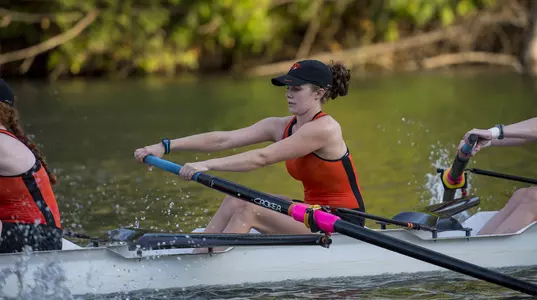
As a freshman, she steadily progressed from the Novice boat to the 3-seat on the Second Varsity 8, and raced in the 4-seat with the Varsity 4 at the Pacific-12 Conference meet.
Last year she filled the 2-seat on the Varsity 8 for the Washington State/UCLA triangular, and the 2-seat on the Second Varsity 8 for Pac-12s and most other regattas.
This season she's been promoted to the Varsity 8, which races on its home Dexter Lake course against Gonzaga on March 19 and against six other crews at the annual Oregon State Classic on April 2.
She also earned first-team Pac-12 Conference all-academic honors, and was named a Collegiate Rowing Coaches Association Scholar-Athlete, in 2015, the first year she was eligible for either honor.
Those are no small accomplishments for a small-town athlete who came to OSU armed with ambition, desire, and a dream to be a Division I competitor.
“I get asked all the time if we're a club team,” she said. “No. We are a fully-funded varsity sport. We practice just as much or more than the other teams do, and people are shocked when you tell them what we do.”
O'Leary said her track background perfectly suited the transition to rowing.
“It's one of those sports where you get out of it what you put into it,” she said. “If you work hard, you'll be successful at it.
“It was something completely different. You can walk on and be successful. That was encouraging.”
O'Leary's story isn't that unusual, given the paucity of high school crew programs outside of Portland, Seattle and other major metropolitan areas on the West Coast.
“On our Varsity 8 this year, there are two of us who were not recruited, and in the past maybe a majority of the people came up through the walk-on program,” she said.
“Rowing comes down to, 'Can you suffer?' It's definitely the hardest sport I've done. It's very difficult, very taxing physically and mentally.
“A lot of it comes down to, how hard you are willing to work, and how deep into the well you are willing to go to make it happen … most people just don't understand how strenuous rowing is.”