The Ultimate Sacrifice
November 11, 2015 | Baseball
By Brooks Hatch
osubeavers.com
It was a match made not in heaven, but in the bean and berry fields outside of Salem.
Morrell Crary and Jeannie Scales met while picking produce on the farms surrounding their hometown, a common summer job for youths hoping to make a little spending money in the idyllic Eisenhower era of 1950s Oregon.
“That's how we met, in the sixth or seventh grade,” the since-remarried Jeannie Williams recalled recently in describing her first encounter with the friendly, gregarious kid from the northeast part of town. “In the bean fields.”
Morrell would subsequently attend Serra High School and Jeanne would go to North Salem, but they stayed in touch through mutual friends, an easy thing to do back when Salem was a small, tight-knit community with only three high schools.
“He had started playing baseball by then, and he was good friends with a lot of my high school friends who played sports,” Jeanne said. “We started dating our junior year of high school.
“He was extremely handsome, had long hair, was tall and had a smile that would just melt any girl's heart. We just hit it off.
“It just happened and it has lasted forever.”
What should have been a lifetime love story took a tragic turn, however, just two short years after their 1965 graduation from Oregon State.
Morrell Crary – by that time a 2nd Lieutenant in the U.S. Marine Corps with a new baby daughter, Shannon, and a budding professional baseball career waiting for him back in the United States – was killed in action in Vietnam on Nov. 1, 1967.
He and Air Force Major Thomas Laird Brattain, a 1953-54 football letterman from Portland who died on Nov. 28, 1968, made the ultimate sacrifice in the Vietnam War, which took the lives of more than 58,000 mostly young Americans before direct U.S. military action ended in Jan., 1973, with the signing of the Paris Peace Accords.
Nearly five decades later, Morrell's OSU teammates still choke up when speaking about a friend whose life was cut short at 24 years of age.
“I thought, 'What a waste,' ” said Rod Trask of Myrtle Point, an outfielder who played with Morrell at OSU in 1964 and 1965, and in Anchorage in the Alaska Summer League in 1964.
“I hate to see young people in their prime leaving us. He had so much to give to our way of life. It was just so hard for me to believe he was gone.”
A longtime coach and educator in Douglas County, Trask has never learned the details of Morrell's passing. But he's certain of one thing.
“Whatever was taking place over there, he was leading it, and taking charge,” he said. “I have no doubt about that.”
OSU will be closed on Wednesday to formally observe Veterans Day and to honor those past and present who served their country. More than 1,000 OSU students received veteran educational benefits during the 2014-15 academic year, the most of any university in Oregon. Veterans now account for about one out of every 25 students at OSU.
From Salem to Corvallis to Vietnam
Morrell was born on Sept. 5, 1943, in Salem. He graduated from Serra Catholic (now Blanchet) High School in 1961 and then headed off to Clark College in Vancouver, Wash., for a year after helping lead Serra to the Oregon A-2 state championship.
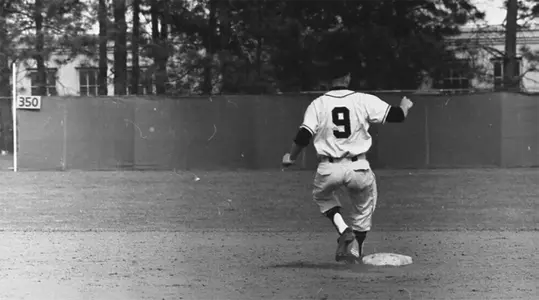
He then transferred to OSU to play for legendary coach Ralph Coleman and assistant coach Gene Tanselli, who outrecruited Oregon and Washington State to land the talented catcher. He lettered in 1963-65, was a Northern Division all-star, and earned the coveted Victor Brown Jr. Award as the team's Most Outstanding Player as a senior, when he hit .301 (34-103) with 21 RBIs and in 34 games.
He was also a member of the Beta Theta Pi fraternity, along with notable teammates Jim Jarvis, Thurman Bell, Danny Espalin, Steve Clark and Frank Peters.
“He loved Oregon State, he loved the Betas and he loved playing for Gene Tanselli,” Jeannie said.
After graduating Morrell signed with the Milwaukee Braves, a lame-duck franchise that would relocate to Atlanta for the 1966 season. He played half a season for the Yakima Braves in the Northwest League in 1965; teammates there included future major-leaguers Mike Lum, Felix Millan, Carl Morton and noted hitting guru Walt Hriniak.
Morrell and Jeannie married on Dec. 28, 1965. A return to Yakima in 1966 wasn't in the cards, however, as military service called. That March he reported to Quantico, Va., for officer training to fulfill the military commitment required of all Reserve Officer Training Corps (ROTC) graduates.
Commissioned as a 2nd Lieutenant, he left for Vietnam in Sept., 1967. Jeanne was seven months pregnant at the time, but they figured he could compete part of his tour before she was born, and thus miss less than a year of his future child's life.
After arriving in-country, he was assigned to “Ripley's Raiders,” Company L (Lima) of the 3rd Battalion, part of the 3rd Marine Regiment of the 3rd Marine Division of the Marine Amphibious Force, on Oct. 6.
Stationed in Quang Tri Province in northern South Vietnam near the Demilitarized Zone, he was killed in a firefight on Nov. 1, 1967, while attempting to capture an enemy position. Morrell was awarded the Bronze Star for bravery, and a Purple Heart.
He was one of 37 members of Lima Company who were killed in action between February and November of 1967, one of the three deadliest years of a war that would ultimately take the lives of 710 Oregonians. Morrell and the others from Lima Company who died in combat are listed on a memorial honoring Ripley's Raiders at the Marine Corps Museum in Triangle, Va.
Coincidentally, another member of Lima Company, Chuck Goggins, did play major league baseball after returning to the U.S. His tour of duty ended on Aug. 20, 1967, shortly before Morrell's began.
A popular teammate and friend
Medals and memorials do not define Morrell Crary, however. There was much more to the man.
Wayne Swango, a pitcher from a Coburg, was Morrell's teammate in 1964 and 1965. He remembers the special bond they formed while working together as a team within the team.
“He was very encouraging,” Swango recalled. “He would come out to the mound and chew your backside if you got a little wild, or ask me, 'What in the hell are you gonna throw now?' if a guy fouled off a few pitches with two strikes.
“Morrell was just a great all-around guy, a great defensive catcher and a very hard person to make mad. He was always in a good mood, had a good sense of humor, was very energetic, always hustling and a motivator. He kept people moving and lively.”
Yet Swango was surprised when Morrell, baseball teammate Tom Hobbs and football letterman Joel Heacock all joined the ROTC program together. Hobbs and Heacock became pilots and survived the war; Morrell joined the infantry and didn't.
Swango remembers being shocked and saddened when he learned Morrell had been killed in action.
“What a sweet person, a great guy with a great wife … that wasn't supposed to happen to a guy like him,” he said. “He was such a nice human being. It was a real shame.”
Several years later, the Swangos were at a volleyball tournament watching their daughter and were intrigued when they noticed a player on an opposing team named Shannie Crary.
“My wife said, 'My goodness, I wonder if that's Morrell's daughter?' ” Swango said.
Their questions were answered the longer they watched Shannie play.
“She was just a spitting image of Morrell,” Swango said. “He had sort of an unusual gait, and she walked just like him and ran just like him.”
Afterwards, they went to the opposing team's fan section and found Jeannie, who was also at the match. After catching up, they asked if they could visit with Shannie and share some of their memories of a father she never knew personally, but had heard so much about.
“It was a good conversation, but it was hard for me and probably even harder for her,” Swango said. “It's hard for me right now just talking about it.”
Shannie also recalls meeting former Crescent Valley High School coach and athletic director Gene Hilliard, an OSU teammate of Morrell's, during an athletic event at CV. He too shared stories, one in particular that illustrated what kind of man her father was.
“My dad was his road roommate,” in an era when there were very few black athletes like Hilliard at OSU, and when race relations were often far more strained than they are today, Shannie said. “A lot of guys wouldn't have done what my dad did back in those days.”
Gone, but never forgotten
Shannon “Shannie” Crary was born on Oct. 27, 1967, just five days before her father's untimely death. Jeannie said she talked with Morrell after Shannie's birth, so he knew he was a father before he was killed.
“He was totally excited and thrilled” by the news, Jeannie said, and even somewhat surprised, since he was sure they were having a boy.
After Morrell's death, Jeannie abandoned her plans of becoming a surgeon.
“Everything changed,” she said.
She instead became an educator, and taught at Candelaria, Hayesville and Yoshikai elementary schools in Salem for 28 years before retiring in 2002.
She later returned to work for five years at Abiqua Elementary, the primary school on the Blanchet campus, just a stone's throw from where Morrell starred at old Serra High School. She finally retired for good several years ago.
Jeannie remarried in 1971 and she and her current husband, Terry Williams, had a daughter in 1973. Terry was the Marine who made the casualty call to the Crary family following Morrell's death; they did not know each other at the time but reconnected several years later after Terry returned from his tour in Vietnam.
Shannie grew up in Salem and graduated from McKay High School. She attended Portland State for two years, transferred to Oregon State and graduated in 1990. Now known as Shannie Rediger, she teaches a mixed second/third-grade at Chapman Hill Elementary School in West Salem.
Last November, she was one of 12 Salem-Keizer educators to earn a Crystal Apple Award, which celebrates and recognize teachers, administrators and support staff who exceed all expectations of their profession and who engage community in their work.
Her sons Riley and Brady Rediger starred at West Salem High School and play baseball for Linfield College. She says Brady, a sophomore catcher-outfielder, looks exactly like Morrell did when he was an OSU standout.
“It's probably very strange for my mother and grandmother” to see someone who so closely resembles their husband and son despite being two generations removed, Shannie said. “Brady has fair skin, like I have and like my dad had.
“He has a quieter personality like my dad's, and many of his mannerisms. It's neat for my grandmother to look at Brady and be able to talk about my dad,” because they seem so alike.
Added Jeannie: “Oh my word … when people who knew Morrell see Brady, they gasp and lose their breath. He looks like him and acts like him.”
Shannie said she's learned a lot about Morrell from her mother and grandmother, and from those who grew up with him and who went to high school with him.
“He sounds like he was a genuine man, very kind, very funny,” she said. “I've never heard anyone say anything negative about him. It's all just very positive.”
One of her most prized possessions is a video of her father playing baseball at old Waters Field in Salem, made by a former teammate who had some old game film from the 1960s. It portrays Morrell as an active, athletic, alive person, something not always apparent in old black and white still photos.
“It was kind of surreal,” and makes her father seem all the more real, she said.
Trask, whose wife Jean was an Alpha Chi Omega sorority sister of Jeannie Williams, said Morrell was one of his favorite teammates.
“He was an excellent catcher and receiver, could call a great game and was in charge,” he said. “He was well-liked by everyone. By everyone.”
Trask said Morrell was always positive and knew how to have a good time, but also “knew when to get after it” if someone needed a little kick in the pants to get moving or straightened out. “He just really enjoyed life and enjoyed baseball.”
After his death the Morrell J. Crary Memorial Scholarship was established in his honor by Dwight and Barbara Quisenberry and Dan and Peggy Fry of Salem, friends of the Crary family. It is awarded annually to an OSU baseball player from the state of Oregon; donations can be made to Morrell J. Crary Memorial Scholarship through the OSU Foundation, 850 SW 35th St., Corvallis, OR, 97333-4015.
“It's nice,” Jeannie said of the scholarship. “We get cards or letters from recipients of who thank us for the scholarship and how it helped them get an education.”
Morrell Joseph Crary is buried in Belcrest Memorial Park in Salem. His name is engraved on line 1 of panel 29E of the Vietnam Veterans Memorial on the Capitol Mall in Washington, D.C., alongside rows and rows of other Americans who also gave the last full measure of devotion in Southeast Asia, thousands of miles from their loved ones and hometowns.
Jeannie said her visit to the Vietnam Veterans Memorial did not bring closure; she's not sure that will ever be possible. But it was a very moving, profound and unforgettable moment she's glad she experienced.
“It was extremely emotional,” she said. “I took a whole bunch of pictures and got rubbings. The people there showed so much respect” for the sacrifice made by those whose names are inscribed on the Wall, “even if they didn't know anybody there.”
The Wall wasn't built when Shannie last visited Washington, D.C. However, she also has photos and rubbings of her father's name, obtained by relatives and friends on their trips to that sacred site.
And she has mementos from, and stories about, the life of a father taken far too soon. Jeannie said she does whatever she can to insure that Morrell's memory lives on, and remains a big part of Shannie's life, and of his grandchildren's lives.
“I want her to know everything. Morrell wasn't a saint,” Jeannie said, laughing at a private memory. “He was just a great, great guy.”