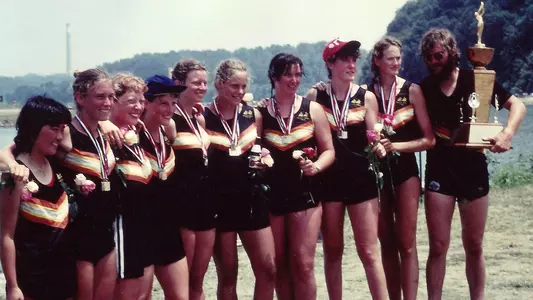
Oregon State’s 1980 women’s openweight 8 of (left to right) coxswain Lynn Nishida, Nancy (Hutchinson) Tuttle, Lise Hubbe, Becky Stephenson, Holly Godard, Connie Johnston, Ann Hinman Ward, Carol Deeming Vanlue, Judith Davidson Schoenberg and head coach Ralph Mathison celebrate with their Elite 8 national championship trophy in Oak Ridge, Tenn.
Photo by: M. Jean Godard
When OSU Women Shocked the World
June 22, 2020 | Women's Rowing
A version of this story originally appeared in the Spring 2020 issue of The Oregon Stater, the magazine of the Oregon State University Alumni Association. To keep up with happenings across OSU and the accomplishments of Beaver students and alumni, you can read the Stater.
By Kip Carlson
In her work as a nurse practitioner at Oregon State's student health center, Nancy Tuttle sometimes discovers her patients are rowers. When she does, Tuttle asks if the Beavers still work out in the shell named The Magic of '80.
"Our names are on that one," Tuttle said. "I just tell them I used to row and if they still row that boat it brings back memories for me."
In July, 1980 – about a month after OSU's women's rowing team wrapped up that season – the mother of Holly Godard, another team member, sat down with a legal pad and pencil and wrote out a nine-page recollection. M. Jean Godard's homage began, "There's a story to be told of the 1980 Women's Crew of OSU …"
Indeed there is. And that story from 40 years ago this spring is one of the great but little-known tales in Oregon State's athletic history – one that has the team among the 2020 inductees into the OSU Sports Hall of Fame.
A CREATIVE COACH PROVIDES AN EDGE
In the late 1970s, women's intercollegiate athletics was emerging from its embryonic stage. OSU still had separate men's and women's athletic departments but women's rowing was under auspices of the men's department because that was where the entire rowing program was housed.
Karl Drlica was head coach overseeing the program, but Ralph Mathison – a former OSU rower and metallurgical engineering student – was responsible for working with the women and was assisted by Kirk Hutchinson, another former OSU rower who had just completed his career.
Hutchinson remembered Mathison as "very creative."
"He kept thinking of, 'Okay, how can I get an edge over somebody else?'" Hutchinson said. What came to Mathison's fertile mind included experimental diets, training runs of up to 20 miles to develop endurance, other land-based workouts, visualization, new stroke styles … you name it.
Tuttle recalled Mathison being ahead of the times in having OSU adopt a style that involved shorter, faster strokes rather than longer, slower strokes: "Maximizing the effect of your core body strength and your legs, minimizing your pull through the arms – because your arms are nowhere near as strong as your back and your legs."
Mathison adopted the idea from elite coaches on the East Coast, where he had connections in the rowing community. Tuttle said Mathison would send tapes of the Beavers to national coaches and get feedback on how they might improve.
With a crew that had members from 5-foot-4 to over 6-foot tall, Tuttle said Mathison's skill as a boat rigger also came into play, setting up the riggers and oarlocks in a way that equalized the efforts of the diverse bodies to keep them working in unison.
"Ralph was a ridiculously eccentric person," Tuttle said fondly. "We loved him dearly, but just a free thinker. And I think he's really the person who could take a motley crew like that, that had high goals, and say, 'Okay, we'll try for this.'"
Tuttle was one of the few Beaver rowers with pre-collegiate experience, having grown up in a rowing family in Connecticut before finding her way to Oregon State.
"It gave me a perspective to have rowed with elite rowers in the past," Tuttle said of seeing a relatively inexperienced Beaver crew mesh and grow to challenge the nation's best. "My sister was on the national and Olympic team. I rowed with others on the East Coast that accomplished a lot in the world of rowing. I came to Oregon and recognized that it is not about any one person when you row in an eight. Teamwork, hard work, and trust in one another and oneself is the key.
"It was a remarkable accomplishment for a motley group of women to have won the final race at nationals. We fondly call ourselves the motley crew: it is not an insult."
Most of OSU's team was like Godard, who hadn't rowed until arriving in Corvallis. As for her athletic background, she remembered being approached by her English teacher at Sunset High in Beaverton – a women's basketball referee - about playing on the girls basketball team she was starting.
"And I looked at her like, 'Well, basketball's fun, but I'm doing dance team, thank you.' And, 'Who would ever go watch that?'" Godard laughed. "Things change."
Godard rowed her freshman year at OSU, took three years off, then decided to get back into the sport in her final year of college. She had bumped into Hutchinson, who encouraged her to come to the informational meeting at the start of the fall.
"I bicycled over," Godard said. "And I thought, 'You know, I can work with this Ralph guy.' Pleasant personality … looks at the valuable person that you are and says, 'Come on down, let's do this.'"
But it wasn't going to be easy.
"Each time I remember coming home to roommates I had: 'I've never worked so hard in my life.' And then the next day: 'I've never worked so hard in my life.' And they'd say, 'You say that every day,'" Godard said. "They were creative in their workouts. We would go to some hill in Corvallis and bicycle up, bicycle down, run up, run down, bicycle up, bicycle down – do lots of different off-water things as well, which kept it interesting.
"We don't know where our energy was to get up and get there every day, to get up and do this, but it was there … both coaches were trustworthy with that commitment. And they were a spark to help us get from here to there, and asking for our commitment but not demanding something."
REASONS TO START THINKING BIG
The Beavers got the season off to a successful start, letting them begin thinking of qualifying for the women's national collegiate championships, which would be held for the first time that year. The athletic department said if OSU placed first or second in the Pacific-10 Championships, they'd support the trip to nationals.
"I'd say about halfway through the season we were ambitious and hopeful," Tuttle said. "Then three-quarters of the way through the season, we were like, 'Hey, maybe we can do something.'"
Oregon State's main competition was West Coast rowing powers Washington and California. At the Corvallis Regatta the Beavers' openweight 8 beat the Huskies, but the system that would determine seeding at the Pac-10s still favored UW.
Seeding was crucial in a Pac-10 meet where the format was head-to-head racing: two crews race and the winner advances to the next round; being seeded second meant not facing favorite Cal until the finals. Mathison and Hutchinson met that Saturday night after the Corvallis Regatta concluded.
"And I can totally remember, he says, 'We have to take this boat to Seattle to Green Lake (regatta) and we have to beat Washington," Hutchinson said. "If we beat Washington, we'll be in the other side of the bracket from Cal at Pac-10s."
The coaches went to the OSU motor pool and secured a van. The next weekend, the openweight 8 piled into the vehicle and headed up Interstate 5.
"We don't take a boat, we don't take oars, we don't take anything," Hutchinson recalled. "We drive up there, we borrow a boat, we get out in the thing. It's just like, 'Whatever.'"
Tuttle remembered Mathison having the Beavers sit under a tree and visualize their race before rowing it.
"Just kind of weird stuff for the time," Tuttle said. "And we did well and upped our seeding. So those kind of little quirky things – Ralph had this kind of can-do attitude."
The Beavers finished second in the race – to the University of British Columbia. As it had in Corvallis, OSU finished ahead of Washington and secured the No. 2 spot in the Pac-10 Championships.
"It was a coming-of-age thing," Hutchinson said.
At the Pacific-10 Championships at Redwood Shores, Calif., the Beavers placed second to California, earning their trip to the nationals in Oak Ridge, Tenn. That Pac-10 meet was when Godard felt something special might be forming.
"That's when we had our thing coming together," she said. The openweight 8 had settled into a lineup of Tuttle (then Nancy Hutchinson, as she and Kirk were married at the time), Godard, Lise Hubbe, Judy Davidson Schoenberg, Carol Deeming Vanlue, Connie Johnston, Becky Stephenson, Ann Hinman Ward and coxswain Lynn Nishida.
Tuttle, Godard and Becky Stephenson also rowed in the Beavers' lightweight 8. Unlike many of the crews they competed against, OSU's rowers came in all shapes and sizes.
"Kind of rag-tag Oregon girls, normal gals," Godard said. "Then looking at Cal with their over-processed program: everyone the same height, the same color, all their hair done the same. It was like, 'No, we're not like you. We're a little more gritty' … It was like, 'You can do that, but it doesn't make you go faster.'"
A LOSS AT NATIONALS – OR WAS IT?
The Oak Ridge competition would be in two parts: the inaugural collegiate-only competition to open the weekend, followed by the National Women's Rowing Association championships, which was open to colleges, club teams and rowers all the way up to national team-level athletes in the "elite" division.
Hutchinson borrowed a friend's new half-ton pickup and he and one of the coxswains drove the shells across country. One of the 8s was a Pocock "cedar speeder" named the Eloise that the lightweights would row; the other was a new Schoenbrod plastic boat that had been bought for the men's lightweights, but Mathison thought its stiffer hull would better suit the openweight women's rowing style.
While Hutchinson and the coxswain motored across the continent, the rest of the 16-person squad flew to Tennessee. Most of the Beavers would row in two or three events over the course of the four days.
The Beavers weren't exactly highly regarded going into the week. As far as West Coast crews went, Washington and California were the ones with national reputations and even that didn't mean much in some circles.
"But still, Harvard and Yale think of Washington as, 'Ah, they're out west, and they've been to the Olympics and they're kind of good. But they're not us, because we are us,'" Hutchinson said. He figured if there were 30 East Coast teams at the regatta, "Even like team 30 says, 'Oh, good, we get to row Oregon State because they're not very good.'"
OSU earned some notice on the opening day of the collegiate meet when its lightweight 8 of Tuttle, Godard, Stephenson, Bene Schleuninger, Mary Knower, Susan Honcharski Mathison, Meghan Lilly, Tanya Duvall Erickson and coxswain Nishida placed second.
Then, in the collegiate openweight 8 final, California edged Oregon State by about five feet over the 1,000-meter course. But when Mathison boated out to talk with the team, something didn't look right: the finish markings were off.
"I think it had to do with how closely Ralph had followed the races and he just had an eye for that sort of stuff and had some sort of feeling that this just can't be right and let's try measuring the lanes," Tuttle said.
Mathison filed a protest, race officials investigated and found that indeed OSU had rowed about 14 feet further than Cal. According to M. Jean Godard's letter, the story was that officials had measured the course and driven pegs on the banks to be used as the finish line; someone mowing the riverside grass then pulled the pegs, cut the lawn, and replaced the pegs in the wrong spots.
Officials wouldn't overturn the race results. As for a rematch in the upcoming NWRA championships, Oregon State was in the Senior openweight 8s race and Cal was in the Elite 8s. Mathison negotiated a spot for the Beavers in the Elite 8s as a way to get another crack at the Bears.
"They didn't give back the medals or anything, but that's what they said," Hutchinson said. "That's how they refereed this discrepancy in the course."
Tuttle remembers Mathison putting it to the team as to whether they wanted to row in the Elite 8 race.
"And hands down, we all wanted to row in the Elite event," Tuttle said.
ROWING TWO NATIONAL FINALS IN TWO HOURS
In the opening days of the NWRA meet, OSU's Elite Pair of Johnston and Tuttle placed second; the Senior 4 of Hubbe, Godard, Vanlue, Ward and coxswain Nishida placed third; and the Lighweight Pair of Lilly and Knower took fourth followed by Mathison and Erickson in fifth.
Then came Sunday, June 22.
Even with its berth in the Elite 8s, OSU elected to also compete in the Senior 8s so the Beavers would be rowing two national championship races in less than two hours; it helped that races then were only 1,000 meters rather than the present 2,000 meters. Oregon State opened the day by taking the Senior 8s by .19 of a second over Pioneer Valley Rowing Association, a team made up of top rowers from five eastern colleges.
"I remember we were under Ralph's direction to go be in the shade and be quiet," Godard said of the wait for the Elite 8s.
Tuttle remembered a sense of, "We have to prove this to ourselves."
"I just feel like it was an inner sort of, 'We know we can do this and the only way we're going to be able to say we weren't silly in thinking we could do it was to actually do it," Tuttle said.
All those long runs Mathison introduced as part of training would be a factor that afternoon.
"The team was really fit, aerobically," Hutchinson said. "So they had a two-hour recovery time and went out and did another sprint."
The Oak Ridge course was six lanes, and the addition of Oregon State to the Elite 8 final meant an adjustment: the Beavers would be in a makeshift Lane 7, rowing outside the buoys. To Godard, that felt odd when she got in the boat.
"I remember looking at the water, and it was a little bit the wrong way out there on the edge (with no outer lane marking). I'm thinking, 'This is silliness,'" Godard said. "But I do remember the complete focus fed out by Ralph and agreed to by all of us that we're going to do this, right here and right now.
"And I do remember blasting out of there."
The Beavers' strategy all season had been to start fast and hold on. Mathison had developed a starting technique that had the Oregon State rowers' bodies in motion while the boat remained stationary until the start command. Not having to get themselves moving before starting their initial stroke gave the Beavers an early surge.
"I have pictures of our boats being like eight seats ahead within 10 strokes," Hutchinson said. "We had like a 43 (stroke-per-minute) racing cadence and just stormed off."
It was a strategy that had risks. At that pace, one rower whacking a wave or "catching a crab" – having an oar blade stick in the water at the wrong moment – would be catastrophic.
"Then you're sunk," Tuttle said. "You can't do it in a race like that. It's just too close and it would be over. But somehow we kept ourselves together. But yeah, it (the stroke rate) was really high. How does it feel? I think that's probably why I don't remember a lot of details, because I think I was probably hypoxic through good portions of a race."
There was a road alongside the Oak Ridge course and OSU's coaches kept tabs on races from the pickup that had towed their shells to Tennessee. They drove at the race's pace until about the 750-meter mark, then accelerated ahead to the finish line to watch the conclusion.
In the final race of the season with the biggest prize at stake, Mathison and Hutchinson dashed to the end of the course and watched OSU try to hold off Wisconsin.
"Lots of races go like this," Hutchinson said, demonstrating with his hands how the bows of two shells might trade the lead as each surged with a stroke and then slowed as the rowers readied for the next stroke. "And this many years later I won't quote that it was either way, but mostly Oregon State led the entire race."
Wisconsin was closing fast, though, and reached the finish line at almost the same instant as the Beavers. Officials spent 20 minutes looking at video to determine the winner; the shells remained on the water during that time.
Finally, the order of finish was announced. The Beavers heard "second place, Wisconsin" and knew they'd won; that anaerobic training paid off with two national championships in less than two hours. The margin of victory turned out to be .18 of a second.
"It's OSU and the shell of black jerseys with the orange stripes has sprung more arms than a centipede has legs," Godard's mother wrote of the celebration scene.
Said Hutchinson: "And then of course Ralph and every one of us is just going berserk because this had started at the Corvallis Regatta and built up this massive hill of the ups and downs of the race course being wrong and then when they won, it was just like, amazing."
"COSMIC GRIT"
Hutchinson remembers after the final race, the Beavers were sitting on the grass near the course, pretending to row on the ground, taking pictures and enjoying their triumph.
"Wisconsin is going by going, 'What the hell did we just lose to?'" Hutchinson said. "And these are really good athletes, but they look more like the Bad News Bears than they look like this Wisconsin, who is just all uniform height, size, weight and everything else."
The Beavers – whose squad also included coxswain Cheryl Griffin - nearly took the overall team title as well, being edged by two points by that all-star Pioneer Valley Rowing Association club.
Hutchinson compared Oregon State shattering expectations against higher-profile competition with another sporting event earlier in 1980.
"The United States Olympic hockey team beat the Russians," Hutchinson said of the amateur U.S. squad going against the Soviet juggernaut. "In the world of hockey, everyone said, 'That should never happen, this is the most amazing thing, this is off the charts.' … This is exactly how big a thing it was for the OSU women to eventually win the national championship through all these other things that went on."
What made that team that Tuttle still happily calls "a motley crew" so good?
"I think that's kind of infectious in a sport like rowing," Tuttle said. "For one thing, if your goals are similar, your training is in sync and with each other and you work hard a lot together, you kind of feed off of each other for that inspiration.
"And yeah, I think we had a core group of people who had high goals for rowing and their own performance. I think we kind of fed off each other with that kind of can-do attitude and Ralph took it to one other level."
Said Godard: "So much of it was secondary to the training. The zen of it, the focus of it, the trust of it. And these gals were not my best friends, they weren't my drinking buddies, they weren't my apartment roommates – they were my rowing people. But we were good boatmates."
Hutchinson agreed the team had "a certain symbiosis about them that they all fed off everybody's strengths. And Ralph was a great technician: I gave him a plaque and an oar thing when he was done coaching us that said, 'Thank you for teaching me the art and science of rowing.'
"He knew about the art part, which is the fuzzy part. But he was a metallurgic engineer, he knew the science, so the boat was rigged just right and everything came together perfectly on that particular day, time and place. And it was that athletic statement that you make when you're on a roll and it just kept growing and peaking at the right time – that's a huge part of athletics … This crew was really good because for four days straight, three days, they did the same thing over and over again."
Godard has her own term for what set that team apart: "Cosmic grit."
"And it was like a cosmic grit that Ralph said, 'Grab onto that that's in you.' And Ralph was a really wonderful leader, coach and leader: 'And if you work with me, and let me work with you, we can use what's in you and we can do this. Because I have ideas about that.'
"And I would have never dreamed about ideas that he had."
OREGON STATE'S FORGOTTEN CHAMPIONS
So what happened to this story? How has a national championship-level performance stayed under the Oregon State radar for four decades?
With the regatta over, the Hutchinsons went sightseeing in North Carolina with Nancy's parents. Mathison drove the boats back to Corvallis and the rest of the team flew home.
Classes had already ended at OSU and the other spring sports had wrapped up weeks earlier; minds were already on summer activities and looking ahead to fall sports. Mathison resigned his coaching position before the next season; he died of cancer in 1997. Many of the rowers had finished their college careers and were on to their post-OSU lives.
When she talks with current rowers about The Magic of '80, Tuttle humbly doesn't mention the national championship those rowers earned.
"It just kind of faded," Hutchinson said of that Beaver crew's shining moment.
At that time, though, the spotlight was theirs.
"Later at a celebration ice cream," Godard's mother wrote, "Other club rowers asked how Holly and the team trained and said, 'We wondered if they were bionic!'"
As it turns out, motley and bionic are a Hall of Fame combination.
By Kip Carlson
In her work as a nurse practitioner at Oregon State's student health center, Nancy Tuttle sometimes discovers her patients are rowers. When she does, Tuttle asks if the Beavers still work out in the shell named The Magic of '80.
"Our names are on that one," Tuttle said. "I just tell them I used to row and if they still row that boat it brings back memories for me."
In July, 1980 – about a month after OSU's women's rowing team wrapped up that season – the mother of Holly Godard, another team member, sat down with a legal pad and pencil and wrote out a nine-page recollection. M. Jean Godard's homage began, "There's a story to be told of the 1980 Women's Crew of OSU …"
Indeed there is. And that story from 40 years ago this spring is one of the great but little-known tales in Oregon State's athletic history – one that has the team among the 2020 inductees into the OSU Sports Hall of Fame.
A CREATIVE COACH PROVIDES AN EDGE
In the late 1970s, women's intercollegiate athletics was emerging from its embryonic stage. OSU still had separate men's and women's athletic departments but women's rowing was under auspices of the men's department because that was where the entire rowing program was housed.
Karl Drlica was head coach overseeing the program, but Ralph Mathison – a former OSU rower and metallurgical engineering student – was responsible for working with the women and was assisted by Kirk Hutchinson, another former OSU rower who had just completed his career.
Hutchinson remembered Mathison as "very creative."
"He kept thinking of, 'Okay, how can I get an edge over somebody else?'" Hutchinson said. What came to Mathison's fertile mind included experimental diets, training runs of up to 20 miles to develop endurance, other land-based workouts, visualization, new stroke styles … you name it.
Tuttle recalled Mathison being ahead of the times in having OSU adopt a style that involved shorter, faster strokes rather than longer, slower strokes: "Maximizing the effect of your core body strength and your legs, minimizing your pull through the arms – because your arms are nowhere near as strong as your back and your legs."
Mathison adopted the idea from elite coaches on the East Coast, where he had connections in the rowing community. Tuttle said Mathison would send tapes of the Beavers to national coaches and get feedback on how they might improve.
With a crew that had members from 5-foot-4 to over 6-foot tall, Tuttle said Mathison's skill as a boat rigger also came into play, setting up the riggers and oarlocks in a way that equalized the efforts of the diverse bodies to keep them working in unison.
"Ralph was a ridiculously eccentric person," Tuttle said fondly. "We loved him dearly, but just a free thinker. And I think he's really the person who could take a motley crew like that, that had high goals, and say, 'Okay, we'll try for this.'"
Tuttle was one of the few Beaver rowers with pre-collegiate experience, having grown up in a rowing family in Connecticut before finding her way to Oregon State.
"It gave me a perspective to have rowed with elite rowers in the past," Tuttle said of seeing a relatively inexperienced Beaver crew mesh and grow to challenge the nation's best. "My sister was on the national and Olympic team. I rowed with others on the East Coast that accomplished a lot in the world of rowing. I came to Oregon and recognized that it is not about any one person when you row in an eight. Teamwork, hard work, and trust in one another and oneself is the key.
"It was a remarkable accomplishment for a motley group of women to have won the final race at nationals. We fondly call ourselves the motley crew: it is not an insult."
Most of OSU's team was like Godard, who hadn't rowed until arriving in Corvallis. As for her athletic background, she remembered being approached by her English teacher at Sunset High in Beaverton – a women's basketball referee - about playing on the girls basketball team she was starting.
"And I looked at her like, 'Well, basketball's fun, but I'm doing dance team, thank you.' And, 'Who would ever go watch that?'" Godard laughed. "Things change."
Godard rowed her freshman year at OSU, took three years off, then decided to get back into the sport in her final year of college. She had bumped into Hutchinson, who encouraged her to come to the informational meeting at the start of the fall.
"I bicycled over," Godard said. "And I thought, 'You know, I can work with this Ralph guy.' Pleasant personality … looks at the valuable person that you are and says, 'Come on down, let's do this.'"
But it wasn't going to be easy.
"Each time I remember coming home to roommates I had: 'I've never worked so hard in my life.' And then the next day: 'I've never worked so hard in my life.' And they'd say, 'You say that every day,'" Godard said. "They were creative in their workouts. We would go to some hill in Corvallis and bicycle up, bicycle down, run up, run down, bicycle up, bicycle down – do lots of different off-water things as well, which kept it interesting.
"We don't know where our energy was to get up and get there every day, to get up and do this, but it was there … both coaches were trustworthy with that commitment. And they were a spark to help us get from here to there, and asking for our commitment but not demanding something."
REASONS TO START THINKING BIG
The Beavers got the season off to a successful start, letting them begin thinking of qualifying for the women's national collegiate championships, which would be held for the first time that year. The athletic department said if OSU placed first or second in the Pacific-10 Championships, they'd support the trip to nationals.
"I'd say about halfway through the season we were ambitious and hopeful," Tuttle said. "Then three-quarters of the way through the season, we were like, 'Hey, maybe we can do something.'"
Oregon State's main competition was West Coast rowing powers Washington and California. At the Corvallis Regatta the Beavers' openweight 8 beat the Huskies, but the system that would determine seeding at the Pac-10s still favored UW.
Seeding was crucial in a Pac-10 meet where the format was head-to-head racing: two crews race and the winner advances to the next round; being seeded second meant not facing favorite Cal until the finals. Mathison and Hutchinson met that Saturday night after the Corvallis Regatta concluded.
"And I can totally remember, he says, 'We have to take this boat to Seattle to Green Lake (regatta) and we have to beat Washington," Hutchinson said. "If we beat Washington, we'll be in the other side of the bracket from Cal at Pac-10s."
The coaches went to the OSU motor pool and secured a van. The next weekend, the openweight 8 piled into the vehicle and headed up Interstate 5.
"We don't take a boat, we don't take oars, we don't take anything," Hutchinson recalled. "We drive up there, we borrow a boat, we get out in the thing. It's just like, 'Whatever.'"
Tuttle remembered Mathison having the Beavers sit under a tree and visualize their race before rowing it.
"Just kind of weird stuff for the time," Tuttle said. "And we did well and upped our seeding. So those kind of little quirky things – Ralph had this kind of can-do attitude."
The Beavers finished second in the race – to the University of British Columbia. As it had in Corvallis, OSU finished ahead of Washington and secured the No. 2 spot in the Pac-10 Championships.
"It was a coming-of-age thing," Hutchinson said.
At the Pacific-10 Championships at Redwood Shores, Calif., the Beavers placed second to California, earning their trip to the nationals in Oak Ridge, Tenn. That Pac-10 meet was when Godard felt something special might be forming.
"That's when we had our thing coming together," she said. The openweight 8 had settled into a lineup of Tuttle (then Nancy Hutchinson, as she and Kirk were married at the time), Godard, Lise Hubbe, Judy Davidson Schoenberg, Carol Deeming Vanlue, Connie Johnston, Becky Stephenson, Ann Hinman Ward and coxswain Lynn Nishida.
Tuttle, Godard and Becky Stephenson also rowed in the Beavers' lightweight 8. Unlike many of the crews they competed against, OSU's rowers came in all shapes and sizes.
"Kind of rag-tag Oregon girls, normal gals," Godard said. "Then looking at Cal with their over-processed program: everyone the same height, the same color, all their hair done the same. It was like, 'No, we're not like you. We're a little more gritty' … It was like, 'You can do that, but it doesn't make you go faster.'"
A LOSS AT NATIONALS – OR WAS IT?
The Oak Ridge competition would be in two parts: the inaugural collegiate-only competition to open the weekend, followed by the National Women's Rowing Association championships, which was open to colleges, club teams and rowers all the way up to national team-level athletes in the "elite" division.
Hutchinson borrowed a friend's new half-ton pickup and he and one of the coxswains drove the shells across country. One of the 8s was a Pocock "cedar speeder" named the Eloise that the lightweights would row; the other was a new Schoenbrod plastic boat that had been bought for the men's lightweights, but Mathison thought its stiffer hull would better suit the openweight women's rowing style.
While Hutchinson and the coxswain motored across the continent, the rest of the 16-person squad flew to Tennessee. Most of the Beavers would row in two or three events over the course of the four days.
The Beavers weren't exactly highly regarded going into the week. As far as West Coast crews went, Washington and California were the ones with national reputations and even that didn't mean much in some circles.
"But still, Harvard and Yale think of Washington as, 'Ah, they're out west, and they've been to the Olympics and they're kind of good. But they're not us, because we are us,'" Hutchinson said. He figured if there were 30 East Coast teams at the regatta, "Even like team 30 says, 'Oh, good, we get to row Oregon State because they're not very good.'"
OSU earned some notice on the opening day of the collegiate meet when its lightweight 8 of Tuttle, Godard, Stephenson, Bene Schleuninger, Mary Knower, Susan Honcharski Mathison, Meghan Lilly, Tanya Duvall Erickson and coxswain Nishida placed second.
Then, in the collegiate openweight 8 final, California edged Oregon State by about five feet over the 1,000-meter course. But when Mathison boated out to talk with the team, something didn't look right: the finish markings were off.
"I think it had to do with how closely Ralph had followed the races and he just had an eye for that sort of stuff and had some sort of feeling that this just can't be right and let's try measuring the lanes," Tuttle said.
Mathison filed a protest, race officials investigated and found that indeed OSU had rowed about 14 feet further than Cal. According to M. Jean Godard's letter, the story was that officials had measured the course and driven pegs on the banks to be used as the finish line; someone mowing the riverside grass then pulled the pegs, cut the lawn, and replaced the pegs in the wrong spots.
Officials wouldn't overturn the race results. As for a rematch in the upcoming NWRA championships, Oregon State was in the Senior openweight 8s race and Cal was in the Elite 8s. Mathison negotiated a spot for the Beavers in the Elite 8s as a way to get another crack at the Bears.
"They didn't give back the medals or anything, but that's what they said," Hutchinson said. "That's how they refereed this discrepancy in the course."
Tuttle remembers Mathison putting it to the team as to whether they wanted to row in the Elite 8 race.
"And hands down, we all wanted to row in the Elite event," Tuttle said.
ROWING TWO NATIONAL FINALS IN TWO HOURS
In the opening days of the NWRA meet, OSU's Elite Pair of Johnston and Tuttle placed second; the Senior 4 of Hubbe, Godard, Vanlue, Ward and coxswain Nishida placed third; and the Lighweight Pair of Lilly and Knower took fourth followed by Mathison and Erickson in fifth.
Then came Sunday, June 22.
Even with its berth in the Elite 8s, OSU elected to also compete in the Senior 8s so the Beavers would be rowing two national championship races in less than two hours; it helped that races then were only 1,000 meters rather than the present 2,000 meters. Oregon State opened the day by taking the Senior 8s by .19 of a second over Pioneer Valley Rowing Association, a team made up of top rowers from five eastern colleges.
"I remember we were under Ralph's direction to go be in the shade and be quiet," Godard said of the wait for the Elite 8s.
Tuttle remembered a sense of, "We have to prove this to ourselves."
"I just feel like it was an inner sort of, 'We know we can do this and the only way we're going to be able to say we weren't silly in thinking we could do it was to actually do it," Tuttle said.
All those long runs Mathison introduced as part of training would be a factor that afternoon.
"The team was really fit, aerobically," Hutchinson said. "So they had a two-hour recovery time and went out and did another sprint."
The Oak Ridge course was six lanes, and the addition of Oregon State to the Elite 8 final meant an adjustment: the Beavers would be in a makeshift Lane 7, rowing outside the buoys. To Godard, that felt odd when she got in the boat.
"I remember looking at the water, and it was a little bit the wrong way out there on the edge (with no outer lane marking). I'm thinking, 'This is silliness,'" Godard said. "But I do remember the complete focus fed out by Ralph and agreed to by all of us that we're going to do this, right here and right now.
"And I do remember blasting out of there."
The Beavers' strategy all season had been to start fast and hold on. Mathison had developed a starting technique that had the Oregon State rowers' bodies in motion while the boat remained stationary until the start command. Not having to get themselves moving before starting their initial stroke gave the Beavers an early surge.
"I have pictures of our boats being like eight seats ahead within 10 strokes," Hutchinson said. "We had like a 43 (stroke-per-minute) racing cadence and just stormed off."
It was a strategy that had risks. At that pace, one rower whacking a wave or "catching a crab" – having an oar blade stick in the water at the wrong moment – would be catastrophic.
"Then you're sunk," Tuttle said. "You can't do it in a race like that. It's just too close and it would be over. But somehow we kept ourselves together. But yeah, it (the stroke rate) was really high. How does it feel? I think that's probably why I don't remember a lot of details, because I think I was probably hypoxic through good portions of a race."
There was a road alongside the Oak Ridge course and OSU's coaches kept tabs on races from the pickup that had towed their shells to Tennessee. They drove at the race's pace until about the 750-meter mark, then accelerated ahead to the finish line to watch the conclusion.
In the final race of the season with the biggest prize at stake, Mathison and Hutchinson dashed to the end of the course and watched OSU try to hold off Wisconsin.
"Lots of races go like this," Hutchinson said, demonstrating with his hands how the bows of two shells might trade the lead as each surged with a stroke and then slowed as the rowers readied for the next stroke. "And this many years later I won't quote that it was either way, but mostly Oregon State led the entire race."
Wisconsin was closing fast, though, and reached the finish line at almost the same instant as the Beavers. Officials spent 20 minutes looking at video to determine the winner; the shells remained on the water during that time.
Finally, the order of finish was announced. The Beavers heard "second place, Wisconsin" and knew they'd won; that anaerobic training paid off with two national championships in less than two hours. The margin of victory turned out to be .18 of a second.
"It's OSU and the shell of black jerseys with the orange stripes has sprung more arms than a centipede has legs," Godard's mother wrote of the celebration scene.
Said Hutchinson: "And then of course Ralph and every one of us is just going berserk because this had started at the Corvallis Regatta and built up this massive hill of the ups and downs of the race course being wrong and then when they won, it was just like, amazing."
"COSMIC GRIT"
Hutchinson remembers after the final race, the Beavers were sitting on the grass near the course, pretending to row on the ground, taking pictures and enjoying their triumph.
"Wisconsin is going by going, 'What the hell did we just lose to?'" Hutchinson said. "And these are really good athletes, but they look more like the Bad News Bears than they look like this Wisconsin, who is just all uniform height, size, weight and everything else."
The Beavers – whose squad also included coxswain Cheryl Griffin - nearly took the overall team title as well, being edged by two points by that all-star Pioneer Valley Rowing Association club.
Hutchinson compared Oregon State shattering expectations against higher-profile competition with another sporting event earlier in 1980.
"The United States Olympic hockey team beat the Russians," Hutchinson said of the amateur U.S. squad going against the Soviet juggernaut. "In the world of hockey, everyone said, 'That should never happen, this is the most amazing thing, this is off the charts.' … This is exactly how big a thing it was for the OSU women to eventually win the national championship through all these other things that went on."
What made that team that Tuttle still happily calls "a motley crew" so good?
"I think that's kind of infectious in a sport like rowing," Tuttle said. "For one thing, if your goals are similar, your training is in sync and with each other and you work hard a lot together, you kind of feed off of each other for that inspiration.
"And yeah, I think we had a core group of people who had high goals for rowing and their own performance. I think we kind of fed off each other with that kind of can-do attitude and Ralph took it to one other level."
Said Godard: "So much of it was secondary to the training. The zen of it, the focus of it, the trust of it. And these gals were not my best friends, they weren't my drinking buddies, they weren't my apartment roommates – they were my rowing people. But we were good boatmates."
Hutchinson agreed the team had "a certain symbiosis about them that they all fed off everybody's strengths. And Ralph was a great technician: I gave him a plaque and an oar thing when he was done coaching us that said, 'Thank you for teaching me the art and science of rowing.'
"He knew about the art part, which is the fuzzy part. But he was a metallurgic engineer, he knew the science, so the boat was rigged just right and everything came together perfectly on that particular day, time and place. And it was that athletic statement that you make when you're on a roll and it just kept growing and peaking at the right time – that's a huge part of athletics … This crew was really good because for four days straight, three days, they did the same thing over and over again."
Godard has her own term for what set that team apart: "Cosmic grit."
"And it was like a cosmic grit that Ralph said, 'Grab onto that that's in you.' And Ralph was a really wonderful leader, coach and leader: 'And if you work with me, and let me work with you, we can use what's in you and we can do this. Because I have ideas about that.'
"And I would have never dreamed about ideas that he had."
OREGON STATE'S FORGOTTEN CHAMPIONS
So what happened to this story? How has a national championship-level performance stayed under the Oregon State radar for four decades?
With the regatta over, the Hutchinsons went sightseeing in North Carolina with Nancy's parents. Mathison drove the boats back to Corvallis and the rest of the team flew home.
Classes had already ended at OSU and the other spring sports had wrapped up weeks earlier; minds were already on summer activities and looking ahead to fall sports. Mathison resigned his coaching position before the next season; he died of cancer in 1997. Many of the rowers had finished their college careers and were on to their post-OSU lives.
When she talks with current rowers about The Magic of '80, Tuttle humbly doesn't mention the national championship those rowers earned.
"It just kind of faded," Hutchinson said of that Beaver crew's shining moment.
At that time, though, the spotlight was theirs.
"Later at a celebration ice cream," Godard's mother wrote, "Other club rowers asked how Holly and the team trained and said, 'We wondered if they were bionic!'"
As it turns out, motley and bionic are a Hall of Fame combination.
Oregon State Women's Rowing - 2022-23
Monday, August 28
Beaver Rowing Virtual Orange & Black Regatta 2020
Thursday, November 05
Walking on with Women’s Rowing - Sierra Bishop
Tuesday, June 30
Oregon State University Boathouse Tour
Wednesday, June 17