The 1999 Season: Offseason
August 27, 2019 | Football
By Kip Carlson
As 1999 dawned, it seemed it indeed would be a happy new year for Oregon State football.
Just over a month before, the Beavers had wrapped up the 1998 season with a 5-6 record, OSU's best since 1971. Oregon State had been within a handful of plays of securing its first winning season since 1970; the campaign finished on a joyful note as the Beavers beat Oregon 44-41 in double overtime in one of the wildest Civil Wars ever played.
Mike Riley's second season as head coach had continued the feel-good story of the local boy making good, as the Corvallis High graduate and son of former Oregon State assistant coach Bud Riley appeared to have the Beavers on the way to the type of gridiron success that had eluded OSU for more than a generation.
By the end of New Year's Day, though, the picture was changing.
That day, OSU athletic director Mitch Barnhart told the Corvallis Gazette-Times he had given Washington athletic director Barbara Hedges permission to talk with Riley about becoming the Huskies' head coach. Barnhart also told the newspaper Oregon State and Riley were reworking his contract with an eye on keeping Riley in Corvallis.
"We're close to finalizing some things," Barnhart said. "We want to continue with Mike Riley."
The plot thickened later in the week as Riley spent two days in San Diego interviewing with the Chargers of the National Football League.
"I know I'm being considered," Riley told the Gazette-Times before heading south on January 5. "That's basically where it is right now."
A day later, San Diego news outlets were reporting Riley would be offered the job. The morning of January 7, the Gazette-Times quoted Riley as saying, "There are some T's to cross and I's to dot. I'm hopeful (it will be done) within 24 hours."
It seemed a devastating blow: If the hometown boy who showed signs of turning around Oregon State football couldn't be talked into staying in Corvallis to finish the job, who could?
Barnhart was already on the lookout for potential successors, with a significantly more optimistic viewpoint. Riley's staff, he told reporters, had "elevated the stature of Oregon State football to where it is a good job."
The official announcement Riley was San Diego bound came later January 7. In general, folks around Corvallis seemed understanding of Riley's decision.
"Seven hundred fifty thousand dollars against $150,000? Figure it out," was what Bill Albright, a customer at City Barber Shop, told the Gazette-Times. "But it's sad because the program has suffered so much for so many years." Added Debbie Walser, owner of the shop: "This year was the first time in years that people didn't start talking about basketball in the middle of football season."
OSU's players had similar thoughts.
"It's an opportunity he can't pass up; he's got to take it," punter Mike Fessler said. "Now we've got to replace him with somebody who is as good as he is." Said quarterback Jonathan Smith: "I think we can come together and hopefully can rally around the new guy. Coach Riley has shown us how to win and how to do things and I think we can carry on."
Barnhart quickly began meeting with candidates, including a pair of head coaches: Colorado State's Sonny Lubick and Idaho's Christ Tormey; he was also reported to have contacted UCLA offensive coordinator Alan Borges and defensive coordinator Nick Aliotti and Arkansas defensive coordinator Keith Burns.
"People are genuinely excited about Oregon State and where we are with our program," Barnhart told the Gazette-Times on January 9. "We are much more marketable now than we probably were the last time (when Riley was hired following the 1996 season). That is attributable to what Mike and the rest of his staff have done. We have benefitted from their efforts."
Barnhart was looking to hire someone by the end of the week to keep recruiting momentum going; OSU had already cancelled one weekend of visits by 22 players in the wake of Riley's departure.
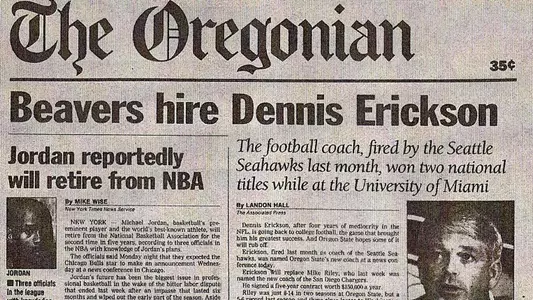
That deadline was met, and the new hire was a name that hadn't come up. As the boldface headline at the top of the Gazette-Times' front page on January 12 put it: "It's Erickson"
Dennis Erickson, the two-time national championship coach while at Miami from 1989-94 and most recently the head coach of the NFL's Seattle Seahawks from 1995-98, would be coming to Corvallis. The deal was still being finalized, but G-T reporter Brooks Hatch wrote of his interview with Erickson, he "certainly sounded like a guy who today will become the seventh man since 1970 to try to end OSU's streak of 28 consecutive losing seasons."
Erickson, 51, was a Northwest native, having grown up in Everett, Washington. He knew collegiate success while coaching at Miami, at Washington State from 1987-88, at Wyoming in 1986 and at Idaho from 1982-85, compiling a 113-40-1 record. He had almost been hired at Oregon State after the 1984 season but an OSU search committee overruled then-athletic director Dee Andros, who favored Erickson.
The news became official January 12 – the same day it was reported Michael Jordan would be retiring from the National Basketball Association - with a news conference on the third floor of the Valley Football Center. A scaled-down version of the OSU pep band serenaded Erickson with the Beaver fight song as he entered the room through a giant inflatable Oregon State helmet.
"I knew I missed something about college football, and that's it right there," Erickson said. As for his goals at Oregon State? "We want to win football games. We want to get to bowl games. We want to win the Pac-10. Let's don't settle with little things," Erickson said. "Let's go ahead and make this one of the best programs in the country, and let's start right now."
It had been a whirlwind courtship. Barnhart and associate athletic director Bob DeCarolis had crisscrossed the country on a jet loaned by a booster. The Gazette-Times reported that Friday night, January 8, they'd had to land in Seattle rather than Portland due to fog. Barnhart took that time to return a call from Erickson, thinking the coach wanted to recommend someone for the OSU job; instead, Erickson told Barnhart he was interested in the position. They met the next day at the Roosevelt Hotel in downtown Seattle, then wrapped up the contract Sunday and Monday.
Erickson – still owed $1.3 million by the Seahawks – signed a five-year contract with a base salary of $150,000 per year, with related payments for things like media and booster appearances and apparel deals bringing his total compensation to about $300,000 annually.
So why would Erickson, who could have his pick of college jobs, select OSU?
"Oregon State opened, obviously," Erickson told reporters. "And it was in the Northwest. And sometimes different things motivate you. The thing that motivates me here the most is, they haven't won since when, 1970? That's a possibility, to put your signature on something like that excites me right now.
"Seeing what they've done facility-wise, the new president (Dr. Paul Risser) – there are some positive things. They're trying to get it done, they've made a commitment to do it, so that really excites me."
While Beaver Nation was positively giddy over Erickson's hiring, it was an especially sweet day for Andros.
"I always knew he was a great coach," Andros said of Erickson. "And I've thought about it for 15 years. I couldn't have thought of anybody I'd rather replace Mike with than Dennis. Erickson was a winner then, and he's going to be a winner now."
Oregon State's players shared a similar outlook. They'd met Erickson at an early-morning meeting.
"It was pretty quick," center Aaron Koch said. "He just wanted to introduce himself. He said he was real happy to be here … this is definitely a big-time hire for Oregon State. People now know Oregon State is on the rise."
OSU Daily Barometer columnist Troy Foster summed it up pretty well, writing, "In one week, Oregon State fans have gone from an aura of quiet confidence, to total dejection, to complete euphoria. We wish you well, Mike; welcome to OSU, Dennis."
Erickson quickly assembled his staff then set to work for a shortened, hurried recruiting season; the signing date of February 3 was fast approaching. When it arrived, Oregon State signed 33 players to letters of intent.
"As late as we started, we were able to keep all of the commitments that Mike (Riley) had gotten, which was our No. 1 priority," Erickson said. "Then we were able to go out and get some commitments of our own."
Among those signing was wide receiver Imani Percoats, a junior college All-American who would have just one year of eligibility; other JC signees included defensive ends DeLawrence Grant and Ladarius Jackson, cornerback Terrence Gray, wide receiver T.J. Houshmandzadeh and offensive tackle Mitch White. High schoolers in the class included linebackers Nick Barnett and Richard Seigler, placekicker Ryan Cesca, defensive end Dwan Edwards, tight end Tim Euhus, wide receiver James Newson and cornerback Terrell Roberts.
"All the ratings, all that stuff really doesn't make a difference until you line them up and play," Erickson said.
Late in spring practice, Erickson felt the Beavers had made progress in the three weeks of drills.
"All I can look at is where we started and where we are right now, and we're a lot better football team right now than we were at the beginning of the spring," Erickson said.
The spring sessions concluded May 1 with a spring game at Hillsboro's Hare Field. The White team ended up beating the Black team 31-24, finishing the win as linebacker Darnell Robinson stuffed running back Ken Simonton at the goal line, setting off a celebration on the White sideline.
"We had to treat it like a real game," White team quarterback Terrance Bryant said. "Those guys talked a lot of stuff, about how they were going to beat us. We came in as the underdogs, but just went out there and did our thing."
Bryant and Smith, both of whom had started for the Beavers in 1998, were still in close competition for the starting job in 1999. Bryant rushed for 53 yards and a touchdown on seven carries and completed 13 of 21 passes for 167 yards, including a 54-yard touchdown to Roddy Tompkins. Smith was more air-oriented, hitting 25 of 36 passes for 358 yards and two touchdowns.
"Both have had great springs, so I'm not going to make a decision until fall practice," Erickson said. "We'll go with one but both could play as the year goes on. You just don't know what's going to happen."
The changes around Oregon State's program continued in early summer. On June 14, OSU announced the renaming of Parker Stadium to Reser Stadium; Al and Pat Reser, owners of Reser's Fine Foods, donated $5 million to Beaver athletics; Al Reser was an Oregon State graduate and longtime booster.
The stadium was initially named for Charles Parker of Portland, who was instrumental in both getting the stadium built in 1953 and expanded in 1967. The Parker name would still be part of the athletic complex, as the area between the stadium and Gill Coliseum would now be known as Parker Plaza.
The stadium's new name – and a new artificial turf that installed in the offseason – would get their baptism in about three months, when Erickson's first Beaver squad would meet Fresno State in OSU's home opener.
NEXT: The season begins.
As 1999 dawned, it seemed it indeed would be a happy new year for Oregon State football.
Just over a month before, the Beavers had wrapped up the 1998 season with a 5-6 record, OSU's best since 1971. Oregon State had been within a handful of plays of securing its first winning season since 1970; the campaign finished on a joyful note as the Beavers beat Oregon 44-41 in double overtime in one of the wildest Civil Wars ever played.
Mike Riley's second season as head coach had continued the feel-good story of the local boy making good, as the Corvallis High graduate and son of former Oregon State assistant coach Bud Riley appeared to have the Beavers on the way to the type of gridiron success that had eluded OSU for more than a generation.
By the end of New Year's Day, though, the picture was changing.
That day, OSU athletic director Mitch Barnhart told the Corvallis Gazette-Times he had given Washington athletic director Barbara Hedges permission to talk with Riley about becoming the Huskies' head coach. Barnhart also told the newspaper Oregon State and Riley were reworking his contract with an eye on keeping Riley in Corvallis.
"We're close to finalizing some things," Barnhart said. "We want to continue with Mike Riley."
The plot thickened later in the week as Riley spent two days in San Diego interviewing with the Chargers of the National Football League.
"I know I'm being considered," Riley told the Gazette-Times before heading south on January 5. "That's basically where it is right now."
A day later, San Diego news outlets were reporting Riley would be offered the job. The morning of January 7, the Gazette-Times quoted Riley as saying, "There are some T's to cross and I's to dot. I'm hopeful (it will be done) within 24 hours."
It seemed a devastating blow: If the hometown boy who showed signs of turning around Oregon State football couldn't be talked into staying in Corvallis to finish the job, who could?
Barnhart was already on the lookout for potential successors, with a significantly more optimistic viewpoint. Riley's staff, he told reporters, had "elevated the stature of Oregon State football to where it is a good job."
The official announcement Riley was San Diego bound came later January 7. In general, folks around Corvallis seemed understanding of Riley's decision.
"Seven hundred fifty thousand dollars against $150,000? Figure it out," was what Bill Albright, a customer at City Barber Shop, told the Gazette-Times. "But it's sad because the program has suffered so much for so many years." Added Debbie Walser, owner of the shop: "This year was the first time in years that people didn't start talking about basketball in the middle of football season."
OSU's players had similar thoughts.
"It's an opportunity he can't pass up; he's got to take it," punter Mike Fessler said. "Now we've got to replace him with somebody who is as good as he is." Said quarterback Jonathan Smith: "I think we can come together and hopefully can rally around the new guy. Coach Riley has shown us how to win and how to do things and I think we can carry on."
Barnhart quickly began meeting with candidates, including a pair of head coaches: Colorado State's Sonny Lubick and Idaho's Christ Tormey; he was also reported to have contacted UCLA offensive coordinator Alan Borges and defensive coordinator Nick Aliotti and Arkansas defensive coordinator Keith Burns.
"People are genuinely excited about Oregon State and where we are with our program," Barnhart told the Gazette-Times on January 9. "We are much more marketable now than we probably were the last time (when Riley was hired following the 1996 season). That is attributable to what Mike and the rest of his staff have done. We have benefitted from their efforts."
Barnhart was looking to hire someone by the end of the week to keep recruiting momentum going; OSU had already cancelled one weekend of visits by 22 players in the wake of Riley's departure.
That deadline was met, and the new hire was a name that hadn't come up. As the boldface headline at the top of the Gazette-Times' front page on January 12 put it: "It's Erickson"
Dennis Erickson, the two-time national championship coach while at Miami from 1989-94 and most recently the head coach of the NFL's Seattle Seahawks from 1995-98, would be coming to Corvallis. The deal was still being finalized, but G-T reporter Brooks Hatch wrote of his interview with Erickson, he "certainly sounded like a guy who today will become the seventh man since 1970 to try to end OSU's streak of 28 consecutive losing seasons."
Erickson, 51, was a Northwest native, having grown up in Everett, Washington. He knew collegiate success while coaching at Miami, at Washington State from 1987-88, at Wyoming in 1986 and at Idaho from 1982-85, compiling a 113-40-1 record. He had almost been hired at Oregon State after the 1984 season but an OSU search committee overruled then-athletic director Dee Andros, who favored Erickson.
The news became official January 12 – the same day it was reported Michael Jordan would be retiring from the National Basketball Association - with a news conference on the third floor of the Valley Football Center. A scaled-down version of the OSU pep band serenaded Erickson with the Beaver fight song as he entered the room through a giant inflatable Oregon State helmet.
"I knew I missed something about college football, and that's it right there," Erickson said. As for his goals at Oregon State? "We want to win football games. We want to get to bowl games. We want to win the Pac-10. Let's don't settle with little things," Erickson said. "Let's go ahead and make this one of the best programs in the country, and let's start right now."
It had been a whirlwind courtship. Barnhart and associate athletic director Bob DeCarolis had crisscrossed the country on a jet loaned by a booster. The Gazette-Times reported that Friday night, January 8, they'd had to land in Seattle rather than Portland due to fog. Barnhart took that time to return a call from Erickson, thinking the coach wanted to recommend someone for the OSU job; instead, Erickson told Barnhart he was interested in the position. They met the next day at the Roosevelt Hotel in downtown Seattle, then wrapped up the contract Sunday and Monday.
Erickson – still owed $1.3 million by the Seahawks – signed a five-year contract with a base salary of $150,000 per year, with related payments for things like media and booster appearances and apparel deals bringing his total compensation to about $300,000 annually.
So why would Erickson, who could have his pick of college jobs, select OSU?
"Oregon State opened, obviously," Erickson told reporters. "And it was in the Northwest. And sometimes different things motivate you. The thing that motivates me here the most is, they haven't won since when, 1970? That's a possibility, to put your signature on something like that excites me right now.
"Seeing what they've done facility-wise, the new president (Dr. Paul Risser) – there are some positive things. They're trying to get it done, they've made a commitment to do it, so that really excites me."
While Beaver Nation was positively giddy over Erickson's hiring, it was an especially sweet day for Andros.
"I always knew he was a great coach," Andros said of Erickson. "And I've thought about it for 15 years. I couldn't have thought of anybody I'd rather replace Mike with than Dennis. Erickson was a winner then, and he's going to be a winner now."
Oregon State's players shared a similar outlook. They'd met Erickson at an early-morning meeting.
"It was pretty quick," center Aaron Koch said. "He just wanted to introduce himself. He said he was real happy to be here … this is definitely a big-time hire for Oregon State. People now know Oregon State is on the rise."
OSU Daily Barometer columnist Troy Foster summed it up pretty well, writing, "In one week, Oregon State fans have gone from an aura of quiet confidence, to total dejection, to complete euphoria. We wish you well, Mike; welcome to OSU, Dennis."
Erickson quickly assembled his staff then set to work for a shortened, hurried recruiting season; the signing date of February 3 was fast approaching. When it arrived, Oregon State signed 33 players to letters of intent.
"As late as we started, we were able to keep all of the commitments that Mike (Riley) had gotten, which was our No. 1 priority," Erickson said. "Then we were able to go out and get some commitments of our own."
Among those signing was wide receiver Imani Percoats, a junior college All-American who would have just one year of eligibility; other JC signees included defensive ends DeLawrence Grant and Ladarius Jackson, cornerback Terrence Gray, wide receiver T.J. Houshmandzadeh and offensive tackle Mitch White. High schoolers in the class included linebackers Nick Barnett and Richard Seigler, placekicker Ryan Cesca, defensive end Dwan Edwards, tight end Tim Euhus, wide receiver James Newson and cornerback Terrell Roberts.
"All the ratings, all that stuff really doesn't make a difference until you line them up and play," Erickson said.
Late in spring practice, Erickson felt the Beavers had made progress in the three weeks of drills.
"All I can look at is where we started and where we are right now, and we're a lot better football team right now than we were at the beginning of the spring," Erickson said.
The spring sessions concluded May 1 with a spring game at Hillsboro's Hare Field. The White team ended up beating the Black team 31-24, finishing the win as linebacker Darnell Robinson stuffed running back Ken Simonton at the goal line, setting off a celebration on the White sideline.
"We had to treat it like a real game," White team quarterback Terrance Bryant said. "Those guys talked a lot of stuff, about how they were going to beat us. We came in as the underdogs, but just went out there and did our thing."
Bryant and Smith, both of whom had started for the Beavers in 1998, were still in close competition for the starting job in 1999. Bryant rushed for 53 yards and a touchdown on seven carries and completed 13 of 21 passes for 167 yards, including a 54-yard touchdown to Roddy Tompkins. Smith was more air-oriented, hitting 25 of 36 passes for 358 yards and two touchdowns.
"Both have had great springs, so I'm not going to make a decision until fall practice," Erickson said. "We'll go with one but both could play as the year goes on. You just don't know what's going to happen."
The changes around Oregon State's program continued in early summer. On June 14, OSU announced the renaming of Parker Stadium to Reser Stadium; Al and Pat Reser, owners of Reser's Fine Foods, donated $5 million to Beaver athletics; Al Reser was an Oregon State graduate and longtime booster.
The stadium was initially named for Charles Parker of Portland, who was instrumental in both getting the stadium built in 1953 and expanded in 1967. The Parker name would still be part of the athletic complex, as the area between the stadium and Gill Coliseum would now be known as Parker Plaza.
The stadium's new name – and a new artificial turf that installed in the offseason – would get their baptism in about three months, when Erickson's first Beaver squad would meet Fresno State in OSU's home opener.
NEXT: The season begins.

Thursday, June 11
Wednesday, May 06
Monday, April 20
Monday, April 13