Beavers Gain Respect and Leadership Skills
September 08, 2015 | Football
By Brooks Hatch
OSUBeavers.com
Special Forces Training Part 1
Special Forces Training Part 2
Special Forces Training Part 3
The working title for the movie - were one to be made chronicling their week in the Utah boonies - could be the Not-So-Dirty Dozen, or the Inglourious Beavers.
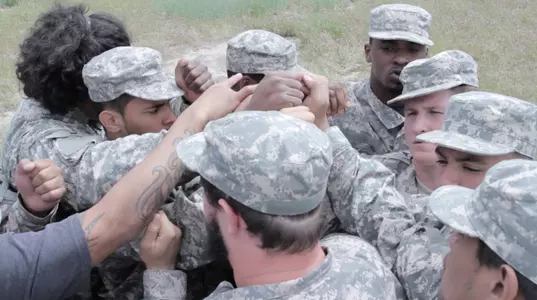
Earlier this summer 12 Oregon State football student-athletes spent a week at the National Guard Training Site in Bluffdale, Utah, for a crash course in leadership skills taught by the U. S. Army's 19th Special Forces Group.
Players from all areas of the 2015 football team learned leadership and teamwork skills; how to prioritize, sacrifice, brainstorm and trust; how to push themselves beyond their limits, and how to synergize in small and large units for the good of the group, from some of the best leadership instructors in the world: Officers and non-coms in the Army and National Guard.
The lessons they learned in the remote, arid high desert about 20 miles south of Salt Lake City will translate to improvement on the playing field, and to personal and professional success once they embark on a life beyond football following their graduation from OSU.
“We wanted to impart on them how important leadership is for us in the military, so they can take that back to their team and improve their organization,” said Lt. Col. Jeffrey Bruce of the 19th Special Forces Group
The message resonated with the Beavers, in military parlance, 5 by 5. A week in basic training and the field only enhanced their already-considerable admiration of their temporary brothers-in-arms.

“I have relatives who are in the military or who have served,” safety Cyril Noland-Lewis said. “It was nice to get a taste of what they experience.
“I already had a great deal of respect for those guys; now I have out-of-this world respect for what they do, day-to-day. Everything is so precise, and that really caught my eye.”
OSU's leadership trainees were Noland-Lewis; senior defensive end Lavonte Barnett; junior wide receiver Victor Bolden; junior cornerback Devin Chappell; redshirt freshman offensive lineman Kammy Delp; sophomore linebacker David Henry; sophomore offensive lineman Fred Lauina; junior linebacker Rommel Mageo; senior offensive lineman Nick Mitchell; junior running back Ricky Ortiz; junior linebacker Caleb Saulo, and senior defensive lineman Kyle Peko.
All are expected to fill leadership roles in 2015, and on future teams. The skills they learned in Utah should make them become effective contributors in their workplaces and communities for years to come, a core value of head coach Gary Andersen's “Developing Leaders for Life” philosophy.
“Beyond football is one facet of the OSU football program that provides opportunities and a platform for the personal and professional development of our athletes,” said Jason Thomas, the team's Director of Operations and Student Services. “We commit to engage, prepare and empower them for life beyond football.”
Noland-Lewis said he learned mental toughness, teamwork, effort, and pushing yourself beyond what you previously thought was possible.
“We all brought back something a little bit different from the trip, and we spread the vibes throughout the locker room,” he said. “Everybody has been coming together, the chemistry and the link is now like a well-oiled bike chain. We just love our team.”
Camp Williams was all-inclusive, but it most definitely wasn't a resort. That is, unless your idea of an idyllic week features rigorous physical exercise, obstacle courses, jump training, free-fall exercises, computerized live-fire drills, timed 2-mile runs, pushups, pull-ups and sit-ups that gave the Beavers a small taste of the life servicemen and servicewomen live on a daily basis.
“From 1 to 10 is was above an 8 for sure,” Saulo said in estimating the camp's degree of difficulty, even for an athlete as fine-tuned as a football player in an era of 12-month training. “The first day wasn't bad, but as each day went by it just got tougher and tougher.
“We did a lot of tower jumping, and some obstacle courses where we worked as teams and use everyone's brains to figure out how to do things.”
Added Noland-Lewis: “It was pretty tough. It definitely tested us and put us on edge. We had to get out of our comfort zone, and we definitely had to overcome a few fears here and there.”
Which, of course, was the entire point of the exercise. The Beavers discovered that effective units - whether in combat, in football or in life – are characterized by selfless values, not selfish ones.
“Putting myself last and my teammates first,” Noland-Lewis summarized. “That has always been a big part of me, treating people with the same amount of respect that I expect to be treated with.
“Everything we did at the base carries over to real life. I use those skills and will use them for the rest of my life.”
There were numerous examples of selfless behavior. Those who led the two-mile run circled back to exhort and escort the slower runners to the finish line. Those wary of heights, or skittish about jumping off a tower in parachute training, leaned on their teammates for strength and encouragement.
“We utilized each other for support, for motivation and for getting through hard times,” Saulo said. “It was tough out there, it definitely wasn't easy. But to have each other's back, and knowing the guy next to you is fighting his butt off for you, makes you want to keep going.”
Saulo said the camp fostered a sense of teamwork, camaraderie and unity that helped 12 different personalities coalesce as a unit and “get everyone on the same bus.”
“In life, this will be a great tool to show a young man or you woman to use everything around you,” he added. “Use all the tools God, your family or your close friends have given you.
“Don't take anything for granted. Use what you have to the best of your ability.”
Saulo enjoyed the jump training and said the most fun he had was watching the parachutes fly open after a stick of paratroopers had all exited in perfect order.
“Seeing 40 guys go out of an airplane and seeing them (engage) their parachutes was a great feeling,” he said. “Tower jumping wasn't as scary as the free-fall from the rope.
“I have a half-brother in the Army. I really gained a lot more respect not only for what my brother does, but for what all our troops do.”
Noland-Lewis wasn't as enthralled as Saulo was with the jump-school portion of the training.
“We didn't go out in actual planes but it was still kind of tough, something to overcome,” he said. “I had a few withdrawals at first, but I just put my trust in my teammates” and completed the training. “That's how it has to be.
“The gun simulation was the most fun thing we did. They had computerized guns,” so they were not shooting live ammo, “but it was an actual assault rifle.
“The most fun was being with the guys, getting that military experience and just being on base, seeing what the day in the life of a [soldier] was like. We definitely had a blast.”