Student-Athlete Profile -- Jaswha James
September 21, 2015 | Football
By Brooks Hatch
osubeavers.com
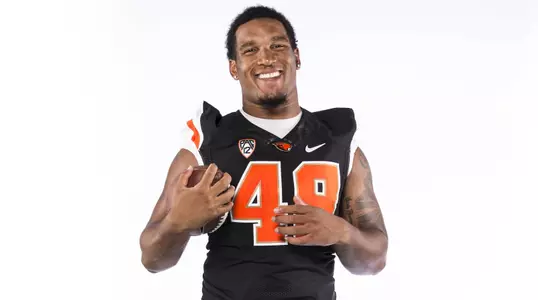
If, as the old adage goes, you are what you eat, then Jaswha James is a much better person than he was a year ago.
A spring-term internship with Oregon State football dietitian Stasi Kasianchuk, College of Public Health and Human Sciences M.S. '10, convinced him to dramatically alter his eating habits. That helped transform the senior defensive end from Inglewood, Calif., into an improved player.

“I learned a lot about my own dietary habits,” during the internship, James said. “I cut out fried foods, chips, fries, stuff like that. I tried to get at least five servings of vegetables and fruits, increased hydration, and my vitamins, my Omega 3s,” the beneficial acids found in certain fish and in plant sources such as nuts and seeds.
“I feel lighter, faster and more explosive,” factors that helped the 6-foot-2, 266-pounder record a career-best seven tackles in last Saturday's 35-7 loss at Michigan. “Fried food and stuff like that just weighs you down and it's bad [for them] to be inside of you.
“I feel fresher, every day, and your nutrition really contributes to your performance on the field. Stasi was a big influence on me getting my nutrition back on track, where it should be for a Division I athlete.”
As a public health major, with an option in health promotion and health behavior, James didn't have a background in nutrition. But everybody eats, so his internship was designed with a public health goal in mind: Encouraging better dietary habits for OSU's 500-plus student-athletes, all of whom get training table at one time or another throughout the year.
His responsibilities were wide-ranging. He worked with other OSU athletic programs; with Levy Restaurants of Chicago, the company responsible for OSU's athletic performance table and the food service at all school athletic venues; with his fellow student-athletes, and with Kasianchuk to help tailor the performance table environment to facilitate optimal fueling for student-athletes.
“Josh was an attentive student, and spent a lot of time at the performance table,” gathering data on what foods the athletes liked; which foods they didn't enjoy; when they ate, and how much they ate, Kasianchuk said. “It was really helpful for me to get insight from him,” to better learn which healthy foods also satisfied the players' taste buds.

Kasianchuk said nutritional advice sometimes sinks in more effectively if it's delivered by a peer instead of an older authority figure. James served as one such conduit.
“There is a role-modeling effect,” Kasianchuk said. “We have to get some of the leaders to engage and have them make nutrition a priority, so the younger guys coming in see that good nutrition does make a difference and ultimately if they learn good nutritional habits it will help them,” on and off the field.
“If we can make nutrition fun and inviting, we are going to get more people to buy in. I learned a lot from Josh and it was a reminder that not everyone walks around thinking about nutrition like I do.”
Born in Brooklyn, James grew up in the Los Angeles suburb of Inglewood. He didn't play football until his junior year, but he blossomed into an Ocean League all-star as a senior and earned an OSU scholarship he says completely changed his life.
“It just all happened fast, it was a blur,” he said. “Five years ago, I didn't even know I was going to go to college. I thought I'd probably be working at an airport, or maybe in the fire academy or something.
“I've matured. You definitely become who you are in college. It will set you up for the rest of your life. It was a blessing for me to get a scholarship so I can obtain my degree. I'm going to take it, and run with it.
“Oregon State has changed my life in a big way,” he added. “First and foremost, it blessed me with an opportunity to get my college education and for that I am eternally grateful.
“There's not much more I can say than that. That's what we are all here for, to get that degree. The people here have been so great to me. I've never had a bad experience or anything here, everybody has been great.”
His most memorable class has been teacher and counselor education 219, civil rights and multicultural issues in education, taught by professor Winston Cornwall. The syllabus examines the context of working with students, schools, communities, and workplaces; the diversity of learning cultures (e.g. urban, suburban, rural) and the diversity among learners within those different cultures; and the influence of culture on one's learning.
“I liked the class so much because there was open discussion, dealing with a different array of life's struggles and situations,” James said. “It was great to communicate with different people from different backgrounds in a classroom setting.
“Everybody had an amazing life story to share that you might not have guessed just by looking at them. Normally you look at a college student and you think, 'Their parents are probably paying for them to go to college.' but that wasn't the case.
“A lot of people had a rough time growing up and you might not have guessed that” had he not taken the class and learned their stories.
He hopes to parlay his public health degree into a career in an unusual public health field: Fire-fighting.
“Being a fire fighter has been a life-long dream,” he said. “There was a firehouse down the street from my house, and [being a fireman] looked like fun.
“It's something that closely relates to football. Fire-fighting is very team-oriented,” with each person having a specific responsibility as a part of a unit working together to reach a common goal.
“I'm a team player. I wouldn't have any trouble at all fitting in. I know their main goal is to save lives, to save houses, to save pets, animals … I'm a helpful guy who likes to help people in tight situations.”