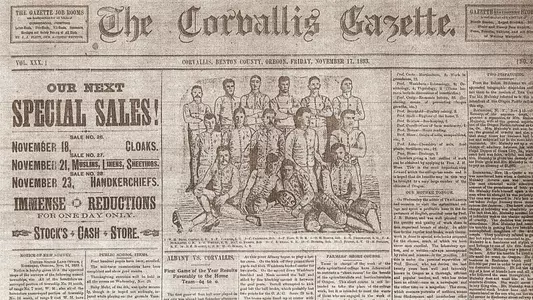
The First Football Game
November 11, 2018 | Football
By Kip Carlson
Careful readers of the Corvallis Gazette on November 10, 1893, found an unusual item tucked away on page 4 of their newspaper, headlined simply "FOOT BALL".
The five-paragraph story gave an overview of the rules of the game that Oregon Agricultural College would play the next afternoon. The Gazette story began, "Many of our people have never witnessed a game of foot ball as it is now played and as there is to be a contest between our boys and the visiting team from Albany tomorrow afternoon, perhaps a few simple points as we remember them will be of interest, the details of which can only be understood by seeing the game on the field."
There was a reason few in Corvallis had ever seen a football game: OAC had never played one. 2018 marks the 125th anniversary of Oregon State's first football game, that contest against Albany College (now Lewis & Clark College) on November 11, 1893.
A GROWING COLLEGE
Oregon Agricultural College had been around for a quarter-century at that point. It began as Corvallis College in the 1850s and, in 1868, was designated by the State of Oregon legislature as the state's agricultural college. By 1890, the institution's name had evolved to Oregon Agricultural College and OAC was one of three land grant schools in the nation offering scientific courses to women. By 1893 enrollment had risen to 204 with a faculty of 20.
At that time, a scattering of intercollegiate athletic events had been held. Students had adopted orange as the school color that year, with black as a background, and the teams were sometimes referred to as the Orangemen or Aggies. The school had a live mascot, a coyote named Jimmie.
Corvallis' population was about 1,600 and the city was a significant agricultural center. Grain and other crops could be shipped via rail or river to Portland.
As the school year began in late September, the Gazette's front-page column of OAC news noted the record enrollment and a number of other items:
"Prof. Shaw has arranged for quite an addition to the mineral cabinet, which is to be rearranged to show the minerals of the state to better advantage. Donations to this collection are always appreciated."
"The cadet band has again made its appearance and is at present under the leadership of W.W. Looney of the second year class. The boys are going to work with a will and hope to be able in a short time to furnish all the music necessary for the college entertainments, etc."
"The board of regents has decided to use one of the large rooms in the mechanical building for a gymnasium. This is hailed with enthusiasm by the boys and the young ladies say they should be allowed to use this room at least twice a week."
Just over a month later, there was news on a similar front. The Gazette of November 3 reported: "The football eleven of the college has been chosen and the boys are out practicing every afternoon. They expect to play Albany on Saturday afternoon, November 11th. The engagement with Monmouth will be played on Thanksgiving, and judging from comments a good game will be put up, as the Monmouth boys have a heavy team and a professional player in charge. The boys have practiced here for about three weeks and they are doing good work on the signals, handling, etc. If the school and townspeople keep up the eleven's spirits, and continue to take an interest in the game, a first-class eleven will be made by spring to contest with any similar team on the Pacific coast."
A TEAM TAKES SHAPE
Coaching the OAC team was William H. Bloss; he had moved to Corvallis the previous year when his father, John Bloss, was named president of the college. The younger Bloss had starred at Indiana and wanted to bring the game he'd grown to love to his new home.
Bloss was not an OAC student – but neither were four of his other players; one of those was a faculty member. There were no real ground rules for eligibility in those days of football spreading across the continent. It had been just 24 years since Princeton visited Rutgers for the first collegiate game on November 6, 1869, with Rutgers winning 6-4.
As that first OAC game neared, Bloss went on the school's first scouting trip, traveling to Monmouth to watch the Oregon State Normal School (now Western Oregon University) play Pacific University of Forest Grove; Pacific took a 53-0 win. OAC was slated to play Oregon State Normal School later in the fall.
The November 8 Corvallis Times article revealing the news of Bloss' excursion also noted, "On Saturday next the O.A.C. boys expect to meet a football team from Albany. A good game is expected. The result is anticipated in our favor. It must not be forgotten that the foot ball eleven intend to meet the Normal school on Thanksgiving day at the Normal grounds."
That same "College Column" announced the OAC athletic association had moved its equipment from Cauthorn Hall to the gymnasium in the new mechanical building. "They seem pleased with the result," the unnamed author wrote. "They have not been able to practice this year, but now ample opportunity is afforded."
The day before the game came the Corvallis Gazette article outlining the rules of the game to be played in town November 11 – the first football Saturday in Corvallis' history. It began with the basics: the lines at each end of the field were goal lines, and the team with its back to a goal was defending that goal. Carrying the ball across the goal line was worth four points; that would be followed by a conversion kick worth two points if successful. Failing to advance the ball five yards in four downs meant the other team took possession of the ball.
"Tripping, striking with fists or unnecessary roughness are fouls and give the other team five yards if they have the ball, and the ball, if the side fouling has the ball," the article stated. The article concluded with a diagram of where the 11 players would line up when a team had possession of the ball and noted this would also be Albany's first-ever game.
The front page of that newspaper offered a brief preview of the game, including starting lineups for both teams. Included in the report: "The expenses of the visiting team are to be paid by our boys, and in view of this fact tickets have been issued and will be sold at ten cents apiece. Of course anyone wishing to see the game will be willing to assist the boys in this way. The tickets will have the college colors attached, by which they are to be tied through the buttonhole or pinned on and everyone is expected to have his ticket in view while on the grounds.
"A good game is guaranteed. This is the first football match that the Oregon agricultural college has ever taken a part in, and it is hoped that this first game will do much toward establishing football as the college game on the Pacific Coast."
KICKING OFF A NEW SPORT
The morning of the game, the Albany College squad arrived in Corvallis via horse-drawn hacks; the visitors were greeted by Bloss and Brady Burnett of the OAC team. As soon as the horses were taken care of, the Albany men were taken to Cauthorn Hall for a pregame meal.
At 1 p.m., the OAC band marched through downtown "playing a few lively quicksteps," the Corvallis Gazette reported. About 30 minutes later, the OAC team went to Professor Pernot's photo studio for a portrait. Soon after, the participants and spectators made their way to the college parade ground – an area that is now the south side of lower campus and site of Callahan and McNary Halls, bisected by S.W. Jefferson Avenue.
"When the home team made their appearance the appreciative audience greeted them with long and hearty cheers," the Corvallis Times reported. The Gazette's account added: "Tin horns of all sizes and tones, some very nicely decorated with college colors were brought along."
Albany won the toss and elected to take the ball, while OAC chose to defend the west goal.
At 2 p.m., the official blew his whistle and the game began. Albany started with a wedge but the OAC men broke through it, knocking the ball loose from Albany's Washburn. Burnett picked up the ball and carried it over the goal for the first touchdown in Oregon State football history. The conversion was no good, and just over a minute into the game OAC had a 4-0 lead.
On Albany's next possession, Bloss knocked the ball loose from Washburn once again and Burnett recovered. Burnett then rattled off a 60-yard run, according to the Gazette, and the conversion made it 10-0.
Albany then turned the ball over for passing the ball forward – an illegal maneuver in that era. The first two plays resulted in gains of 15 yards by Burnett and 20 yards by Percival Nash, "then the O.A.C.'s worked the criss cross and Burnett carried the ball and made the third touch-down," the Gazette-reported, with the conversion failing as OAC led 14-0.
"Enthusiasm ran high during the game and amid the squeaking of horns and the ringing of the college yell of 'Zip boom bee! zip boom bee! O.A., O.A., O.A.C!' one could hardly think," the Gazette recounted. "The ladies were so excited that they actually yelled and followed with interest every move of the players."
The rest of the half went in a similar vein to the game's start, with the Gazette describing Albany's mode of attack as "all beef and no science," and by halftime it was 38-0.
"This so discouraged the Albany boys that three of them would not play during the second half," the Times told its readers. "Their places were filled by OSC substitutes, and the game continued, which was but a repetition of the first half."
But a shorter one, noted the Gazette: "The Albany men also came to the conclusion they were no match for the 'Farmers' and wished to have the last half shortened. It was therefore decided to play only a ten-minute half."
Once the OAC band finished its performance of several numbers during intermission, it didn't take long for their classmates to add to their score. The Gazette reported the team's "parallel line 'kick off' trick" secured the ball, with Bloss carrying for 30 yards and Burnett taking it in for the score to make it 42-0.
It continued thus until the game ended with OAC on top 62-0 – though the Gazette's headline incorrectly put it at 64-0.
"Remembering the rivalry existing between Albany and Corvallis in field games and the difference in size between the respective cities (Albany's population was over 3,000 at the time), we may well crow over our well-earned success and hope that this will dampen Albany's ardor," the Times proclaimed.
The OAC team had sold 320 tickets at a dime each, and the Gazette estimated a total of about 500 spectators had been on hand. Burnett led OAC with seven touchdowns and Nash had four, while Bloss and Henry Desborough had one each.
ANOTHER VICTORY, AND CONTROVERSY
Just under a week later, on Friday, November 17, OAC took the train up the west side of the Willamette Valley to Monmouth to play Oregon State Normal School. They were met at the depot by a member of the home team and taken to the college to prepare for the game.
"Only about 300 people witnessed the game and of course most of those were in sympathy with the home team," the Gazette reported in its account of the game. "The few people from Corvallis had a hard time making themselves heard."
Nonetheless, OAC pulled out a 30-22 victory, Burnett scoring four times and Nash twice. After the game, the OAC team dined with the OSNS players and stayed overnight in Monmouth, returning to Corvallis the next day.
Apparently, the game's aftermath was not completely a tale of goodwill and fellowship.
The Gazette of December 1 reported not on the return game between the two schools that had been set for November 30 in Corvallis, but of apparent disparagement of the OAC squad by its counterpart in Monmouth and its supporters. And the Polk County residents had telegraphed the scurrilous news to The Oregonian newspaper in Portland. This, the Gazette felt, was simply sour grapes for the defeat the OSNS had suffered at the hands of OAC.
The OAC players, the Gazette opined, were too well known in Corvallis to need defense by the local prints. "Charges of foul play, blackguardism, dishonest play, and drunkenness would fail one atom of belief in this community, even if they professed to be authenticated," the Gazette scoffed. "It is no secret here that President Bloss has investigated these four charges with the result on which every one here would have staked heavily. It is perhaps too much to expect of poor human nature that our friends on the other side should 'withdraw and apologize.' Of course they ought – and at once.
"It is possibly a good thing that bad weather and sickness, and a desire to let as much as possible of this vaporing pass off in air (i.e. wind) has caused the postponement of the return match between the two elevens … Another game or two may possibly help the Normals to a better understanding of the niceties of football, and a greater willingness to take as well as give the hard knocks and pushes allowed in every college game."
POSTSCRIPT
The game with Oregon State Normal School was indeed rescheduled, with OAC winning 28-0 in Corvallis. The Orangemen would finish their initial season with a 5-1 record, also beating Multnomah Athletic Club 6-0 and the Corvallis Athletic Association 36-0 before ending the season with a 26-12 loss to Portland on February 24, 1894.
The University of Oregon would begin playing football that spring. The next autumn would see the inaugural game in the series that would become known as "the Civil War," with OAC winning 16-0.
Careful readers of the Corvallis Gazette on November 10, 1893, found an unusual item tucked away on page 4 of their newspaper, headlined simply "FOOT BALL".
The five-paragraph story gave an overview of the rules of the game that Oregon Agricultural College would play the next afternoon. The Gazette story began, "Many of our people have never witnessed a game of foot ball as it is now played and as there is to be a contest between our boys and the visiting team from Albany tomorrow afternoon, perhaps a few simple points as we remember them will be of interest, the details of which can only be understood by seeing the game on the field."
There was a reason few in Corvallis had ever seen a football game: OAC had never played one. 2018 marks the 125th anniversary of Oregon State's first football game, that contest against Albany College (now Lewis & Clark College) on November 11, 1893.
A GROWING COLLEGE
Oregon Agricultural College had been around for a quarter-century at that point. It began as Corvallis College in the 1850s and, in 1868, was designated by the State of Oregon legislature as the state's agricultural college. By 1890, the institution's name had evolved to Oregon Agricultural College and OAC was one of three land grant schools in the nation offering scientific courses to women. By 1893 enrollment had risen to 204 with a faculty of 20.
At that time, a scattering of intercollegiate athletic events had been held. Students had adopted orange as the school color that year, with black as a background, and the teams were sometimes referred to as the Orangemen or Aggies. The school had a live mascot, a coyote named Jimmie.
Corvallis' population was about 1,600 and the city was a significant agricultural center. Grain and other crops could be shipped via rail or river to Portland.
As the school year began in late September, the Gazette's front-page column of OAC news noted the record enrollment and a number of other items:
"Prof. Shaw has arranged for quite an addition to the mineral cabinet, which is to be rearranged to show the minerals of the state to better advantage. Donations to this collection are always appreciated."
"The cadet band has again made its appearance and is at present under the leadership of W.W. Looney of the second year class. The boys are going to work with a will and hope to be able in a short time to furnish all the music necessary for the college entertainments, etc."
"The board of regents has decided to use one of the large rooms in the mechanical building for a gymnasium. This is hailed with enthusiasm by the boys and the young ladies say they should be allowed to use this room at least twice a week."
Just over a month later, there was news on a similar front. The Gazette of November 3 reported: "The football eleven of the college has been chosen and the boys are out practicing every afternoon. They expect to play Albany on Saturday afternoon, November 11th. The engagement with Monmouth will be played on Thanksgiving, and judging from comments a good game will be put up, as the Monmouth boys have a heavy team and a professional player in charge. The boys have practiced here for about three weeks and they are doing good work on the signals, handling, etc. If the school and townspeople keep up the eleven's spirits, and continue to take an interest in the game, a first-class eleven will be made by spring to contest with any similar team on the Pacific coast."
A TEAM TAKES SHAPE
Coaching the OAC team was William H. Bloss; he had moved to Corvallis the previous year when his father, John Bloss, was named president of the college. The younger Bloss had starred at Indiana and wanted to bring the game he'd grown to love to his new home.
Bloss was not an OAC student – but neither were four of his other players; one of those was a faculty member. There were no real ground rules for eligibility in those days of football spreading across the continent. It had been just 24 years since Princeton visited Rutgers for the first collegiate game on November 6, 1869, with Rutgers winning 6-4.
As that first OAC game neared, Bloss went on the school's first scouting trip, traveling to Monmouth to watch the Oregon State Normal School (now Western Oregon University) play Pacific University of Forest Grove; Pacific took a 53-0 win. OAC was slated to play Oregon State Normal School later in the fall.
The November 8 Corvallis Times article revealing the news of Bloss' excursion also noted, "On Saturday next the O.A.C. boys expect to meet a football team from Albany. A good game is expected. The result is anticipated in our favor. It must not be forgotten that the foot ball eleven intend to meet the Normal school on Thanksgiving day at the Normal grounds."
That same "College Column" announced the OAC athletic association had moved its equipment from Cauthorn Hall to the gymnasium in the new mechanical building. "They seem pleased with the result," the unnamed author wrote. "They have not been able to practice this year, but now ample opportunity is afforded."
The day before the game came the Corvallis Gazette article outlining the rules of the game to be played in town November 11 – the first football Saturday in Corvallis' history. It began with the basics: the lines at each end of the field were goal lines, and the team with its back to a goal was defending that goal. Carrying the ball across the goal line was worth four points; that would be followed by a conversion kick worth two points if successful. Failing to advance the ball five yards in four downs meant the other team took possession of the ball.
"Tripping, striking with fists or unnecessary roughness are fouls and give the other team five yards if they have the ball, and the ball, if the side fouling has the ball," the article stated. The article concluded with a diagram of where the 11 players would line up when a team had possession of the ball and noted this would also be Albany's first-ever game.
The front page of that newspaper offered a brief preview of the game, including starting lineups for both teams. Included in the report: "The expenses of the visiting team are to be paid by our boys, and in view of this fact tickets have been issued and will be sold at ten cents apiece. Of course anyone wishing to see the game will be willing to assist the boys in this way. The tickets will have the college colors attached, by which they are to be tied through the buttonhole or pinned on and everyone is expected to have his ticket in view while on the grounds.
"A good game is guaranteed. This is the first football match that the Oregon agricultural college has ever taken a part in, and it is hoped that this first game will do much toward establishing football as the college game on the Pacific Coast."
KICKING OFF A NEW SPORT
The morning of the game, the Albany College squad arrived in Corvallis via horse-drawn hacks; the visitors were greeted by Bloss and Brady Burnett of the OAC team. As soon as the horses were taken care of, the Albany men were taken to Cauthorn Hall for a pregame meal.
At 1 p.m., the OAC band marched through downtown "playing a few lively quicksteps," the Corvallis Gazette reported. About 30 minutes later, the OAC team went to Professor Pernot's photo studio for a portrait. Soon after, the participants and spectators made their way to the college parade ground – an area that is now the south side of lower campus and site of Callahan and McNary Halls, bisected by S.W. Jefferson Avenue.
"When the home team made their appearance the appreciative audience greeted them with long and hearty cheers," the Corvallis Times reported. The Gazette's account added: "Tin horns of all sizes and tones, some very nicely decorated with college colors were brought along."
Albany won the toss and elected to take the ball, while OAC chose to defend the west goal.
At 2 p.m., the official blew his whistle and the game began. Albany started with a wedge but the OAC men broke through it, knocking the ball loose from Albany's Washburn. Burnett picked up the ball and carried it over the goal for the first touchdown in Oregon State football history. The conversion was no good, and just over a minute into the game OAC had a 4-0 lead.
On Albany's next possession, Bloss knocked the ball loose from Washburn once again and Burnett recovered. Burnett then rattled off a 60-yard run, according to the Gazette, and the conversion made it 10-0.
Albany then turned the ball over for passing the ball forward – an illegal maneuver in that era. The first two plays resulted in gains of 15 yards by Burnett and 20 yards by Percival Nash, "then the O.A.C.'s worked the criss cross and Burnett carried the ball and made the third touch-down," the Gazette-reported, with the conversion failing as OAC led 14-0.
"Enthusiasm ran high during the game and amid the squeaking of horns and the ringing of the college yell of 'Zip boom bee! zip boom bee! O.A., O.A., O.A.C!' one could hardly think," the Gazette recounted. "The ladies were so excited that they actually yelled and followed with interest every move of the players."
The rest of the half went in a similar vein to the game's start, with the Gazette describing Albany's mode of attack as "all beef and no science," and by halftime it was 38-0.
"This so discouraged the Albany boys that three of them would not play during the second half," the Times told its readers. "Their places were filled by OSC substitutes, and the game continued, which was but a repetition of the first half."
But a shorter one, noted the Gazette: "The Albany men also came to the conclusion they were no match for the 'Farmers' and wished to have the last half shortened. It was therefore decided to play only a ten-minute half."
Once the OAC band finished its performance of several numbers during intermission, it didn't take long for their classmates to add to their score. The Gazette reported the team's "parallel line 'kick off' trick" secured the ball, with Bloss carrying for 30 yards and Burnett taking it in for the score to make it 42-0.
It continued thus until the game ended with OAC on top 62-0 – though the Gazette's headline incorrectly put it at 64-0.
"Remembering the rivalry existing between Albany and Corvallis in field games and the difference in size between the respective cities (Albany's population was over 3,000 at the time), we may well crow over our well-earned success and hope that this will dampen Albany's ardor," the Times proclaimed.
The OAC team had sold 320 tickets at a dime each, and the Gazette estimated a total of about 500 spectators had been on hand. Burnett led OAC with seven touchdowns and Nash had four, while Bloss and Henry Desborough had one each.
ANOTHER VICTORY, AND CONTROVERSY
Just under a week later, on Friday, November 17, OAC took the train up the west side of the Willamette Valley to Monmouth to play Oregon State Normal School. They were met at the depot by a member of the home team and taken to the college to prepare for the game.
"Only about 300 people witnessed the game and of course most of those were in sympathy with the home team," the Gazette reported in its account of the game. "The few people from Corvallis had a hard time making themselves heard."
Nonetheless, OAC pulled out a 30-22 victory, Burnett scoring four times and Nash twice. After the game, the OAC team dined with the OSNS players and stayed overnight in Monmouth, returning to Corvallis the next day.
Apparently, the game's aftermath was not completely a tale of goodwill and fellowship.
The Gazette of December 1 reported not on the return game between the two schools that had been set for November 30 in Corvallis, but of apparent disparagement of the OAC squad by its counterpart in Monmouth and its supporters. And the Polk County residents had telegraphed the scurrilous news to The Oregonian newspaper in Portland. This, the Gazette felt, was simply sour grapes for the defeat the OSNS had suffered at the hands of OAC.
The OAC players, the Gazette opined, were too well known in Corvallis to need defense by the local prints. "Charges of foul play, blackguardism, dishonest play, and drunkenness would fail one atom of belief in this community, even if they professed to be authenticated," the Gazette scoffed. "It is no secret here that President Bloss has investigated these four charges with the result on which every one here would have staked heavily. It is perhaps too much to expect of poor human nature that our friends on the other side should 'withdraw and apologize.' Of course they ought – and at once.
"It is possibly a good thing that bad weather and sickness, and a desire to let as much as possible of this vaporing pass off in air (i.e. wind) has caused the postponement of the return match between the two elevens … Another game or two may possibly help the Normals to a better understanding of the niceties of football, and a greater willingness to take as well as give the hard knocks and pushes allowed in every college game."
POSTSCRIPT
The game with Oregon State Normal School was indeed rescheduled, with OAC winning 28-0 in Corvallis. The Orangemen would finish their initial season with a 5-1 record, also beating Multnomah Athletic Club 6-0 and the Corvallis Athletic Association 36-0 before ending the season with a 26-12 loss to Portland on February 24, 1894.
The University of Oregon would begin playing football that spring. The next autumn would see the inaugural game in the series that would become known as "the Civil War," with OAC winning 16-0.
Tuesday, August 25
Wednesday, August 19
Wednesday, August 19
Wednesday, August 19