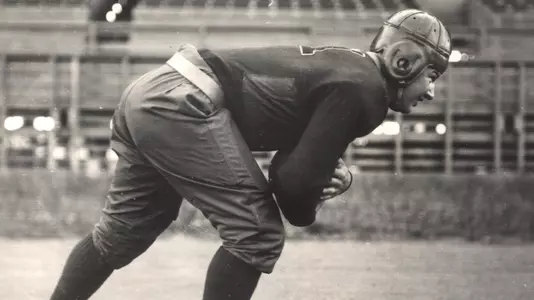
1928 In NYC
October 18, 2018 | Football
A look back at the Beavers' 25-13 win in 1928 at NYC
By Kip Carlson
As they came to the big city, one New York writer referred to them as "the student-peasants from the rain belt." By the time they left, the Big Apple's top nightclubs were asking if the young men from the frontier might pay a visit; even the typewriters of Will Rogers, Damon Runyon and Ed Sullivan – yes, the Ed Sullivan – had taken note.
It was 90 years ago this fall that Oregon State Agricultural College became the first college football team from the West Coast to play a game on the Eastern seaboard, meeting New York University in a Thanksgiving Day game at Yankee Stadium. By the time the Beavers finished their 25-13 victory on Nov. 29, 1928, they had turned the nation's perception of college football topsy-turvy.
After all, NYU had established itself as the top team in the East a week earlier by beating Carnegie Tech. And, the experts were quick to point out, East Coast football was the standard to which the rest of the nation would have to rise.
When Notre Dame coaching legend Knute Rockne learned that OSAC had landed a place on the Violets' schedule, he tried to prepare Beaver coach Paul Schissler by warning: "Don't feel disappointed if you lose too badly. (NYU coach) Chick Meehan's got a plenty tough team.
"They'll beat most of the teams in the United States. They'll probably beat you."
How quickly opinions can be amended.
Once the Beavers had trampled the Violets, New York columnist Bill Corum wrote: "It goes to show that you can never tell about a country boy in the big city. Every time a subway train passed the Stadium yesterday, one of those Aggies grabbed the ball and started for the station. They thought it was time they were getting back to Corvallis.
So did the NYU rooters."
THE LONG TRIP EAST
Oregon State's visit to the House that Ruth Built – which had opened just five years earlier – came about after Schissler met Meehan at a national coaches meeting in 1927.
That was when Rockne told Schissler, whom he had mentored early in Schissler's career, what could lie ahead for his squad.
As the time drew near for the Beavers to board their train and head east, Rockne's view seemed prophetic. Coming off a 12-0 upset loss to Oregon at Bell Field, OSAC sported a record of just 5-3; New York was 8-1 after that much-ballyhooed victory over Carnegie Tech and was led by Ken Strong, who would go on to star for the New York Giants and enter the Pro Football Hall of Fame.
The nation's grid experts all seemed to agree: Oregon State was traveling clear across the continent to be served as NYU's Thanksgiving turkey.
Schissler, the Beaver coaching staff and the 30-man traveling squad left Corvallis by train on Thursday, Nov. 22. After reaching Portland, they switched trains to the Oriental Limited bound for Chicago. On Schissler's orders, a special baggage car's contents included plenty of Willamette Valley drinking water for the Beavers to consume en route.
OSAC arrived in Chicago on Sunday night, then worked out Monday afternoon and Tuesday morning at cavernous Soldier Field. Before boarding the 20th Century Limited for New York, Schissler found time to meet with Rockne and swap notes, since Rockne's Irish were getting ready to meet Southern California.
The Beavers' itinerary called for them to arrive in New York City on Wednesday, work out in Yankee Stadium (field conditions permitting), and be quartered at the Westchester Biltmore Club in Rye, N.Y. There, the Beavers would be staying in the same hotel as the Stanford team that was to meet Army at Yankee Stadium on Saturday.
EXCITEMENT BUILDS ON TWO COASTS
Oregon State could expect about 500 fans in the expected crowd of 40,000. OSAC Alumni Association chairman Edward Leibner reported tickets had been taken by Staters from as far south as Virginia, as far west as Chicago and as far east as Boston; they were going for $4 for box seats, $3 for the grandstand and $1.50 for the far-away bleachers.
Arrangements had also been made to broadcast the game over college radio station KOAC, and the contest would be reproduced on the "gridgraph" board in the Beaver gymnasium.
One person getting his game reports via telegraph would be NYU captain Al Lassman. The big tackle was still in a Pittsburgh hospital after suffering what was feared to be a fractured skull against Carnegie Tech, and the New York Telegram newspaper had made arrangements to have the game sent by special direct wire to Lassman's bedside.
The Beavers had health worries of their own upon arrival in the East. Quarterback Howard Maple had a severe cold and guards Vernon Eilers and Jules Carlson both had the flu. New York oddsmakers W.L. Darnell and & Co. listed the Beavers as 3-to-1 underdogs the morning of the game.
Prior to the game, the Beaver halfback Henry "Honolulu" Hughes, gave an exhibition of his barefoot kicking talents that had been noted in the New York papers leading up to the game, then laced up his cleats. Coquelle Thompson, a native American fullback who was the other subject of much of the press' pre-game interest, would not play because of the flu.
Half a dozen Beavers were now ill; Schissler admitted to Meehan that he was afraid his players might not be able to go at full speed for four quarters. Meehan offered to shorten the last two quarters from 15 minutes each down to 10 if Schissler thought at halftime that his team couldn't stand the pace.
It was 1:30 p.m. – time for kickoff.
A DECISIVE SURGE BY THE WESTERNERS
NYU took the ball first and easily maneuvered its way downfield. Less than five minutes into the contest, the Violets' Beryl Follet ran 14 yards for a score and a 7-0 lead.
"The 40,000 in the stands sat back, contentedly watching another typical Violet slaughter," wrote Edward J. Neil of the Associated Press. "Before they knew what happened the surge of the white-clad westerners was under way. The ball was in New York territory, and it stayed there for all but the last few minutes of the game, punctuated by touchdowns, until the field was almost hidden in dusk."
The Beavers erased that 7-0 lead with a 19-point second quarter that had the Eastern sophisticates in the triple-decked grandstand gaping at their efficiency.
Follet fumbled a punt, and the Beavers' Melvin Whitlock recovered at the NYU 22. Eight plays later, Cecil Sherwood scored up the middle, but Whitlock's kick was blocked and the Beavers still trailed 7-6.
After an NYU punt, it was Maple's turn. Passes of 35 and 20 yards to Bill McKalip set up Carl Gillmore's four-yard scoring plunge; this time it was Maple's kick that hit the crossbar but the Beavers had a 12-7 lead.
Some fancy flinging had a part in the third Beaver touchdown, as a lateral pass from Maple to Gillmore to Sherwood ate up 17 yards. A few plays later, McKalip managed a one-handed snag of Maple's 16-yard pass in the back of the end zone; Maple's kick made it 19-7.
"The game was a revelation to those closely identified with football," wrote Walter Eckersall of the Chicago Tribune Press Service, who also served as part of the game's officiating crew. "New York had been doped to win by a one-sided score. The Aggies simply went into the game determined to score by use of the lateral and forward pass and they did. New York was unable to cope with this aerial attack, which was mixed with quick opening plays in which the Aggies' forwards cooperated splendidly with the backs."
Back in Corvallis, several hundred fans had postponed their Thanksgiving dinner to follow the game in the OSAC gymnasium. Despondence after the early deficit gave way to howls of delight by halftime.
It was more of the same in the second half, as another Follet fumble in NYU territory resulted in Hughes' four-yard touchdown run. NYU managed a final gasp of glory when Strong scored on a 10-yard run in the game's closing moments.
"One minute later Walter Eckersall, the umpire, fired the gun, putting out of misery a team that didn't know whether it was coming or going, and most assuredly didn't know where the distinguished visitors were going," wrote Jack Lippert of the New York Morning World.
The domination in the 25-13 victory was that complete. The Beavers outgained the Violets 423 yards to 212 and had a 26-10 edge in first downs.
NEWFOUND CELEBRITY FOR THE AGGIES
The Associated Press reported Schissler had to wait 10 minutes for the Beavers to quiet down in the locker room, then he climbed on a battered equipment trunk and told them, "You had it in you all year, but you didn't get it out until today. You were great today, boys, and I want to thank you."
In Pittsburgh, as the final gun sounded, Lassman wired Maple: "To Captain Maple, Oregon Aggies. Congratulations to you and your teammates on your splendid victory. Sorry I was not able to at least sit on the sidelines and watch such a wonderful team in action. Hope you have an enjoyable trip home."
That would wait for a few days. After returning to their quarters in Rye for Thanksgiving dinner, the Beavers would enjoy the sights of New York and then watch Stanford play Army. The Corvallis Gazette-Times reported that a telegram from Schissler said the Beavers "are in great demand in New York. Every night club in the city wants them for tonight and tomorrow night. Photographers besiege the men on every corner, and girls are after autographs."
The next day, the homespun Rogers wrote: "Say, our champion New York university team looked like a man of war till that bunch of Oregon apple knockers got a hold of 'em Thursday afternoon. It was no place for a raccoon coat athlete, up against an old bunch of wheat shockers whose college emblem is a pair of Levi overalls. These old salmon giggers from the mouth of the Columbia had the city slickers strewn from goal to goal.
"With Yale, Harvard, Princeton, Columbia and Al Smith going down all in succession, it just looks like it's the old country boys' year."
Sullivan, a young sportswriter, scoffed in his "Sports Whirl" column at a fellow writer's notion that the Violets had been drugged by "the needle of the press" with its praise after the win at Carnegie Tech. Sullivan opined that NYU simply hadn't been able to gather itself for another strong effort so quickly after that game.
"The modern game of football has become so exacting, and the big games on a schedule occur so frequently that it is impossible to judge a team on its play during a season," Sullivan wrote. "You must judge them on their play in ONE game – I doubt that any team, on a given day, turned in the same magnificent exhibition of football that New York University displayed against Carnegie Tech. On that day, the Violent Violets were champions of the entire country. They were kings for a day."
Two days after their triumph, the men of Oregon State watched Stanford wallop Army 26-0. That prompted Damon Runyon to write, "Any and all arguments as to the merits of Eastern and Mid-Western and Western chuckball end here. The West wins by seven lengths. Let us be thankful that the title remains in America."
HEROES BACK HOME
When the Beavers' train neared home, boisterous welcomes were prepared along the way. It began at 6:30 a.m. on Wednesday, Dec. 5, in La Grande; four of the Beavers had played their high school ball in Union County. There were also rallies by the rails in Pendleton and The Dalles.
Those were just the warmups for the greetings in Portland and Corvallis.
In Portland, the OSAC band was just one of seven that met the Beavers at Union Station, along with thousands of cheering fans. During their four-hour stay, the Beavers were paraded through downtown Portland on a bus as planes circled overhead, then the players were honored at a banquet at the Multnomah Hotel.
By 10:30 p.m., the OSAC squad had arrived in Corvallis. A crowd of students, faculty and townspeople estimated at 4,000 braved a cold night to meet the team at the station; a torchlight procession then wound its way to the Memorial Union for a victory dance.
The next morning, more than 3,000 people crammed their way into the college gymnasium for a special convocation; one newspaper reported that "as the team marched in through the lane to the seats of honor the audience sent up a deafening roar."
Schissler, though, wasn't on hand for any of the festivities. The flu bug that had bitten the Beavers finally got to the coach, and he was confined to St. Luke's Hospital in Chicago.
When Schissler finally returned home to close the book on the historic transcontinental trip, it was with a check for $27,200, OSAC's share of the gate. En route to Corvallis, he stopped briefly in Portland and spoke with sportswriter Don McLeod.
"The way they played at New York, they could have beaten almost any team," Schissler said of the Beavers. "I talked with a veteran newspaper man after the game, one who has been covering football for 15 years, and he said the Aggie club was the best, at least that day, he had ever seen in action."
As they came to the big city, one New York writer referred to them as "the student-peasants from the rain belt." By the time they left, the Big Apple's top nightclubs were asking if the young men from the frontier might pay a visit; even the typewriters of Will Rogers, Damon Runyon and Ed Sullivan – yes, the Ed Sullivan – had taken note.
It was 90 years ago this fall that Oregon State Agricultural College became the first college football team from the West Coast to play a game on the Eastern seaboard, meeting New York University in a Thanksgiving Day game at Yankee Stadium. By the time the Beavers finished their 25-13 victory on Nov. 29, 1928, they had turned the nation's perception of college football topsy-turvy.
After all, NYU had established itself as the top team in the East a week earlier by beating Carnegie Tech. And, the experts were quick to point out, East Coast football was the standard to which the rest of the nation would have to rise.
When Notre Dame coaching legend Knute Rockne learned that OSAC had landed a place on the Violets' schedule, he tried to prepare Beaver coach Paul Schissler by warning: "Don't feel disappointed if you lose too badly. (NYU coach) Chick Meehan's got a plenty tough team.
"They'll beat most of the teams in the United States. They'll probably beat you."
How quickly opinions can be amended.
Once the Beavers had trampled the Violets, New York columnist Bill Corum wrote: "It goes to show that you can never tell about a country boy in the big city. Every time a subway train passed the Stadium yesterday, one of those Aggies grabbed the ball and started for the station. They thought it was time they were getting back to Corvallis.
So did the NYU rooters."
THE LONG TRIP EAST
Oregon State's visit to the House that Ruth Built – which had opened just five years earlier – came about after Schissler met Meehan at a national coaches meeting in 1927.
That was when Rockne told Schissler, whom he had mentored early in Schissler's career, what could lie ahead for his squad.
As the time drew near for the Beavers to board their train and head east, Rockne's view seemed prophetic. Coming off a 12-0 upset loss to Oregon at Bell Field, OSAC sported a record of just 5-3; New York was 8-1 after that much-ballyhooed victory over Carnegie Tech and was led by Ken Strong, who would go on to star for the New York Giants and enter the Pro Football Hall of Fame.
The nation's grid experts all seemed to agree: Oregon State was traveling clear across the continent to be served as NYU's Thanksgiving turkey.
Schissler, the Beaver coaching staff and the 30-man traveling squad left Corvallis by train on Thursday, Nov. 22. After reaching Portland, they switched trains to the Oriental Limited bound for Chicago. On Schissler's orders, a special baggage car's contents included plenty of Willamette Valley drinking water for the Beavers to consume en route.
OSAC arrived in Chicago on Sunday night, then worked out Monday afternoon and Tuesday morning at cavernous Soldier Field. Before boarding the 20th Century Limited for New York, Schissler found time to meet with Rockne and swap notes, since Rockne's Irish were getting ready to meet Southern California.
The Beavers' itinerary called for them to arrive in New York City on Wednesday, work out in Yankee Stadium (field conditions permitting), and be quartered at the Westchester Biltmore Club in Rye, N.Y. There, the Beavers would be staying in the same hotel as the Stanford team that was to meet Army at Yankee Stadium on Saturday.
EXCITEMENT BUILDS ON TWO COASTS
Oregon State could expect about 500 fans in the expected crowd of 40,000. OSAC Alumni Association chairman Edward Leibner reported tickets had been taken by Staters from as far south as Virginia, as far west as Chicago and as far east as Boston; they were going for $4 for box seats, $3 for the grandstand and $1.50 for the far-away bleachers.
Arrangements had also been made to broadcast the game over college radio station KOAC, and the contest would be reproduced on the "gridgraph" board in the Beaver gymnasium.
One person getting his game reports via telegraph would be NYU captain Al Lassman. The big tackle was still in a Pittsburgh hospital after suffering what was feared to be a fractured skull against Carnegie Tech, and the New York Telegram newspaper had made arrangements to have the game sent by special direct wire to Lassman's bedside.
The Beavers had health worries of their own upon arrival in the East. Quarterback Howard Maple had a severe cold and guards Vernon Eilers and Jules Carlson both had the flu. New York oddsmakers W.L. Darnell and & Co. listed the Beavers as 3-to-1 underdogs the morning of the game.
Prior to the game, the Beaver halfback Henry "Honolulu" Hughes, gave an exhibition of his barefoot kicking talents that had been noted in the New York papers leading up to the game, then laced up his cleats. Coquelle Thompson, a native American fullback who was the other subject of much of the press' pre-game interest, would not play because of the flu.
Half a dozen Beavers were now ill; Schissler admitted to Meehan that he was afraid his players might not be able to go at full speed for four quarters. Meehan offered to shorten the last two quarters from 15 minutes each down to 10 if Schissler thought at halftime that his team couldn't stand the pace.
It was 1:30 p.m. – time for kickoff.
A DECISIVE SURGE BY THE WESTERNERS
NYU took the ball first and easily maneuvered its way downfield. Less than five minutes into the contest, the Violets' Beryl Follet ran 14 yards for a score and a 7-0 lead.
"The 40,000 in the stands sat back, contentedly watching another typical Violet slaughter," wrote Edward J. Neil of the Associated Press. "Before they knew what happened the surge of the white-clad westerners was under way. The ball was in New York territory, and it stayed there for all but the last few minutes of the game, punctuated by touchdowns, until the field was almost hidden in dusk."
The Beavers erased that 7-0 lead with a 19-point second quarter that had the Eastern sophisticates in the triple-decked grandstand gaping at their efficiency.
Follet fumbled a punt, and the Beavers' Melvin Whitlock recovered at the NYU 22. Eight plays later, Cecil Sherwood scored up the middle, but Whitlock's kick was blocked and the Beavers still trailed 7-6.
After an NYU punt, it was Maple's turn. Passes of 35 and 20 yards to Bill McKalip set up Carl Gillmore's four-yard scoring plunge; this time it was Maple's kick that hit the crossbar but the Beavers had a 12-7 lead.
Some fancy flinging had a part in the third Beaver touchdown, as a lateral pass from Maple to Gillmore to Sherwood ate up 17 yards. A few plays later, McKalip managed a one-handed snag of Maple's 16-yard pass in the back of the end zone; Maple's kick made it 19-7.
"The game was a revelation to those closely identified with football," wrote Walter Eckersall of the Chicago Tribune Press Service, who also served as part of the game's officiating crew. "New York had been doped to win by a one-sided score. The Aggies simply went into the game determined to score by use of the lateral and forward pass and they did. New York was unable to cope with this aerial attack, which was mixed with quick opening plays in which the Aggies' forwards cooperated splendidly with the backs."
Back in Corvallis, several hundred fans had postponed their Thanksgiving dinner to follow the game in the OSAC gymnasium. Despondence after the early deficit gave way to howls of delight by halftime.
It was more of the same in the second half, as another Follet fumble in NYU territory resulted in Hughes' four-yard touchdown run. NYU managed a final gasp of glory when Strong scored on a 10-yard run in the game's closing moments.
"One minute later Walter Eckersall, the umpire, fired the gun, putting out of misery a team that didn't know whether it was coming or going, and most assuredly didn't know where the distinguished visitors were going," wrote Jack Lippert of the New York Morning World.
The domination in the 25-13 victory was that complete. The Beavers outgained the Violets 423 yards to 212 and had a 26-10 edge in first downs.
NEWFOUND CELEBRITY FOR THE AGGIES
The Associated Press reported Schissler had to wait 10 minutes for the Beavers to quiet down in the locker room, then he climbed on a battered equipment trunk and told them, "You had it in you all year, but you didn't get it out until today. You were great today, boys, and I want to thank you."
In Pittsburgh, as the final gun sounded, Lassman wired Maple: "To Captain Maple, Oregon Aggies. Congratulations to you and your teammates on your splendid victory. Sorry I was not able to at least sit on the sidelines and watch such a wonderful team in action. Hope you have an enjoyable trip home."
That would wait for a few days. After returning to their quarters in Rye for Thanksgiving dinner, the Beavers would enjoy the sights of New York and then watch Stanford play Army. The Corvallis Gazette-Times reported that a telegram from Schissler said the Beavers "are in great demand in New York. Every night club in the city wants them for tonight and tomorrow night. Photographers besiege the men on every corner, and girls are after autographs."
The next day, the homespun Rogers wrote: "Say, our champion New York university team looked like a man of war till that bunch of Oregon apple knockers got a hold of 'em Thursday afternoon. It was no place for a raccoon coat athlete, up against an old bunch of wheat shockers whose college emblem is a pair of Levi overalls. These old salmon giggers from the mouth of the Columbia had the city slickers strewn from goal to goal.
"With Yale, Harvard, Princeton, Columbia and Al Smith going down all in succession, it just looks like it's the old country boys' year."
Sullivan, a young sportswriter, scoffed in his "Sports Whirl" column at a fellow writer's notion that the Violets had been drugged by "the needle of the press" with its praise after the win at Carnegie Tech. Sullivan opined that NYU simply hadn't been able to gather itself for another strong effort so quickly after that game.
"The modern game of football has become so exacting, and the big games on a schedule occur so frequently that it is impossible to judge a team on its play during a season," Sullivan wrote. "You must judge them on their play in ONE game – I doubt that any team, on a given day, turned in the same magnificent exhibition of football that New York University displayed against Carnegie Tech. On that day, the Violent Violets were champions of the entire country. They were kings for a day."
Two days after their triumph, the men of Oregon State watched Stanford wallop Army 26-0. That prompted Damon Runyon to write, "Any and all arguments as to the merits of Eastern and Mid-Western and Western chuckball end here. The West wins by seven lengths. Let us be thankful that the title remains in America."
HEROES BACK HOME
When the Beavers' train neared home, boisterous welcomes were prepared along the way. It began at 6:30 a.m. on Wednesday, Dec. 5, in La Grande; four of the Beavers had played their high school ball in Union County. There were also rallies by the rails in Pendleton and The Dalles.
Those were just the warmups for the greetings in Portland and Corvallis.
In Portland, the OSAC band was just one of seven that met the Beavers at Union Station, along with thousands of cheering fans. During their four-hour stay, the Beavers were paraded through downtown Portland on a bus as planes circled overhead, then the players were honored at a banquet at the Multnomah Hotel.
By 10:30 p.m., the OSAC squad had arrived in Corvallis. A crowd of students, faculty and townspeople estimated at 4,000 braved a cold night to meet the team at the station; a torchlight procession then wound its way to the Memorial Union for a victory dance.
The next morning, more than 3,000 people crammed their way into the college gymnasium for a special convocation; one newspaper reported that "as the team marched in through the lane to the seats of honor the audience sent up a deafening roar."
Schissler, though, wasn't on hand for any of the festivities. The flu bug that had bitten the Beavers finally got to the coach, and he was confined to St. Luke's Hospital in Chicago.
When Schissler finally returned home to close the book on the historic transcontinental trip, it was with a check for $27,200, OSAC's share of the gate. En route to Corvallis, he stopped briefly in Portland and spoke with sportswriter Don McLeod.
"The way they played at New York, they could have beaten almost any team," Schissler said of the Beavers. "I talked with a veteran newspaper man after the game, one who has been covering football for 15 years, and he said the Aggie club was the best, at least that day, he had ever seen in action."

Thursday, June 11
Wednesday, May 06
Monday, April 20
Monday, April 13