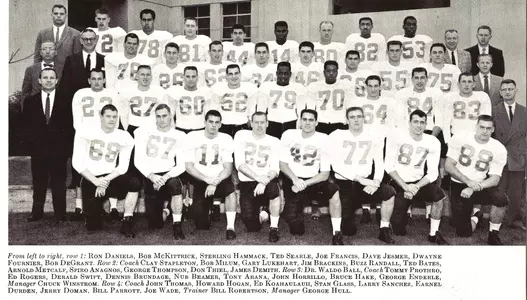
The Forgotten Champions
January 01, 2018 | Football
They should have been playing on New Year's Day. And in any other decade, they would have been.
Over the past 60 years, Oregon State's 1957 football team has become the school's forgotten gridiron champion, rarely mentioned in the same breath as the Rose Bowl teams of 1941, 1956 and 1964, or the Fiesta Bowl team of 2000.
But six decades ago this past fall, Oregon State met all the criteria for appearing in the 1958 Rose Bowl – yet the Beavers had known from the start of the season they had no chance to participate in the game. As the defending Pacific Coast Conference champions, the Beavers were barred from returning to Pasadena because of the "no repeat" rule the PCC and Big Ten had for most of the 1950s: schools were not allowed to play in the Rose Bowl in back-to-back years.
However, the lack of a postseason trip made the season – particularly the Civil War, which took place that autumn both on and off the field – no less satisfying.
1957 was Tommy Prothro's third year as head football coach at what was then known as Oregon State College. His rebuilding of the Beavers had occurred far ahead of any schedule that might have been envisioned when Prothro was hired after a last-place, 1-8 season in 1954 resulted in head coach Kip Taylor's resignation.
Prothro – who had played for Duke in its loss to Oregon State in the "transplanted" 1942 Rose Bowl – came to Corvallis from UCLA, where he had been backfield coach for six seasons under legendary head coach Red Sanders. Said the Oregon State press guide of the 36-year-old Tennessee native: "Some say that Prothro's biggest asset is his ability to get the utmost out of his players for each and every game – regardless of whether or not the opposition is heavily favored to win and boasts better personnel. To Beaver players, Prothro's word is final, and his analysis of a situation near-perfect."
In 1955, Prothro guided the Beavers to a 6-3 record and second place in the PCC standings. In 1956, Oregon State went a step further, taking the conference title with a 6-1-1 record; losing to Iowa 35-19 in the Rose Bowl left the Beavers 7-3-1 overall.
WHO'S IN, AND WHO'S OUT?
When practice for the 1957 season began, Oregon State knew another shot at New Year's Day glory wasn't a possibility. The Beavers weren't the only team starting the campaign knowing they didn't have a shot: UCLA, Southern California and Washington were still under sanction by the PCC for having provided improper financial aid to athletes, with penalties that including a Rose Bowl ban and having players declared ineligible.
With those three schools and Oregon State listed among the preseason conference favorites, it was possible the PCC could end up sending its fifth-best squad to the Rose Bowl. And all during the fall of 1957, there were noises being made about who might or might not pull out of the conference over the whole affair. There was talk of the four California schools – UCLA, USC, California and Stanford – leaving the PCC to start their own conference; this was complicated by California and Stanford advocating for tighter regulations on recruiting and aid to athletes while UCLA and USC wanted to go the other direction. UCLA no longer wanted to be required to play the Pacific Northwest schools, but realized that could result in its expulsion from the PCC. Some wanted seldom-competitive Idaho out of the conference to eliminate the Pacific Northwest's 5-4 advantage in votes in conference matters. Some Oregon State fans and officials ventured that a "big five" conference on the West Coast should include the Beavers, USC, UCLA, California and Washington.
When the Beavers visited Los Angeles to start the season, Bob Seizer of the Los Angeles Mirror-News talked with Prothro about his thoughts on the matter, and Prothro told him he thought his interests would come out "healthier and stronger" regardless of the PCC's fate.
"I asked Tommy if Oregon State was fearful of becoming an independent and getting lost in the national grid picture," Seizer wrote. "'Definitely not,' he snapped. 'We're climbing up the football ladder and we are going to have good enough teams that people will be interested in playing us. And we will have good enough won-loss records to draw well on the road or at home. Consequently, Oregon State will have no schedule difficulties."

REASON FOR OPTIMISM
Going into 1957, Prothro had reason to feel good about the future. Among the Beavers' 15 lettermen lost from the 1956 champions was two-time All-America tackle John Witte, but the 13 returning lettermen boasted enough talent to make a title defense a realistic possibility.
Senior tailback Joe Francis (Honolulu) was an All-America candidate in his own right, capable of gaining ground as both a runner and – as the position required in Oregon State's single-wing attack – a passer. In two seasons, he'd accounted for 1,587 yards total offense and nine touchdowns, with 203 yards in the Rose Bowl loss to Iowa.
Junior fullback Nub Beamer (Roseburg) and junior wingback Earnel Durdan (Los Angeles) had both been productive the previous season. Durdan, also a sprinter on the track team, led the 1956 Beavers in rushing with 508 yards rushing and receiving with 205.
Up front, junior tackle Ted Bates (Los Angeles), senior tackle Dave Jesmer (Omo Beach, Calif.), junior guard Jim Brackins (Redlands, Calif.) and senior ends Bob DeGrant (Burlingame, Calif.) and Dwayen Fournier (McMinnville) were all returning lettermen. Junior center Buzz Randall (Estacada), senior guard Bob McKittrick (Baker) and senior blocking back Ted Searle (Honolulu) had shown well in reserve roles, and Searle was named team captain.
As the Beavers convened in Corvallis for the September 1 start of fall practice, construction workers were putting the finishing touches on Cordley Hall, Oregon State's new agricultural and biological science building, and the Cauthorn/Hawley/Poling Halls dormitory complex. OSC expected a near-record enrollment in the area of 7,300, trailing only the post-World War II years when the campus was packed with military veterans.
While Oregon State went through the first week of readying for the September 21 season-opener against Southern California in Portland, the nation – increasingly linked electronically by not only radio, but television - watched as Arkansas Gov. Orval Faubus called out the state's National Guard to prevent nine African American students from enrolling in Little Rock Central High School. Less than a week later in Nashville, Tenn., Hattie Cotton Elementary School was dynamited late one night just days after admitting its first African American student.
The Beavers' final scrimmage had the starters defeating the reserves 27-0 at Parker (now Reser) Stadium on September 12.
A STRONG START
The opening game against USC at Portland's Multnomah Stadium matched the Beavers, ranked No. 13 in the Associated Press preseason national poll of sportswriters and broadcasters, and the Trojans, ranked No. 19.
"In all my years of coaching, no team has ever had an opener so important as the one we face this weekend," Prothro told a luncheon of reporters in the week leading up to the game. "Without the Rose Bowl as a goal, winning is our team's main incentive … I feel the boys have a lot of pride and want to win."
A crowd of 36,885 – the largest ever for a football game in Oregon to that point – watched the Beavers thump the Trojans 20-0. Oregon State rushed for 326 yards, with Beamer gaining 131 and Durden 168, while limiting USC to 170 yards total offense.
"The whole football team looked good," Prothro told reporters afterward.
With the win, the Beavers moved up to No. 9 in the AP poll and fan interest went even higher. OSC business manager Jim Barratt told the Corvallis Gazette-Times the win had caused a surge in ticket sales and alumni had called from Los Angeles, Berkeley, Seattle and Chicago – all places the Beavers would play that season – asking about tickets. Those in Corvallis could buy a season ticket for the Parker Stadium games against Idaho, Washington State and Stanford for $10 and get seats on the 30-yard line.
Things weren't as bright that week in another sporting location. On September 24, the Brooklyn Dodgers played what was thought to be their final game at Ebbets Field, beating the Pittsburgh Pirates 2-0. The official announcement hadn't yet been made, but it was expected the Dodgers would move to Los Angeles for the 1958 season.
Oregon State ventured to Kansas on September 28 and returned home with a 34-6 win. The Beavers rolled up 458 yards of total offense, 353 of those rushing, despite the second- and third-stringers playing over half the game. Francis' 53-yard touchdown run ended the scoring just three plays into the third quarter.
Prothro wasn't pleased, though.
"The score was the only satisfying thing about the game," he said. "The boys didn't play good football, at least up to what they're capable of."
Oregon State hit the road again for an October 5 game at Northwestern. After the Beavers' DC-7 landed at Chicago's Midway Airport, Prothro was helicoptered to a local television station for an interview. John Eggers, OSC's athletic news director, wrote in a dispatch to the G-T: "Believe what we say: this Beaver grid machine has quite a following, even in the Midwest where they know better than anywhere else how the game is played. Men like Wilfred Smith of the Tribune and Leo Fischer of the Chicago American – gentlemen we met at the Rose Bowl game – think highly of Oregon State football in general and Tommy Prothro in particular."
The Beavers may not have left the best impression but did get a 22-13 win over the Wildcats, OSC's first win over a Big Ten team since 1949. Francis passed for 110 yards and a touchdown and rushed for 62 more, and Prothro singled out Bates and Durden for outstanding performances, but Prothro's approval was far from universal.
"Our squad has lost its condition attained for Southern California several weeks ago," Prothro said. "We not only weren't in shape, but gave in to them in the second half. We didn't hit."
Two days later, the Space Race began as the Soviet Union launched Sputnik, the first artificial satellite. That led to fears in the United States that it had fallen behind its Cold War rival in developing technology.
Of more immediate interest to Oregon State was that it would finally, after having played on 13 different fields in their last 16 games, get to play on its own campus against Idaho on October 9. OSC would do it as the No. 7-ranked team in the country, and a big Kiwanis Kids Day crowd was expected as youth groups would be admitted for 25 cents per boy or girl.
Oregon State ground out a 20-0 win over Idaho after the pesky Vandals managed to stay in a scoreless tie at halftime. The defense got things going, as two fumble recoveries and an interception resulted in the three Beaver touchdowns.
UPS AND DOWNS
Oregon State was still ranked No. 7, and the road was about to get much tougher: a trip to Los Angeles to play UCLA, which hadn't lost in the Los Angeles Coliseum since midway through the 1951 season. Warned Prothro: "If we don't play better football than we've been playing, we're not going to do it this Saturday. We're riding for a fall."
The coach was right. UCLA pounded the Beavers 26-7, ending Oregon State's PCC win streak at nine games. OSC was also beat up, including Francis being knocked unconscious by a hard tackle and several other players suffering minor injuries. Wrote Jack Rickard of the Corvallis Gazette-Times: "Oregon State deserved to lose … Oregon State built up that all-important right mental attitude for USC five long weeks ago, but their determination, and in turn their effectiveness, has been gradually going downhill since then."
Oregon State dropped from the national rankings but looked to get back on track at Washington, which was winless so far in 1957. It wasn't to be, as the Huskies beat the Beavers 19-6. Both Francis and Beamer saw limited action due to injuries and weren't at full speed when they were on the field.
Oregon State's Homecoming on November 2 had the Beavers meeting a Washington State team sporting a 4-2 record and strong passing attack. A Saturday morning parade through the streets of Corvallis featured 42 floats centered on the theme "Autumn Serenade"; that was in contrast to Halloween a few nights earlier, when Corvallis police stopped several cars that had attempted to firebomb the OSC Homecoming bonfire, among other targets.
A crowd of 20,000 enjoyed the spectacle of Oregon State rolling to a 39-25 win, the highest point total for OSC in Prothro's tenure thus far. The Beavers allowed the pass-happy Cougars three touchdown throws, but Beamer rushed for 114 yards and Francis ran for 102 yards, passed for 54 more and a score of his own, and intercepted two WSC passes.
"Francis had his greatest day at Oregon State, both offensively and defensively,"
Prothro said. And, after watching the game film, he would add, "I believe Ted Bates played the best game I've ever seen a college lineman play … our whole line dominated the game about as much as a line can do."
The win kept Oregon State in the race for the PCC championship, now led by surprising Oregon, which had been picked to finish near the bottom of the conference.
Oregon State sustained its momentum by edging past California 21-19 in Berkeley on November 9. OSC was without Francis, who traveled with the team but spent Saturday afternoon in his hotel bed with the flu; a number of other Beavers were ill but able to play. Led by Francis' backups, Larry Sanchez and Tony Arana, Oregon State led 21-0 at the half before holding off the Bears' comeback, with point-after kicks blocked by Brackins and Randall.
While Oregon State was winning, Oregon was being beaten 13-6 by Washington to pull the Beavers within one game of the PCC lead. Beat Stanford the next week, and at worst Oregon State would be playing for a share of the conference title when it met the Ducks in the Civil War.
Stanford, however, also had Rose Bowl hopes riding on its November 16 meeting with the Beavers in Corvallis. When the contest concluded, though, it was Oregon State whose chance survived, as the Beavers won 24-14; OSC had yet to lose a game at Parker Stadium under Prothro. Francis, who felt the effects of the flu throughout the week, rallied to run for 138 yards and pass for 136 more; his 274 yards total offense set a school record.
Oregon beat Southern California that afternoon to keep the Pacific Coast Conference lead and the Ducks were assured of the Rose Bowl berth. Oregon State, however, had a chance to claim a share of the title – and assert supremacy over the co-champions – if it could beat Oregon in Eugene on November 23.
CIVIL WAR SKIRMISHES
In the Oregon Journal the week of the Civil War, George Pasero wrote in his "Pasero Says" column that while the Beavers had a season-long goal of defending their title, the lack of Rose Bowl incentive affected their play. Continued Pasero: "However, Coach Tommy Prothro's boys have had an eye cocked toward the Oregon game since the Ducks started their Rose Bowl march. They want to win this one to bolster their own prestige and that of Prothro, who has never achieved a victory over a Len Casanova-coached Oregon team. And they remember last year, when Oregon tied the Rose Bowl Beavers, 14 to 14."
It wasn't just Oregon State's football team that had been pointing toward this game for a month or so. For much of the autumn, the two campuses were trying to either ruffle the other's feathers or make some fur fly.
On November 1, the day before the Beavers' Homecoming game, Homecoming Queen Pearl Friel and two members of her court, LuAnn Mullen and Verle Pilling, were "kidnapped" by four Oregon athletes posing as newspaper photographers. Telling the young ladies they were from the Seattle Post-Intelligencer and wanted to take them for a photo session, the Duck lads – two tracksters, a golfer and a baseball player – got them in two cars and drove them to Salem.
After lunch at the home of one of the UO students, the group went to another home in Salem to avoid detection by legitimate reporters, all the while chaperoned by parents of the young men. Finally, reporters from The Oregonian did find them.
"At first we were scared and awfully surprised," Friel said. "But later on we had a good time." She said the Oregon students seemed worried about the potential consequences of their actions.
The kidnappers had planned a dinner for them, but the Homecoming royalty said they wanted to attend the OSC Rook bonfire and rally on the eve of the game, so they were returned to Corvallis in time for the events. After speaking with the students, UO Dean of Men Ray Hawk said the kidnapping had not been in retaliation for the OSC's stealing of the Oregon "O" from Skinner's Butte in Eugene earlier in the week.
That engineering achievement had taken place October 28, pulled off by pledges of the Tau Kappa Epsilon fraternity. Originally, their plan had been to simply paint the wooden monogram orange, as had been done several times over the years; however, they decided to take the project a step further.
The group rented a truck with a 15-foot bed and made its way to the hillside overlooking Eugene at about 2:30 a.m. It cut the 20-foot by 30-foot letter, constructed of 2x6 boards, into five sections – one weighing approximately 600 pounds – and got them into the truck, then headed north.
TKE President Boyd Davis told the Corvallis Gazette-Times they had one close call, when a Eugene police officer stopped to investigate their presence near the "O", asking them if they were planning on painting it.
No, we're not painting it – we're stealing it," the G-T quoted the OSC student as telling the officer. The story continued: "The policeman, to the surprise of the apprehensive crew, told them he, too, had attended Oregon State, and decided he'd 'better head back across town.'" The fraternity completed its heist and returned to Corvallis, where they initially stashed the pieces in their yard before finding a more secure hiding place outside the city.
That theft led to a meeting of Oregon State and Oregon student leaders and administrators to go over just what was acceptable and what wasn't in the Civil War rivalry. OSC Daily Barometer editor Roger Widness said both Oregon State Dean of Men Dan Poling and Hawk emphasized the rules included not taking students from their campus. Wrote Widness later, after the "kidnapping" of the court: "We thought that it was pretty well decided that this was to be frowned on by both schools. We find, however, that Dean Hawk approved of the idea of spiriting away the OSC beauties. It seems that he cast aside all of the decisions of Tuesday's meeting in allowing his students to follow through on the stunt."
That same day's Gazette-Times carried a report of unidentified flying objects spotted over New Mexico; Levelland, Tex.; the Gulf of Mexico – and Corvallis. A young couple told the G-T they had seen a bright object moving over Marys Peak that then seemed to descend into the valley between the peak and Bellfountain Road at about 7:45 p.m.
An easier object to identify would be seen after the game between Corvallis and Eugene: either OSC student body president Charles Dunn or UO student body president James Lynch. Dunn had issued a challenge to Lynch that the losing school's student leader bicycle from the opponent's campus to their own, wearing a jacket of the rival team's colors.
Things settled down November 13, as Oregon State's student senate voted to return the "O" to Oregon's student body. Dunn had suggested that the emblem be held for a year by the winner of that season's football game, but Lynch's response was that Oregon would not bargain for its return. Said Dunn: "We are in a position now to return the 'O' with no strings attached. I feel that it would be to our advantage to return it to them before their Homecoming."
As Civil War week opened, administrators and student leaders from both OSC and Oregon reiterated that students destroying or defacing property on the rival campus, or kidnapping students of the other school, would be subject to suspension. Said OSC's Poling, "Burning of either school's bonfire is considered fair game. But students must still accept the consequences inflicted on them if they are caught by the rival school's students."
BACK ON THE GRIDIRON
As the Civil War hijinks played out off the field, the matter of the game remained.
Not long after Oregon State wrapped up its win over Stanford, Prothro announced the Beavers' practices during Civil War week would be closed to all onlookers, including Beaver Club members. Cracked Prothro: "After all, there might be some Oregon alumni in the Beaver Club."
As for the Ducks, Prothro observed, "They're bound to be a good team if they're going to the Rose Bowl."
Oregon had been picked to finish seventh in the conference in a preseason poll of PCC coaches. After winning four of their first five games, though – the only loss being to No. 16 Pittsburgh by a 6-3 score in Portland - the Ducks broke into the AP national rankings at No. 18 and had climbed as high as No. 13 before losing to Washington. With a 7-2 overall record and 6-1 PCC mark, they were ranked No. 15 going into the Civil War.
While Oregon had the Rose Bowl bid clinched, that didn't lessen the emphasis the Ducks were putting on the Civil War outcome.
"Remember that when the season started I said time and time again that I thought the team that won the (Rose Bowl) bid should also be the undisputed champion," Oregon head coach Len Casanova told the Oregon Journal. "I meant it just as much for us as I did for California, Stanford or WSC. And I still mean it.
"We've got to beat OSC to win the title and deserve the bowl bid."
A sellout crowd of over 20,000 was expected at Hayward Field. Oregon State's students quickly bought out their allotment of 2,000 tickets for the game – about 1,000 more than the number that would usually attend a Civil War in Eugene. "
Prothro kept his word about closed workouts, as the OSC Rook team kept visitors at a distance from the practice field. A group of Oregon State students gathered at the gate to the field after one practice and cheered the exiting Beavers with exhortations of "Beat Oregon!"
The Oregon Journal's Hal Laman surveyed the scene at Oregon State that week and wrote: "This is the 61st renewal of this 'Civil War' football classic, and no one in Corvallis can remember the time enthusiasm ran so high. The austere Memorial Union building, never before in history decorated under any circumstance, has a 40-foot banner streaming from its rooftop. It says simply, 'Beat Oregon.' Three others fly from other campus buildings."
Now in his third year at Oregon State, Prothro had figured out the spirit of the Civil War.
"When I first came to Oregon State, I didn't react particularly to the anti-Oregon feeling that built up for this game," Prothro told the Oregon Journal. "We just played it as hard and best as we could. But now, when someone here gets up and delivers an oration about beating Oregon, I find myself saying, 'You said it.'"
At midweek, oddsmakers rated the game a tossup and it was announced the contest would be televised by the National Broadcast System with Chick Hearn of Los Angeles behind the microphone. It would be the second straight year the Civil War was televised.
Two days before the game, a low-flying plane circled the UO practice field for more than 30 minutes; loudspeakers attached to its exterior played the OSC fight song. Laman offered that the responsible party may have been from Eugene rather than Corvallis, noting, "After all, you don't want to make the guys you're gonna play any madder than they already are."
Finally, on a sunny afternoon with the temperature approaching 60 degrees, the Beavers and Ducks got around to playing the game before a packed house of 23,150. And play it they did: the Journal's Laman would call it "what will go down as one of the roughest, toughest football games of the 61-year 'Civil War' history."
Oregon State would be without Durden due to an injury he'd suffered against Stanford, but the Beavers went up 7-0 when Francis burst off-tackle for a three-yard touchdown run in the first quarter, capping a 69-yard drive, and Searle added the conversion kick.
The Beavers decided a bit of surprise might lead to a second quick score, so they opted for an onside kick. Searle barely touched the ball, though, sending it only a yard or so and the Ducks took possession at the Beaver 41-yard line. Oregon quickly drove the distance to even the game at 7-7, scoring on Jack Crabtree's one-yard pass to Jim Shanley.
Searle redeemed himself in the third quarter, booting through a 17-yard field goal to put Oregon State in front 10-7.
That came amid continuing rugged play. Wrote Rickard in the Gazette-Times, "The game was a fierce struggle between two hard-hitting, keyed-up elevens – a game that saw Oregon's Jack Morris stagger to his feet, then collapse after a vicious tackle … a game that saw Oregon State's Joe Francis come back from a wicked bump on his head in the first half that left him unconscious on the field, to spark his team to triumph."
Prothro would later say, "I can say, without fear of contradiction, that was the most bitterly fought game that I have ever seen. Both sides were really playing for keeps."
The game was decided on a series of plays midway through the fourth quarter.
Oregon was driving inside the Beaver 20-yard line but Jack Morris fumbled and Bates recovered for Oregon State. On the next play, though, Beamer – surehanded all season – fumbled the ball back to the Ducks.
Oregon moved the ball inside the 10 had had first-and-goal, but the Beavers stopped them three times. On fourth down, Shanley darted toward the left end, the goal line and a lead for the Ducks; Beamer moved up, grabbed Shanley's arm and pried the ball loose, then fell on it at the OSC 2 with about five minutes to play.
"I just yanked him and the next thing I knew the ball was bobbling right in front of me," said Beamer, who had gone from goat to hero in a matter of minutes.
A penalty moved OSC back to its 1-yard line, but Oregon State ground out four first downs to edge across midfield. Beamer fumbled to give Oregon one last desperate chance, but the Ducks couldn't advance into scoring position.
Oregon State 10, Oregon 7 was how it ended. The Beavers had their share of a second straight PCC championship and could claim a win over the co-champs. The final total offense numbers told the story of what type game it was, as the Beavers outgained the Ducks 216-213.
"You bet Oregon was tough," Francis said afterward. "The toughest we met all year, and we all knew before it was over that we had been in a real scrap." Added DeGrant: "This was the sweetest one of all."
Casanova, his team still Rose Bowl bound, told reporters, "We are bitterly disappointed."
After Prothro and the Beavers passed through a field of well-wishers and finally reached their dressing room in the basement of McArthur Court, Prothro told his team, "You're winner and still champions." The Beavers roared their approval.

POSTSCRIPT
Immediately after the game Friel, the OSC Homecoming queen, presented Casanova a yellow floral football with a red rose on top, telling him it carried the best wishes of Oregon State's student body for success in the Rose Bowl. As Oregon Staters tried to pull down the goalposts, a Beaver student and a Duck student fell to the ground while exchanging blows; that was a rarity for the day, though, as it seemed the pregame public address exhortation by Prothro and Casanova for peaceful coexistence had been effective.
In the next morning's issue of The Oregonian, it was observed that the players themselves dropped the bitterness once the final gun sounded. Said Randall to Oregon's Bob Gottkau after the game, "Get ready for a real time (at the Rose Bowl). That chamber of commerce down there will really give you the works." In that same newspaper, there were drawings of the design for Portland's new glass-walled sports and exposition arena to be built on the east bank of the Willamette River just across from downtown.
UO student body president Lynch did, indeed, bicycle from Corvallis to Eugene after losing the bet with his OSC counterpart Dunn. Over 2,000 Oregon State students cheered as he began his trek down U.S. Highway 99W.
Prothro got a short break before to leaving for San Francisco, where he would be part of the West coaching staff for the annual East-West Shrine Game.
 Francis finished the season with 626 yards and eight touchdowns rushing and 456 yards and three touchdowns passing. He concluded his career with Oregon State school records for total offense in a season (1,082 yards), highest average total offense per play in a season (6.3 yards), total offense in a game (274 yards vs. Stanford), most offensive plays in a game (35 vs. Stanford) and highest pass completion percentage in a game (.900, 9-of-10, vs. Stanford).
Francis earned the Pop Warner Award as the outstanding senior football player on the West Coast; he and Randall earned All-Coast honors and were on the All-PCC first team. Named to the All-PCC second team were Bates, Brackins, Jesmer, DeGrant, Beamer and Durden. Francis and Searle were named to the Hula Bowl, and Francis and Jesmer played in the Easter-West Shrine Game.
Francis was drafted by the Green Bay Packers in the fifth round of the NFL draft, and Bates would be drafted in the fifth round by the Chicago Cardinals a year later after earning All-America first team honors. Francis, Bates, and Prothro have all been inducted into the State of Oregon Sports Hall of Fame, and Prothro has been inducted into the National College Football Hall of Fame.
Randall, named a co-captain along with Brackins for the 1958 season, died of leukemia on September 20, 1958, one day after the Beavers opened their season with a loss to Southern California. A few days before his death, Randall received a letter of encouragement from the members of the Oregon football team.
In that era, the final national rankings were made at the end of the regular season and before the bowl games were played. The Beavers were ranked No. 19 in the Associated Press poll immediately after beating Oregon, then slipped from the Top 20 when the final poll was taken the next week and weren't ranked in the United Press International coaches poll.
Oregon finished the season unranked in the AP poll and ranked No. 17 in the UPI poll. The Ducks lost the Rose Bowl but impressed observers, falling to second-ranked Ohio State 10-7 on a field goal in the closing minutes.
The Pacific Coast Conference proved unable to resolve its differences and eventually broke up in 1959. The conference gradually reformed into what is now the Pacific-12, initially with the four California schools and Washington creating the Athletic Association of Western Universities later in 1959; Washington State joined them in 1962, then Oregon State and Oregon in 1964. In that first season back in the conference, the Beavers and Ducks both went into the Civil War with their Rose Bowl chances alive. Oregon State earned the bid by beating the Ducks 7-6 at Parker Stadium – putting Oregon State back in the New Year's Day spotlight it had been denied in 1958.
Over the past 60 years, Oregon State's 1957 football team has become the school's forgotten gridiron champion, rarely mentioned in the same breath as the Rose Bowl teams of 1941, 1956 and 1964, or the Fiesta Bowl team of 2000.
But six decades ago this past fall, Oregon State met all the criteria for appearing in the 1958 Rose Bowl – yet the Beavers had known from the start of the season they had no chance to participate in the game. As the defending Pacific Coast Conference champions, the Beavers were barred from returning to Pasadena because of the "no repeat" rule the PCC and Big Ten had for most of the 1950s: schools were not allowed to play in the Rose Bowl in back-to-back years.
However, the lack of a postseason trip made the season – particularly the Civil War, which took place that autumn both on and off the field – no less satisfying.
1957 was Tommy Prothro's third year as head football coach at what was then known as Oregon State College. His rebuilding of the Beavers had occurred far ahead of any schedule that might have been envisioned when Prothro was hired after a last-place, 1-8 season in 1954 resulted in head coach Kip Taylor's resignation.
Prothro – who had played for Duke in its loss to Oregon State in the "transplanted" 1942 Rose Bowl – came to Corvallis from UCLA, where he had been backfield coach for six seasons under legendary head coach Red Sanders. Said the Oregon State press guide of the 36-year-old Tennessee native: "Some say that Prothro's biggest asset is his ability to get the utmost out of his players for each and every game – regardless of whether or not the opposition is heavily favored to win and boasts better personnel. To Beaver players, Prothro's word is final, and his analysis of a situation near-perfect."
In 1955, Prothro guided the Beavers to a 6-3 record and second place in the PCC standings. In 1956, Oregon State went a step further, taking the conference title with a 6-1-1 record; losing to Iowa 35-19 in the Rose Bowl left the Beavers 7-3-1 overall.
WHO'S IN, AND WHO'S OUT?
When practice for the 1957 season began, Oregon State knew another shot at New Year's Day glory wasn't a possibility. The Beavers weren't the only team starting the campaign knowing they didn't have a shot: UCLA, Southern California and Washington were still under sanction by the PCC for having provided improper financial aid to athletes, with penalties that including a Rose Bowl ban and having players declared ineligible.
With those three schools and Oregon State listed among the preseason conference favorites, it was possible the PCC could end up sending its fifth-best squad to the Rose Bowl. And all during the fall of 1957, there were noises being made about who might or might not pull out of the conference over the whole affair. There was talk of the four California schools – UCLA, USC, California and Stanford – leaving the PCC to start their own conference; this was complicated by California and Stanford advocating for tighter regulations on recruiting and aid to athletes while UCLA and USC wanted to go the other direction. UCLA no longer wanted to be required to play the Pacific Northwest schools, but realized that could result in its expulsion from the PCC. Some wanted seldom-competitive Idaho out of the conference to eliminate the Pacific Northwest's 5-4 advantage in votes in conference matters. Some Oregon State fans and officials ventured that a "big five" conference on the West Coast should include the Beavers, USC, UCLA, California and Washington.
When the Beavers visited Los Angeles to start the season, Bob Seizer of the Los Angeles Mirror-News talked with Prothro about his thoughts on the matter, and Prothro told him he thought his interests would come out "healthier and stronger" regardless of the PCC's fate.
"I asked Tommy if Oregon State was fearful of becoming an independent and getting lost in the national grid picture," Seizer wrote. "'Definitely not,' he snapped. 'We're climbing up the football ladder and we are going to have good enough teams that people will be interested in playing us. And we will have good enough won-loss records to draw well on the road or at home. Consequently, Oregon State will have no schedule difficulties."
REASON FOR OPTIMISM
Going into 1957, Prothro had reason to feel good about the future. Among the Beavers' 15 lettermen lost from the 1956 champions was two-time All-America tackle John Witte, but the 13 returning lettermen boasted enough talent to make a title defense a realistic possibility.
Senior tailback Joe Francis (Honolulu) was an All-America candidate in his own right, capable of gaining ground as both a runner and – as the position required in Oregon State's single-wing attack – a passer. In two seasons, he'd accounted for 1,587 yards total offense and nine touchdowns, with 203 yards in the Rose Bowl loss to Iowa.
Junior fullback Nub Beamer (Roseburg) and junior wingback Earnel Durdan (Los Angeles) had both been productive the previous season. Durdan, also a sprinter on the track team, led the 1956 Beavers in rushing with 508 yards rushing and receiving with 205.
Up front, junior tackle Ted Bates (Los Angeles), senior tackle Dave Jesmer (Omo Beach, Calif.), junior guard Jim Brackins (Redlands, Calif.) and senior ends Bob DeGrant (Burlingame, Calif.) and Dwayen Fournier (McMinnville) were all returning lettermen. Junior center Buzz Randall (Estacada), senior guard Bob McKittrick (Baker) and senior blocking back Ted Searle (Honolulu) had shown well in reserve roles, and Searle was named team captain.
As the Beavers convened in Corvallis for the September 1 start of fall practice, construction workers were putting the finishing touches on Cordley Hall, Oregon State's new agricultural and biological science building, and the Cauthorn/Hawley/Poling Halls dormitory complex. OSC expected a near-record enrollment in the area of 7,300, trailing only the post-World War II years when the campus was packed with military veterans.
While Oregon State went through the first week of readying for the September 21 season-opener against Southern California in Portland, the nation – increasingly linked electronically by not only radio, but television - watched as Arkansas Gov. Orval Faubus called out the state's National Guard to prevent nine African American students from enrolling in Little Rock Central High School. Less than a week later in Nashville, Tenn., Hattie Cotton Elementary School was dynamited late one night just days after admitting its first African American student.
The Beavers' final scrimmage had the starters defeating the reserves 27-0 at Parker (now Reser) Stadium on September 12.
A STRONG START
The opening game against USC at Portland's Multnomah Stadium matched the Beavers, ranked No. 13 in the Associated Press preseason national poll of sportswriters and broadcasters, and the Trojans, ranked No. 19.
"In all my years of coaching, no team has ever had an opener so important as the one we face this weekend," Prothro told a luncheon of reporters in the week leading up to the game. "Without the Rose Bowl as a goal, winning is our team's main incentive … I feel the boys have a lot of pride and want to win."
A crowd of 36,885 – the largest ever for a football game in Oregon to that point – watched the Beavers thump the Trojans 20-0. Oregon State rushed for 326 yards, with Beamer gaining 131 and Durden 168, while limiting USC to 170 yards total offense.
"The whole football team looked good," Prothro told reporters afterward.
With the win, the Beavers moved up to No. 9 in the AP poll and fan interest went even higher. OSC business manager Jim Barratt told the Corvallis Gazette-Times the win had caused a surge in ticket sales and alumni had called from Los Angeles, Berkeley, Seattle and Chicago – all places the Beavers would play that season – asking about tickets. Those in Corvallis could buy a season ticket for the Parker Stadium games against Idaho, Washington State and Stanford for $10 and get seats on the 30-yard line.
Things weren't as bright that week in another sporting location. On September 24, the Brooklyn Dodgers played what was thought to be their final game at Ebbets Field, beating the Pittsburgh Pirates 2-0. The official announcement hadn't yet been made, but it was expected the Dodgers would move to Los Angeles for the 1958 season.
Oregon State ventured to Kansas on September 28 and returned home with a 34-6 win. The Beavers rolled up 458 yards of total offense, 353 of those rushing, despite the second- and third-stringers playing over half the game. Francis' 53-yard touchdown run ended the scoring just three plays into the third quarter.
Prothro wasn't pleased, though.
"The score was the only satisfying thing about the game," he said. "The boys didn't play good football, at least up to what they're capable of."
Oregon State hit the road again for an October 5 game at Northwestern. After the Beavers' DC-7 landed at Chicago's Midway Airport, Prothro was helicoptered to a local television station for an interview. John Eggers, OSC's athletic news director, wrote in a dispatch to the G-T: "Believe what we say: this Beaver grid machine has quite a following, even in the Midwest where they know better than anywhere else how the game is played. Men like Wilfred Smith of the Tribune and Leo Fischer of the Chicago American – gentlemen we met at the Rose Bowl game – think highly of Oregon State football in general and Tommy Prothro in particular."
The Beavers may not have left the best impression but did get a 22-13 win over the Wildcats, OSC's first win over a Big Ten team since 1949. Francis passed for 110 yards and a touchdown and rushed for 62 more, and Prothro singled out Bates and Durden for outstanding performances, but Prothro's approval was far from universal.
"Our squad has lost its condition attained for Southern California several weeks ago," Prothro said. "We not only weren't in shape, but gave in to them in the second half. We didn't hit."
Two days later, the Space Race began as the Soviet Union launched Sputnik, the first artificial satellite. That led to fears in the United States that it had fallen behind its Cold War rival in developing technology.
Of more immediate interest to Oregon State was that it would finally, after having played on 13 different fields in their last 16 games, get to play on its own campus against Idaho on October 9. OSC would do it as the No. 7-ranked team in the country, and a big Kiwanis Kids Day crowd was expected as youth groups would be admitted for 25 cents per boy or girl.
Oregon State ground out a 20-0 win over Idaho after the pesky Vandals managed to stay in a scoreless tie at halftime. The defense got things going, as two fumble recoveries and an interception resulted in the three Beaver touchdowns.
UPS AND DOWNS
Oregon State was still ranked No. 7, and the road was about to get much tougher: a trip to Los Angeles to play UCLA, which hadn't lost in the Los Angeles Coliseum since midway through the 1951 season. Warned Prothro: "If we don't play better football than we've been playing, we're not going to do it this Saturday. We're riding for a fall."
The coach was right. UCLA pounded the Beavers 26-7, ending Oregon State's PCC win streak at nine games. OSC was also beat up, including Francis being knocked unconscious by a hard tackle and several other players suffering minor injuries. Wrote Jack Rickard of the Corvallis Gazette-Times: "Oregon State deserved to lose … Oregon State built up that all-important right mental attitude for USC five long weeks ago, but their determination, and in turn their effectiveness, has been gradually going downhill since then."
Oregon State dropped from the national rankings but looked to get back on track at Washington, which was winless so far in 1957. It wasn't to be, as the Huskies beat the Beavers 19-6. Both Francis and Beamer saw limited action due to injuries and weren't at full speed when they were on the field.
Oregon State's Homecoming on November 2 had the Beavers meeting a Washington State team sporting a 4-2 record and strong passing attack. A Saturday morning parade through the streets of Corvallis featured 42 floats centered on the theme "Autumn Serenade"; that was in contrast to Halloween a few nights earlier, when Corvallis police stopped several cars that had attempted to firebomb the OSC Homecoming bonfire, among other targets.
A crowd of 20,000 enjoyed the spectacle of Oregon State rolling to a 39-25 win, the highest point total for OSC in Prothro's tenure thus far. The Beavers allowed the pass-happy Cougars three touchdown throws, but Beamer rushed for 114 yards and Francis ran for 102 yards, passed for 54 more and a score of his own, and intercepted two WSC passes.
"Francis had his greatest day at Oregon State, both offensively and defensively,"
Prothro said. And, after watching the game film, he would add, "I believe Ted Bates played the best game I've ever seen a college lineman play … our whole line dominated the game about as much as a line can do."
The win kept Oregon State in the race for the PCC championship, now led by surprising Oregon, which had been picked to finish near the bottom of the conference.
Oregon State sustained its momentum by edging past California 21-19 in Berkeley on November 9. OSC was without Francis, who traveled with the team but spent Saturday afternoon in his hotel bed with the flu; a number of other Beavers were ill but able to play. Led by Francis' backups, Larry Sanchez and Tony Arana, Oregon State led 21-0 at the half before holding off the Bears' comeback, with point-after kicks blocked by Brackins and Randall.
While Oregon State was winning, Oregon was being beaten 13-6 by Washington to pull the Beavers within one game of the PCC lead. Beat Stanford the next week, and at worst Oregon State would be playing for a share of the conference title when it met the Ducks in the Civil War.
Stanford, however, also had Rose Bowl hopes riding on its November 16 meeting with the Beavers in Corvallis. When the contest concluded, though, it was Oregon State whose chance survived, as the Beavers won 24-14; OSC had yet to lose a game at Parker Stadium under Prothro. Francis, who felt the effects of the flu throughout the week, rallied to run for 138 yards and pass for 136 more; his 274 yards total offense set a school record.
Oregon beat Southern California that afternoon to keep the Pacific Coast Conference lead and the Ducks were assured of the Rose Bowl berth. Oregon State, however, had a chance to claim a share of the title – and assert supremacy over the co-champions – if it could beat Oregon in Eugene on November 23.
CIVIL WAR SKIRMISHES
In the Oregon Journal the week of the Civil War, George Pasero wrote in his "Pasero Says" column that while the Beavers had a season-long goal of defending their title, the lack of Rose Bowl incentive affected their play. Continued Pasero: "However, Coach Tommy Prothro's boys have had an eye cocked toward the Oregon game since the Ducks started their Rose Bowl march. They want to win this one to bolster their own prestige and that of Prothro, who has never achieved a victory over a Len Casanova-coached Oregon team. And they remember last year, when Oregon tied the Rose Bowl Beavers, 14 to 14."
It wasn't just Oregon State's football team that had been pointing toward this game for a month or so. For much of the autumn, the two campuses were trying to either ruffle the other's feathers or make some fur fly.
On November 1, the day before the Beavers' Homecoming game, Homecoming Queen Pearl Friel and two members of her court, LuAnn Mullen and Verle Pilling, were "kidnapped" by four Oregon athletes posing as newspaper photographers. Telling the young ladies they were from the Seattle Post-Intelligencer and wanted to take them for a photo session, the Duck lads – two tracksters, a golfer and a baseball player – got them in two cars and drove them to Salem.
After lunch at the home of one of the UO students, the group went to another home in Salem to avoid detection by legitimate reporters, all the while chaperoned by parents of the young men. Finally, reporters from The Oregonian did find them.
"At first we were scared and awfully surprised," Friel said. "But later on we had a good time." She said the Oregon students seemed worried about the potential consequences of their actions.
The kidnappers had planned a dinner for them, but the Homecoming royalty said they wanted to attend the OSC Rook bonfire and rally on the eve of the game, so they were returned to Corvallis in time for the events. After speaking with the students, UO Dean of Men Ray Hawk said the kidnapping had not been in retaliation for the OSC's stealing of the Oregon "O" from Skinner's Butte in Eugene earlier in the week.
That engineering achievement had taken place October 28, pulled off by pledges of the Tau Kappa Epsilon fraternity. Originally, their plan had been to simply paint the wooden monogram orange, as had been done several times over the years; however, they decided to take the project a step further.
The group rented a truck with a 15-foot bed and made its way to the hillside overlooking Eugene at about 2:30 a.m. It cut the 20-foot by 30-foot letter, constructed of 2x6 boards, into five sections – one weighing approximately 600 pounds – and got them into the truck, then headed north.
TKE President Boyd Davis told the Corvallis Gazette-Times they had one close call, when a Eugene police officer stopped to investigate their presence near the "O", asking them if they were planning on painting it.
No, we're not painting it – we're stealing it," the G-T quoted the OSC student as telling the officer. The story continued: "The policeman, to the surprise of the apprehensive crew, told them he, too, had attended Oregon State, and decided he'd 'better head back across town.'" The fraternity completed its heist and returned to Corvallis, where they initially stashed the pieces in their yard before finding a more secure hiding place outside the city.
That theft led to a meeting of Oregon State and Oregon student leaders and administrators to go over just what was acceptable and what wasn't in the Civil War rivalry. OSC Daily Barometer editor Roger Widness said both Oregon State Dean of Men Dan Poling and Hawk emphasized the rules included not taking students from their campus. Wrote Widness later, after the "kidnapping" of the court: "We thought that it was pretty well decided that this was to be frowned on by both schools. We find, however, that Dean Hawk approved of the idea of spiriting away the OSC beauties. It seems that he cast aside all of the decisions of Tuesday's meeting in allowing his students to follow through on the stunt."
That same day's Gazette-Times carried a report of unidentified flying objects spotted over New Mexico; Levelland, Tex.; the Gulf of Mexico – and Corvallis. A young couple told the G-T they had seen a bright object moving over Marys Peak that then seemed to descend into the valley between the peak and Bellfountain Road at about 7:45 p.m.
An easier object to identify would be seen after the game between Corvallis and Eugene: either OSC student body president Charles Dunn or UO student body president James Lynch. Dunn had issued a challenge to Lynch that the losing school's student leader bicycle from the opponent's campus to their own, wearing a jacket of the rival team's colors.
Things settled down November 13, as Oregon State's student senate voted to return the "O" to Oregon's student body. Dunn had suggested that the emblem be held for a year by the winner of that season's football game, but Lynch's response was that Oregon would not bargain for its return. Said Dunn: "We are in a position now to return the 'O' with no strings attached. I feel that it would be to our advantage to return it to them before their Homecoming."
As Civil War week opened, administrators and student leaders from both OSC and Oregon reiterated that students destroying or defacing property on the rival campus, or kidnapping students of the other school, would be subject to suspension. Said OSC's Poling, "Burning of either school's bonfire is considered fair game. But students must still accept the consequences inflicted on them if they are caught by the rival school's students."
BACK ON THE GRIDIRON
As the Civil War hijinks played out off the field, the matter of the game remained.
Not long after Oregon State wrapped up its win over Stanford, Prothro announced the Beavers' practices during Civil War week would be closed to all onlookers, including Beaver Club members. Cracked Prothro: "After all, there might be some Oregon alumni in the Beaver Club."
As for the Ducks, Prothro observed, "They're bound to be a good team if they're going to the Rose Bowl."
Oregon had been picked to finish seventh in the conference in a preseason poll of PCC coaches. After winning four of their first five games, though – the only loss being to No. 16 Pittsburgh by a 6-3 score in Portland - the Ducks broke into the AP national rankings at No. 18 and had climbed as high as No. 13 before losing to Washington. With a 7-2 overall record and 6-1 PCC mark, they were ranked No. 15 going into the Civil War.
While Oregon had the Rose Bowl bid clinched, that didn't lessen the emphasis the Ducks were putting on the Civil War outcome.
"Remember that when the season started I said time and time again that I thought the team that won the (Rose Bowl) bid should also be the undisputed champion," Oregon head coach Len Casanova told the Oregon Journal. "I meant it just as much for us as I did for California, Stanford or WSC. And I still mean it.
"We've got to beat OSC to win the title and deserve the bowl bid."
A sellout crowd of over 20,000 was expected at Hayward Field. Oregon State's students quickly bought out their allotment of 2,000 tickets for the game – about 1,000 more than the number that would usually attend a Civil War in Eugene. "
Prothro kept his word about closed workouts, as the OSC Rook team kept visitors at a distance from the practice field. A group of Oregon State students gathered at the gate to the field after one practice and cheered the exiting Beavers with exhortations of "Beat Oregon!"
The Oregon Journal's Hal Laman surveyed the scene at Oregon State that week and wrote: "This is the 61st renewal of this 'Civil War' football classic, and no one in Corvallis can remember the time enthusiasm ran so high. The austere Memorial Union building, never before in history decorated under any circumstance, has a 40-foot banner streaming from its rooftop. It says simply, 'Beat Oregon.' Three others fly from other campus buildings."
Now in his third year at Oregon State, Prothro had figured out the spirit of the Civil War.
"When I first came to Oregon State, I didn't react particularly to the anti-Oregon feeling that built up for this game," Prothro told the Oregon Journal. "We just played it as hard and best as we could. But now, when someone here gets up and delivers an oration about beating Oregon, I find myself saying, 'You said it.'"
At midweek, oddsmakers rated the game a tossup and it was announced the contest would be televised by the National Broadcast System with Chick Hearn of Los Angeles behind the microphone. It would be the second straight year the Civil War was televised.
Two days before the game, a low-flying plane circled the UO practice field for more than 30 minutes; loudspeakers attached to its exterior played the OSC fight song. Laman offered that the responsible party may have been from Eugene rather than Corvallis, noting, "After all, you don't want to make the guys you're gonna play any madder than they already are."
Finally, on a sunny afternoon with the temperature approaching 60 degrees, the Beavers and Ducks got around to playing the game before a packed house of 23,150. And play it they did: the Journal's Laman would call it "what will go down as one of the roughest, toughest football games of the 61-year 'Civil War' history."
Oregon State would be without Durden due to an injury he'd suffered against Stanford, but the Beavers went up 7-0 when Francis burst off-tackle for a three-yard touchdown run in the first quarter, capping a 69-yard drive, and Searle added the conversion kick.
The Beavers decided a bit of surprise might lead to a second quick score, so they opted for an onside kick. Searle barely touched the ball, though, sending it only a yard or so and the Ducks took possession at the Beaver 41-yard line. Oregon quickly drove the distance to even the game at 7-7, scoring on Jack Crabtree's one-yard pass to Jim Shanley.
Searle redeemed himself in the third quarter, booting through a 17-yard field goal to put Oregon State in front 10-7.
That came amid continuing rugged play. Wrote Rickard in the Gazette-Times, "The game was a fierce struggle between two hard-hitting, keyed-up elevens – a game that saw Oregon's Jack Morris stagger to his feet, then collapse after a vicious tackle … a game that saw Oregon State's Joe Francis come back from a wicked bump on his head in the first half that left him unconscious on the field, to spark his team to triumph."
Prothro would later say, "I can say, without fear of contradiction, that was the most bitterly fought game that I have ever seen. Both sides were really playing for keeps."
The game was decided on a series of plays midway through the fourth quarter.
Oregon was driving inside the Beaver 20-yard line but Jack Morris fumbled and Bates recovered for Oregon State. On the next play, though, Beamer – surehanded all season – fumbled the ball back to the Ducks.
Oregon moved the ball inside the 10 had had first-and-goal, but the Beavers stopped them three times. On fourth down, Shanley darted toward the left end, the goal line and a lead for the Ducks; Beamer moved up, grabbed Shanley's arm and pried the ball loose, then fell on it at the OSC 2 with about five minutes to play.
"I just yanked him and the next thing I knew the ball was bobbling right in front of me," said Beamer, who had gone from goat to hero in a matter of minutes.
A penalty moved OSC back to its 1-yard line, but Oregon State ground out four first downs to edge across midfield. Beamer fumbled to give Oregon one last desperate chance, but the Ducks couldn't advance into scoring position.
Oregon State 10, Oregon 7 was how it ended. The Beavers had their share of a second straight PCC championship and could claim a win over the co-champs. The final total offense numbers told the story of what type game it was, as the Beavers outgained the Ducks 216-213.
"You bet Oregon was tough," Francis said afterward. "The toughest we met all year, and we all knew before it was over that we had been in a real scrap." Added DeGrant: "This was the sweetest one of all."
Casanova, his team still Rose Bowl bound, told reporters, "We are bitterly disappointed."
After Prothro and the Beavers passed through a field of well-wishers and finally reached their dressing room in the basement of McArthur Court, Prothro told his team, "You're winner and still champions." The Beavers roared their approval.
POSTSCRIPT
Immediately after the game Friel, the OSC Homecoming queen, presented Casanova a yellow floral football with a red rose on top, telling him it carried the best wishes of Oregon State's student body for success in the Rose Bowl. As Oregon Staters tried to pull down the goalposts, a Beaver student and a Duck student fell to the ground while exchanging blows; that was a rarity for the day, though, as it seemed the pregame public address exhortation by Prothro and Casanova for peaceful coexistence had been effective.
In the next morning's issue of The Oregonian, it was observed that the players themselves dropped the bitterness once the final gun sounded. Said Randall to Oregon's Bob Gottkau after the game, "Get ready for a real time (at the Rose Bowl). That chamber of commerce down there will really give you the works." In that same newspaper, there were drawings of the design for Portland's new glass-walled sports and exposition arena to be built on the east bank of the Willamette River just across from downtown.
UO student body president Lynch did, indeed, bicycle from Corvallis to Eugene after losing the bet with his OSC counterpart Dunn. Over 2,000 Oregon State students cheered as he began his trek down U.S. Highway 99W.
Prothro got a short break before to leaving for San Francisco, where he would be part of the West coaching staff for the annual East-West Shrine Game.
Francis finished the season with 626 yards and eight touchdowns rushing and 456 yards and three touchdowns passing. He concluded his career with Oregon State school records for total offense in a season (1,082 yards), highest average total offense per play in a season (6.3 yards), total offense in a game (274 yards vs. Stanford), most offensive plays in a game (35 vs. Stanford) and highest pass completion percentage in a game (.900, 9-of-10, vs. Stanford).Francis earned the Pop Warner Award as the outstanding senior football player on the West Coast; he and Randall earned All-Coast honors and were on the All-PCC first team. Named to the All-PCC second team were Bates, Brackins, Jesmer, DeGrant, Beamer and Durden. Francis and Searle were named to the Hula Bowl, and Francis and Jesmer played in the Easter-West Shrine Game.
Francis was drafted by the Green Bay Packers in the fifth round of the NFL draft, and Bates would be drafted in the fifth round by the Chicago Cardinals a year later after earning All-America first team honors. Francis, Bates, and Prothro have all been inducted into the State of Oregon Sports Hall of Fame, and Prothro has been inducted into the National College Football Hall of Fame.
Randall, named a co-captain along with Brackins for the 1958 season, died of leukemia on September 20, 1958, one day after the Beavers opened their season with a loss to Southern California. A few days before his death, Randall received a letter of encouragement from the members of the Oregon football team.
In that era, the final national rankings were made at the end of the regular season and before the bowl games were played. The Beavers were ranked No. 19 in the Associated Press poll immediately after beating Oregon, then slipped from the Top 20 when the final poll was taken the next week and weren't ranked in the United Press International coaches poll.
Oregon finished the season unranked in the AP poll and ranked No. 17 in the UPI poll. The Ducks lost the Rose Bowl but impressed observers, falling to second-ranked Ohio State 10-7 on a field goal in the closing minutes.
The Pacific Coast Conference proved unable to resolve its differences and eventually broke up in 1959. The conference gradually reformed into what is now the Pacific-12, initially with the four California schools and Washington creating the Athletic Association of Western Universities later in 1959; Washington State joined them in 1962, then Oregon State and Oregon in 1964. In that first season back in the conference, the Beavers and Ducks both went into the Civil War with their Rose Bowl chances alive. Oregon State earned the bid by beating the Ducks 7-6 at Parker Stadium – putting Oregon State back in the New Year's Day spotlight it had been denied in 1958.

Thursday, June 11
Wednesday, May 06
Monday, April 20
Monday, April 13