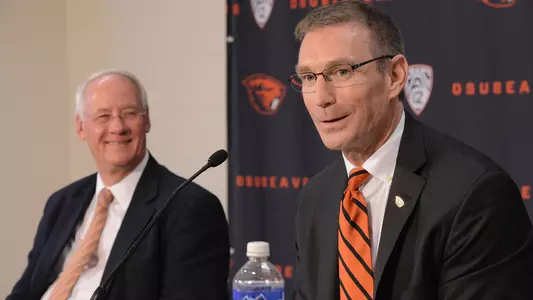
Q&A With Todd Stansbury
October 13, 2015 | Football
Reprinted with the permission of the National Football Foundation & College Hall of Fame - FootballMatters.org
Todd Stansbury did not play football until high school, but the game has certainly had a big impact on his life. The new Athletic Director at Oregon State University knows that many of the professional opportunities that he has received are a direct result of him playing football. In this exclusive interview with FootballMatters.org, Stansbury discusses how football has made such a big difference in his life.
Football Matters: When you look back on your career in football as a player, what are some of your earliest memories about why the sport was special to you?
Todd Stansbury: I think the camaraderie with your teammates and being in the trenches with guys who become lifelong friends.
FM: You grew up in Canada. In your particular area, were you exposed to football early?
TS: I was actually not exposed to football as a player until I got to high school. So, the sports I played early were hockey and lacrosse.
FM: When you started playing football, did it come naturally to you?
TS: It actually was a lot different than hockey, which is more of a free flowing sport where you just react. It was a major change going to a sport where plays are called and it's the ultimate team sport because you are relying on your teammates more. It's not the type of sport where one or two dominant players can really change things.
FM: Did you have a mentor for your football career, and can you talk about what that person meant to you?
TS: The reason I switched sports when I got to high school was that I had been exposed to some Georgia Tech football players while I was on a family vacation in Florida when I was 10 or 12 years old. I was so enamored with those guys that I decided that when I had the opportunity, I would play football and hopefully end up getting the opportunity to play in college, just like they had.
FM: What was it about those football players that fascinated you?
TS: They were on spring break and were having a lot of fun and seemed to garner a lot of attention. I was in awe of these big, strong guys who kind of took over every room that they walked into.
FM: What lessons that you learned in football do you still use every day in your current job?
TS: The thing I use the most is the effect that coaches and administrators can have on their team and the individuals on the team. I felt like my experience at Georgia Tech as a player really changed the whole trajectory of my life. My coach was Bill Curry and my Athletic Director was Homer Rice. As an Athletic Director now, I look at the influence that they were able to have on me and my teammates and the opportunity that they provided. I think that has played a huge role in my philosophy as an Athletic Director.
FM: Having Bill Curry and Homer Rice in your life, did that influence your decision to go into athletics administration?
TS: Not really. I think that as a graduate of Georgia Tech, I assumed that I would go into the corporate world, which I did. It wasn't until I was out for a couple of years and had the opportunity to go back to Georgia Tech in an administrative role that I really thought about athletic administration as a career. But once it was presented to me, it was an easy decision to make. Once I got back, my first job was as the academic advisor to the football team, I realized pretty quickly that I had found my passion.
FM: You went from UCF to Oregon State, moving from one corner of the country to the other. How's that transition going?
TS: It's been great. I had been at Oregon State for nine years prior to going to UCF as the Athletic Director. So, in a lot of ways, it's like coming home. It's an institution and a community that I am very familiar with. It's probably an easier transition than most.
FM: In a few sentences, can you tell us how much football has meant to you and your life?
TS: Football taught me that, through the love of sport, you can develop young people into leaders and help them become more than they think is possible. You can open up new worlds to them, that was my personal experience. The opportunity to go to Georgia Tech on a football scholarship really changed everything for me. Knowing the power of football as an educational tool is kind of the root of my philosophy as an Athletic Director. Because these kids want to play a game, we have the leverage to expand their horizons and push them to meet their full potential, which, in many cases, they don't even realize they have. I look at football as an incredible educational tool. It's obviously a wonderful way for people from all walks of life to come together and be teammates. The sport itself creates bonds between players and coaches that will last a lifetime.