Jacoby Ellsbury And The Stolen Base
By Sean McAdam
In their long, storied history, the Red Sox have been known for their great hitters (Ted Williams, Wade Boggs, Carl Yastzemski, Manny Ramirez), great sluggers (Jimmie Foxx, Jim Rice, David Ortiz) and even, on occasion, some great pitchers (Cy Young, Roger Clemens, Pedro Martinez).
Never before, however, have they been known for their base stealers. But like the team's October fortunes, that might be changing, too.
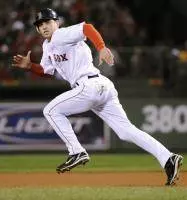
Not until he had played his 73rd game in the big leagues Sunday against Milwaukee had Jacoby Ellsbury been caught stealing, having swiped successfully in each of his first 25 tries.
The 25 straight steals without being caught to begin a career were a club record and fell just two short of the major league record, set by Tim Raines during 1979-1981.
"Even then," said teammate Jason Varitek, "it took a pitchout and a perfect throw to get him."
Ellsbury joked that he was so unaccustomed to being caught, he was momentarily unsure of what to do. Accustomed to standing up and dusting himself off, he instead had to make the long, lonely trot into the dugout.
But the Red Sox know exactly what to do with Ellsbury's speed: utilize it.
In the past, Red Sox managers have been reluctant to green-light the few good base stealers the franchise has boasted, for fear that an ill-timed out on the bases would rob the lineup's big boppers of run-producing opportunities.
But, then, this Red Sox lineup is more athletic than most, featuring Julio Lugo and, at times, Coco Crisp. All three possess enough speed and base-stealing know-how that the risk of running into outs is minimal. Through Tuesday, the trio had combined to go 30-for-33 this season.
Of course, Ellsbury is the fastest of three and the best pure base stealer. Red Sox bench coach Brad Mills recently timed the outfielder at 3.75 seconds from home to first on a drag bunt; anything less than 4.0 seconds is considered spectacular.
The Red Sox have given him nearly free rein.
"Like most guys, he's a better base stealer when he's on his own," said Red Sox manager Terry Francona. "He's proven his intelligence [on the basepaths] to us at an early stage. We trust him."
Asked to highlight Ellsbury's strongest suit as a base stealer, Francona cited the 24-year-old outfielder's "explosive first step. He gets it going in a hurry." Mills, meanwhile, zeroed in on the way Ellsbury "finishes off and slides through the bag."
Clearly, he's got both ends covered.
Ellsbury's preparation begins not in the batter's box or on base, but in the Red Sox video room, where he researches the opposing starter.
"I usually try to look at some film and get an understanding of his move to first," said Ellsbury, "not necessarily his time, but what he does with his body when he goes home."
Ellsbury is looking for patterns, something he can use to give him the smallest advantage, the most minuscule edge since, as he notes, almost every stolen base attempt "is bang-bang -- a fraction of a second can make the difference [between being safe or out]."
The work pays dividends.
"A lot of little factors play into it," he said of his approach. "A lot of times, being new, I'm seeing guys for the first time, so it's important to find out whatever you can.
I'm talking about subtle things: the first step, eliminating any unnecessary movement. I've always been a student of the game, so I talk to a lot of people."
His list of confidants includes Lugo -- who stole 39 of 50 in the American League in 2005, Crisp and Red Sox instructor Tommy Harper, who holds the franchise's single-season mark of 54 steals in 1973.
Technique is critical.
"That's what has allowed me to get into my starting position as fast as I can," Ellsbury said. "Where I have my hands, how far my feet are spread apart, how I take a lead, how I get back to the bag on [pickoff attempts]."
To save wear-and-tear on his body, he's been working on a crossover step that enables him to get back to first without diving into the bag on a pickoff attempt. That helps conserve energy and reduces nagging aches and pains.
But for all the study and talk of technique, there's a certain utilitarian approach to baserunning.
"The biggest thing is to find what works best for you," Ellsbury said. "How fast can you get down to second -- that's what it comes down to. I may have tweaked a few things over the year, but I could probably look back at high school footage and my basic form would be pretty much the same."
Blessed with natural speed, Ellsbury has lately concentrated on understanding situations. Harper and minor league coach Lou Frazier helped ease the learning curve.
"You have to be able to read different situations," Ellsbury said. "If there's a lefty at the plate, different relievers have different pickoff moves. There's no one formula for every pitcher. You just have to be able to make adjustments pitch to pitch, quickly. Some people don't make those adjustments. But in reality, pitchers are different all the time. They hold runners differently. They might pause longer in certain situations. There's a lot to be aware of.
"You'll see me talking to [Red Sox first base coach Luis Alicea] after every pitch, asking, 'Hey, did you see that?' [In the dugout], I'll watch Coco -- and what the pitcher's trying to do -- or Julio. I don't pay much attention when the big guys who aren't much of a threat are on base because then the pitcher's not using his slide step. Things are different.
It's work, but it's well worth it. Especially when the game is on the line and you get in scoring position. It can be the difference between a win and a loss."
Should Ellsbury or a member of the coaching staff miss something, chances are Matt James won't. James has been Ellsbury's personal trainer for years and watches most Red Sox games in his native Oregon. He knows Ellsbury well enough that the slightest fundamental flaw -- feet spread too far apart; body leaning too far one way -- can be detected from across the country. The two talk often.
But Ellsbury has been doing this long enough and well enough that he's capable of instant self-inspection.
"I'll know if have a base stolen within the first two or three steps," he said. "The other day against Milwaukee, I got a great jump and peeked in [toward the plate]. I always look in. People tell you not to, but I always do, real quick. As soon as I saw [Brewers catcher Jason Kendall] pop up, I knew my chances weren't very good. It's timing. Most guys would agree -- for me it's all about start. The first two or three steps, those are the most important. That's the difference.
"I worked on improving that this spring training -- my first-step quickness. As an outfielder, going after a ball, it's the same thing. Once you get going, a lot of guys are fast. But those first couple steps are going to give you the advantage."
Speed counts when it comes to learning, too.
"I think the biggest improvement I've made is making adjustments more quickly," Ellsbury said. "It used to take a whole at-bat to see a flaw or pitcher giving something away. Now, I recognize pitch to pitch. It doesn't take as long for me to pick up something that I can use to help myself."
Ellsbury knows just enough about Red Sox history to know his is a unique skill.
"This team is normally built around power and driving in runs," said Ellsbury, "and we still are. But base stealing is very important when you're not scoring a lot of runs and not swinging the bats well. When things aren't going well, getting into scoring position and with the great hitters behind me -- I couldn't ask for better guys.
"And who doesn't like hitting with guys in scoring position. It makes their job a little easier. It gives us a chance to score and puts a little stress on the defense. When you have a guy who can run, you have to pay more attention. Even when you don't go, just the threat of you going means opening a hole [in the infield], making them throw over, sometimes they don't their full attention on the batter. Maybe instead of being fully focused, instead of throwing something on the black, they leave something over the plate."
Speed kills and thrills. Who knew? In Boston, some lessons take a while to learn.
Sean McAdam of The Providence (R.I.) Journal covers baseball for ESPN.com.