Unbowed
By Ken Goe
The Oregonian
LA PINE -- The man in the motorized wheelchair parks behind the discus ring at a recent La Pine High School track and field practice. He misses nothing.
He watches every athlete intently. Some are high school students. Some go to middle school. Some spin and throw with practiced ease. Some are awkward.
It makes no difference to the man. He has something to say to each, although the throwers sometimes strain to understand him. He talks slowly, carefully attempting to enunciate each syllable in a high-pitched, sing-song voice.
Sometimes, he communicates successfully on his first attempt. Sometimes not.
But each thrower listens, leaning forward, eyes narrowed, brow furrowed. They know Tim Fox. They know his story. They know if he has something to say, it's worth being heard.
"Tim has forgotten more about the discus than most people will ever know," La Pine athletic director Rusty Zysett says.
What is most compelling about Fox isn't what he has forgotten. And it isn't what people have forgotten about Fox.
It's what they can't forget, and what he won't.
On July 4, 2001, in a split-second, fate robbed Fox of control of his limbs. But, inside the broken body, a champion's fierce determination is unflagging.
"My ultimate goal is to get out of this chair," he says. "I know this is a marathon, not a sprint."
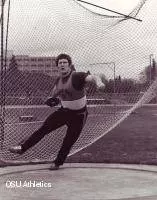
For the first 44 years of his life, Fox was larger than life, a 6-foot-1, 265-pound force field of a man, a two-time Pacific-10 Conference discus champion for Oregon State, a national master's discus champion at age 40.
Greg Likens was a student and aspiring pole vaulter in 1981 at Junction City High School, where his father was track coach. One day his father walked into the gymnasium, where Likens and a friend were attempting to dunk a volleyball.
Likens' father had in tow a new student teacher built like a heavy-duty truck. Likens remembers his father asking them to give the volleyball to Mr. Fox.
Fox took the ball, walked over to the basket, and looked up at the rim. Then, from where he stood, flat-footed on the floor, he leaped up, screamed, and slammed the ball through the basket.
"There must have been 40 boys there, and our jaws just dropped," Likens says.
The first impression lingered. Thirteen years later, Likens took a phone call from Fox, then teaching and building the track program at La Pine, a working-class community about 30 miles south of Bend. Fox asked Likens to take over the middle school track team. Likens didn't hesitate.
Through the 1990s, Fox, with help from Likens and high school track co-coach Jim Rehberg, fashioned a consistent contender in what was then the Class 3A Sky-Em League.
Fox's bulk was intimidating and his voice carried from one end of the track to the other. But he was a blend of strength and gentleness.
"After you raced, he would give you a hug," says La Pine girls track coach Brian Earls, who ran the mid-distances for Fox in high school. "It didn't matter what level you were at, whether you were the best or the worst. He was there for you, every single time."
When Fox started competing again on the master's level at 40, he could still throw the discus 160 feet. That didn't surprise Zysett, who used to meet Fox in the La Pine High weight room early in the morning to lift weights.
Once, Fox loaded 405 pounds on a barbell and asked Zysett to spot him in the bench press.
"I said, 'OK, Tim. But I can't dead lift that,' " Zysett says. "His attitude was, if a man can't do it, he shouldn't attempt it. He got underneath there and blew that thing up. I struggled more with my warm-up sets than he struggled with 405 pounds."
In La Pine, Fox was viewed as indestructible, which is why the news from a Maui beach on July 4, 2001, blindsided a whole community. While attempting to dive under a wave, Fox met it head-first instead, fracturing a vertebra and bruising his spinal cord.
It left Fox paralyzed from the shoulders down. While hospitalized shortly after the injury, he developed an infection. His temperature soared to 108, damaging the part of his brain controlling speech and fine motor skills.
Fox spent months in hospitals and rehabilitation centers in Hawaii, Portland and Bend, before finally returning home in the fall of 2001. He was 50 pounds lighter, unable to dress or feed himself, or take care of the most basic of bodily functions. The booming voice had become an often unintelligible whisper.
It was traumatic for everybody who knew him.
"I know kids who are still afraid to go see him," Likens says, blinking back tears. "They haven't come to see him because they are afraid."
Afraid to face evidence of a world so capricious that being in the wrong place at the wrong millisecond can shatter someone once thought invincible.
This could be a tragedy, except that Fox won't have it. In the nearly six years since his accident, he has regained some use of his arms, although not complete use of his hands. His speech has improved dramatically thanks to Botox injections in his larynx.
Friends in the community donated materials and labor for a one-room addition to the house that Fox shares with his wife, Sara, and 9-year-old son, Mack. Fox works out in the room six days a week, putting on 45 pounds, much of it upper-body muscle, since he returned home. He keeps close track of his personal records.
"He has every one in his mind," Sara Fox says. "He knows where he started and how much weight he has increased it by."
Every new PR is further proof the paralysis hasn't won.
Sara remembers lying on their bed, Tim trying to raise his right leg and she looking for the slightest separation between leg and bed. One day, there was.
The advances come slowly. But, they haven't stopped coming, and Fox hasn't stopped pushing.
"I'm persistent," he says.
He spent seven months painstakingly tapping out his life story with one finger on his desktop computer. That was a goal met.
He has others. He wants to walk again, and to go steelhead fishing with Mack in his favorite spot on the Lower Deschutes River.
Last summer, Fox helped catch a 62-inch sturgeon -- two inches too long to keep -- on the Columbia River near Astoria. He has another sturgeon fishing trip planned this summer.
When the weather cooperates, Sara loads Tim into a specially-fitted van. They go to track practice so he can work with the discus throwers.
"It's bittersweet," Fox says.
Bitter because every practice is a reminder of what he can no longer do. Sweet because even after being sideswiped by life, he still finds a way to make a difference.
Fox may be a volunteer coach, but he contributes. La Pine produced four of the last five Sky-Em League girls discus champions.
Zysett, the La Pine athletic director, says he believes the athletes not only respond to Fox's coaching, but to something more elemental.
"If you ask Tim right now, 'Are you going to walk again?' I'll guarantee he'll say yes," Zysett says. "I'll guarantee you he'll say yes until the day he dies. It's good for our kids to see someone with that kind of focus and motivation.
"He teaches them lessons without even attempting to. That's Tim. That's what he's always done."
Ken Goe: 503-221-8040; kengoe@news.oregonian.com