Walkons Succeed in Football
By Cliff Kirkpatrick
As far as walk-on programs go, the Oregon State football team has developed one of the better ones in the nation during the Mike Riley era.
The Beavers don’t do anything special, they just give people a chance. And that’s a big first step.
Opportunity has led to success, even though it’s not as well-know as Nebraska bringing in more than 30 non-scholarship players to fill out the roster.
Oregon State is a haven for athletes who did not start out in the spotlight
As far as walk-on programs go, the Oregon State football team has developed one of the better ones in the nation during the Mike Riley era.
The Beavers don’t do anything special, they just give people a chance. And that’s a big first step.
Opportunity has led to success, even though it’s not as well-know as Nebraska bringing in more than 30 non-scholarship players to fill out the roster.
OSU, however, has Mike Hass and Alexis Serna as examples of reaching the peak even though no one wanted them out of high school.
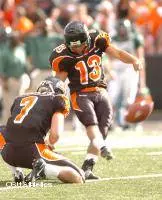
Hass won the Biletnikoff Award, which goes to the nation’s best receiver, last season and could be a first-day NFL draft pick Saturday. Serna earned the Lou Groza Award, which goes to the nation’s top place-kicker, last season. And he has two more years of eligibility.
Both of them earned scholarships after they arrived on campus. Both were lost on the depth chart early, but worked hard and made the coaches take notice.
When the opportunity came in the game, they delivered.
“If I’m a walk-on, I want to come to Oregon State because it’s the land of opportunity,” Riley said. “We spend a lot of time evaluating the walk-on deal and try to basically gather information as to who might be like (Hass or Serna). That doesn’t happen too often, but we don’t take it lightly. We evaluate that very hard.”
Looking for those hidden gems is challenging, but finding them is gratifying.
Serna and Hass became such national success stories that Riley spoke about them everywhere he went the past two years. And it never grew tiring because there was so much pride in what they’ve accomplished.
“It’s not easy to see,” running backs coach Jim Gilstrap said of finding the next Hass. “You can’t see inside the heart of the kid and see how important it is to that kid. You can see someone with talent, but never his dedication to performance and playing and learning and getting stronger, until it happens. We look at their overall athletic ability. They have the height, weight, speed and work in with our group. Then we watch them play.”
The Beavers have been looking at a new crop of walk-ons this spring, and it will continue into the season and beyond. There are 22 on the roster, and that number should increase in the fall.
Most grew up being Beavers fans, with 18 from the state of Oregon. There were opportunities to go to smaller schools and play major roles, but they decided that wearing orange-and-black was more important.
“This is where I wanted to be,” said receiver Taylor Kavanaugh, who is from Portland. “A few smaller colleges talked to me, but I never thought about that. I’ve been coming to Beaver games since I was 4 years old. It’s something I’ve always wanted to do and it worked out for me. I just love the game of football. I love to be out here. It’s a dream come true — seriously.”
The four from out of state also look at OSU as the best opportunity. Long snapper Aaron Carlson is from Washington, and was asked by the coaches to join the team.
Special teams specialists such as kickers, punters and long snappers are frequently recruited walk-ons, and given scholarships later.
Brian Davilla is a wide receiver from Aptos, Calif. He played at Cabrilla College and drew interest from Division I-AA and Division II colleges, but always dreamed of playing at the Division I level.
He was high school friends with offensive lineman Andy Levitre, so Levitre was a reference for the OSU coaching staff to bring Davilla in.
“I love the California schools, but this seemed to be the right fit,” Davilla said. “They helped me get into school. They wanted me here early for fall camp, and that was important to me. I had schools like Cal that said if I could get in they wanted me at the beginning of the school year (at midseason). That was fine, but I wanted a chance to establish myself.”
Getting noticed is difficult. Since there are up to 85 scholarship players on the roster, the team wants a return on it investment so they are given the most opportunity.
Hass and Serna support the walks-on, encouraging them to keep going even when it looks like they won’t play much, if at all. Serna has become so popular that they even track him down by e-mail before they arrive for advice.
“It’s definitely harder for a walk-on coming into a D-I program,” Serna said. “You have to work twice as hard as a scholarship player. And you have to show the coaches that you are working hard all the time.”
Once school begins, walk-ons aren’t allowed to eat with the scholarship players in the dinning hall unless they pay out of pocket. Serna had trouble keeping weight on because of a lack of nutrition in the early years because of financial problems.
“You just come out and don’t take anything for granted, especially being on this team,” Kavanaugh said. “I don’t think I should have anything given to me. I should earn it. If I get one shot in the game, you try and make the best of it and show the coach you can do something.”
Most of the time walk-ons work on the scout team, being used as enhancement talent. However, coaches see who’s making the starters look bad and word spreads.
Kavanaugh has been impressive catching passes, and running back Dan Weis may get into games as a blocking back. Zach Harris is a second-string offensive guard.
“They give you the best shot possible, and that’s all I can ask for,” Weis said. “Working harder and getting the plays down better, that helps you out. Just give yourself the opportunity to show your ability. But just being considered part of the team makes me happy. I’m loving it.”
Walk-ons have been given plenty of reps during spring practice. This time of year is a good chance to evaluate them because the team isn’t preparing for any games.
Most of their opportunities in the fall will come on special teams, blocking or tackling on kickoffs and punts. However, they all hope to enter the game at their regular position.
And then, who knows. The next Mike Hass might emerge.
“If you make plays, your time will come when they put you in the game,” Davilla said. “And you never know what can happen. So I just come out here every day and work as hard as I can and leave everything on this field.”
OSU, however, has Mike Hass and Alexis Serna as examples of reaching the peak even though no one wanted them out of high school.
Hass won the Biletnikoff Award, which goes to the nation’s best receiver, last season and could be a first-day NFL draft pick Saturday. Serna earned the Lou Groza Award, which goes to the nation’s top place-kicker, last season. And he has two more years of eligibility.
Both of them earned scholarships after they arrived on campus. Both were lost on the depth chart early, but worked hard and made the coaches take notice.
When the opportunity came in the game, they delivered.
“If I’m a walk-on, I want to come to Oregon State because it’s the land of opportunity,” Riley said. “We spend a lot of time evaluating the walk-on deal and try to basically gather information as to who might be like (Hass or Serna). That doesn’t happen too often, but we don’t take it lightly. We evaluate that very hard.”
Looking for those hidden gems is challenging, but finding them is gratifying.
Serna and Hass became such national success stories that Riley spoke about them everywhere he went the past two years. And it never grew tiring because there was so much pride in what they’ve accomplished.
“It’s not easy to see,” running backs coach Jim Gilstrap said of finding the next Hass. “You can’t see inside the heart of the kid and see how important it is to that kid. You can see someone with talent, but never his dedication to performance and playing and learning and getting stronger, until it happens. We look at their overall athletic ability. They have the height, weight, speed and work in with our group. Then we watch them play.”
The Beavers have been looking at a new crop of walk-ons this spring, and it will continue into the season and beyond. There are 22 on the roster, and that number should increase in the fall.
Most grew up being Beavers fans, with 18 from the state of Oregon. There were opportunities to go to smaller schools and play major roles, but they decided that wearing orange-and-black was more important.
“This is where I wanted to be,” said receiver Taylor Kavanaugh, who is from Portland. “A few smaller colleges talked to me, but I never thought about that. I’ve been coming to Beaver games since I was 4 years old. It’s something I’ve always wanted to do and it worked out for me. I just love the game of football. I love to be out here. It’s a dream come true — seriously.”
The four from out of state also look at OSU as the best opportunity. Long snapper Aaron Carlson is from Washington, and was asked by the coaches to join the team.
Special teams specialists such as kickers, punters and long snappers are frequently recruited walk-ons, and given scholarships later.
Brian Davilla is a wide receiver from Aptos, Calif. He played at Cabrilla College and drew interest from Division I-AA and Division II colleges, but always dreamed of playing at the Division I level.
He was high school friends with offensive lineman Andy Levitre, so Levitre was a reference for the OSU coaching staff to bring Davilla in.
“I love the California schools, but this seemed to be the right fit,” Davilla said. “They helped me get into school. They wanted me here early for fall camp, and that was important to me. I had schools like Cal that said if I could get in they wanted me at the beginning of the school year (at midseason). That was fine, but I wanted a chance to establish myself.”
Getting noticed is difficult. Since there are up to 85 scholarship players on the roster, the team wants a return on it investment so they are given the most opportunity.
Hass and Serna support the walks-on, encouraging them to keep going even when it looks like they won’t play much, if at all. Serna has become so popular that they even track him down by e-mail before they arrive for advice.
“It’s definitely harder for a walk-on coming into a D-I program,” Serna said. “You have to work twice as hard as a scholarship player. And you have to show the coaches that you are working hard all the time.”
Once school begins, walk-ons aren’t allowed to eat with the scholarship players in the dinning hall unless they pay out of pocket. Serna had trouble keeping weight on because of a lack of nutrition in the early years because of financial problems.
“You just come out and don’t take anything for granted, especially being on this team,” Kavanaugh said. “I don’t think I should have anything given to me. I should earn it. If I get one shot in the game, you try and make the best of it and show the coach you can do something.”
Most of the time walk-ons work on the scout team, being used as enhancement talent. However, coaches see who’s making the starters look bad and word spreads.
Kavanaugh has been impressive catching passes, and running back Dan Weis may get into games as a blocking back. Zach Harris is a second-string offensive guard.
“They give you the best shot possible, and that’s all I can ask for,” Weis said. “Working harder and getting the plays down better, that helps you out. Just give yourself the opportunity to show your ability. But just being considered part of the team makes me happy. I’m loving it.”
Walk-ons have been given plenty of reps during spring practice. This time of year is a good chance to evaluate them because the team isn’t preparing for any games.
Most of their opportunities in the fall will come on special teams, blocking or tackling on kickoffs and punts. However, they all hope to enter the game at their regular position.
And then, who knows. The next Mike Hass might emerge.
“If you make plays, your time will come when they put you in the game,” Davilla said. “And you never know what can happen. So I just come out here every day and work as hard as I can and leave everything on this field.”