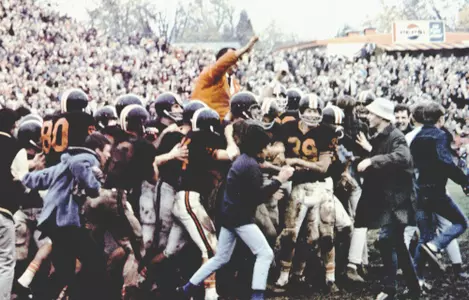
Giant Killers -- The Preseason
October 09, 2017 | Football
One of the most iconic teams in the history of the university will be honored this Saturday.
Oregon State University Athletics is proudly celebrating the 50th anniversary of the famed "Giant Killers" football team. Led by the late head coach Dee Andros, Oregon State posted a 7-2-1 record that included victories over No. 1 ranked USC, No. 2 Purdue and then a tie with the new No. 2 team in the land UCLA.
Historian Kip Carlson is in the midst of writing a six-part series on the team that originally prints in the gameday program that is available at Reser Stadium.
The Giant Killers will be honored at this Saturday's game vs. Colorado that kicks at 1:07 p.m. Tickets are available for the early afternoon contest at BeaverTickets.com
PART 1 – THE PRESEASON
By Kip Carlson
August 30, 1967.
That day, Thurgood Marshall was confirmed by the United States Senate as the first African American justice ever to sit on the U.S. Supreme Court. The grandson of a slave, Marshall had been nominated in June by President Lyndon Johnson.
Half a world away, the U.S. Army 4th Battalion, 9th Infantry Regiment – long and proudly nicknamed the Manchus - fought the Battle of the Horseshoe. After an area of the Viet Cong stronghold known as the Iron Triangle was shelled heavily, three companies were helicoptered into a bend where the Saigon and Thi Tinh Rivers met to count casualties and assess damage; they were ambushed and 11 Americans were killed and 40 wounded in the daylong battle. All told, 32 U.S. servicemen died in Vietnam that day.
There was conflict at home, as well, in what would become known as "The Long Hot Summer"; riots had flared in cities across the country, most notably in Newark and Detroit. At the same time, the "Summer of Love" had drawn thousands of young people to San Francisco's Haight-Ashbury district.
As the summer wound down that week, radios might be playing chart-toppers such as "Ode to Billie Joe" by Bobbie Gentry, "All You Need is Love" by the Beatles, "Pleasant Valley Sunday" by the Monkees and "Light My Fire" by the Doors. Among recently released films in theaters were "In the Heat of the Night" starring Sidney Poitier and Rod Steiger and "Bonny and Clyde" featuring Warren Beatty and Faye Dunaway.
Corvallis' population had reached 30,000, a jump of over 8,000 since 1960; the city would soon welcome back 13,000 Oregon State University students – and some of them were already on campus.
That Wednesday afternoon, with the temperature headed for a high in the low 80s, the 1967 Beaver football team gathered for the first time, getting publicity pictures taken and then running the "Andros Mile" on the Bell Field track.
The run was named for the man born Demosthenes Konstandies Androkopoulos, but long known to the world simply as Dee Andros, who was entering his third season as Oregon State's head coach. Raised in Oklahoma, Andros went from high school into the U.S. Marine Corps and won the Bronze Star for valor in battle at Iwo Jima. After returning from World War II, he played football four years at Oklahoma and then was an assistant coach there before moving on to Kansas, Texas Tech, Nebraska, California and Illinois.
Andros finally got his shot at a head coaching job in 1962 at Idaho; in three seasons, the Vandals went 11-16 against much higher-profile competition. That attracted the attention of Oregon State, which hired him after Tommy Prothro took the UCLA coaching job following the Beavers' 1964 Rose Bowl season.
A man of stocky build who now favored orange and black attire, Andros had been dubbed "The Great Pumpkin" by a sportswriter the previous autumn as the Beavers thumped Washington State 41-13 on Halloween.
That was part of six straight wins to end the 1966 season, giving the Beavers a 7-3 record after they'd gone 5-5 in Andros' first campaign in Corvallis. 1967 would present challenges, though, given the Beavers had graduated six defensive and seven offensive starters; among those gone on offense were quarterback Paul Brothers, fullback Pete Pifer and wingback Bobby Grim.

In the new year, among OSU's 26 returning lettermen were just five seniors: offensive guard Dave Marlette, tight end/punter Gary Houser, linebacker Skip Vanderbundt, defensive end Harry Gunner (who had been a split end the previous season) and defensive tackle Gary Neal. A sixth, starting offensive tackle Jeff Hardrath, was advised by a doctor just before fall camp to quit the sport because of a string of knee injuries.
The squad reporting in late August included over 30 sophomores up from the Rook team and the juniors included a number of junior college transfers new to Oregon State.
"I suppose with our many rookies and juniors, you would call this a building year," Andros told Don McLeod of The Oregonian, who noted the coach mentioned this "between puffs on a long stogie." Andros continued: "But even with so many newcomers figuring highly in our plans, right now I'm confident we'll be a tough team to beat. The big question is how soon our rookies become veterans."
The first step was the Andros Mile, which required players to run a mile in under 6 minutes; if they failed, they'd have to try again the next day. Only three players didn't make the mark and the top finishers were sophomore defensive back Don Whitney in 5:16, junior fullback Bill Enyart in 5:20 and junior college transfer defensive back Mel Easley in 5:25.
"They all came back in excellent physical condition and the way they ran our mile test proved to me that they are here to play football," Andros told reporters. After the mile concluded, the Beavers elected Vanderbundt and Marlette as captains.
The next day, the Beavers began daily doubles with practices at 7 a.m. and 3:30 p.m. That schedule would continue for eight days as OSU prepared for its September 16 season-opener against Stanford in Portland's Multnomah Stadium. The 16 days of preparation time weren't enough, in the minds of Andros and his coaching colleagues up and down the West Coast.
"That opening game sneaks up pretty fast when it falls on September 16," Andros told Don Fair of The Oregonian. "Ideally, a coach would like to hold 12 days of daily doubles … when you have only 16 days to get ready for that opener, this is impossible.
"Why? Because it takes the players a week to get their legs back, to get that snap back. So there's no way we can hold more than eight days of daily doubles. After that, it's a schedule of one workout per day so the athletes can recover. When their legs are dead, an athlete doesn't have quickness, the reactions that are so important on a football field. And it doesn't matter how well conditioned the athletes are when they report for practice. They still need a week to get their leg spring back."

The Pacific-8 Conference Skywriters – a group of journalists from up and down the West Coast - visited on September 5 and OSU practiced under their watchful eyes. The offense beat the defense 35-24 in a 111-play scrimmage; fullbacks carried the ball on 47 of those plays. Junior Steve Preece, now the starting quarterback after having been Brothers' backup, guided a 65-yard drive for a score, with Enyart – a linebacker the previous season – taking the ball over from the 1-yard line. Preece also passed to junior wingback Billy Main for a score.
"We did some things well, but we didn't look quick out there on defense," Andros said afterward. "I know their legs are tired."
The Corvallis Gazette-Times' story on the Skywriters' visit included a look at another newcomer to Oregon State: the 40-row addition to Parker Stadium's west grandstand and the new press box above it, raising the stadium's capacity by to 41,000 from the previous 33,000. A photo showed the action as seen from the top row to give fans an idea what the view would be twice as far away from the field as the old back row.
"The new construction has changed Parker Stadium from a homey little facility to one of vastness," wrote Oregon Journal columnist George Pasero. The column quoted athletic director Jim Barratt as saying the $600,000 project had been built entirely on donations and athletic department funds; Pasero noted Barratt wasn't just building for expected larger crowds in the coming decades but wanted full houses now rather than "50 years ahead. But by that time, an East grandstand could be built to match that of the west side," Pasero wrote. He also pointed out that lush grass again covered the field after the previous year's turf had been damaged by overfertilization.
By now, the preseason prognostications of both the Pac-8 sports information directors and the media had been released. The SIDs picked OSU fourth with UCLA winning the conference and USC as the runner-up; the Skywriters also had the Beavers fourth but tabbed the Trojans as the league favorite followed by the Bruins.
NEXT: The games begin.
Historian Kip Carlson is in the midst of writing a six-part series on the team that originally prints in the gameday program that is available at Reser Stadium.
The Giant Killers will be honored at this Saturday's game vs. Colorado that kicks at 1:07 p.m. Tickets are available for the early afternoon contest at BeaverTickets.com
PART 1 – THE PRESEASON
By Kip Carlson
August 30, 1967.
That day, Thurgood Marshall was confirmed by the United States Senate as the first African American justice ever to sit on the U.S. Supreme Court. The grandson of a slave, Marshall had been nominated in June by President Lyndon Johnson.
Half a world away, the U.S. Army 4th Battalion, 9th Infantry Regiment – long and proudly nicknamed the Manchus - fought the Battle of the Horseshoe. After an area of the Viet Cong stronghold known as the Iron Triangle was shelled heavily, three companies were helicoptered into a bend where the Saigon and Thi Tinh Rivers met to count casualties and assess damage; they were ambushed and 11 Americans were killed and 40 wounded in the daylong battle. All told, 32 U.S. servicemen died in Vietnam that day.
There was conflict at home, as well, in what would become known as "The Long Hot Summer"; riots had flared in cities across the country, most notably in Newark and Detroit. At the same time, the "Summer of Love" had drawn thousands of young people to San Francisco's Haight-Ashbury district.
As the summer wound down that week, radios might be playing chart-toppers such as "Ode to Billie Joe" by Bobbie Gentry, "All You Need is Love" by the Beatles, "Pleasant Valley Sunday" by the Monkees and "Light My Fire" by the Doors. Among recently released films in theaters were "In the Heat of the Night" starring Sidney Poitier and Rod Steiger and "Bonny and Clyde" featuring Warren Beatty and Faye Dunaway.
Corvallis' population had reached 30,000, a jump of over 8,000 since 1960; the city would soon welcome back 13,000 Oregon State University students – and some of them were already on campus.
That Wednesday afternoon, with the temperature headed for a high in the low 80s, the 1967 Beaver football team gathered for the first time, getting publicity pictures taken and then running the "Andros Mile" on the Bell Field track.
The run was named for the man born Demosthenes Konstandies Androkopoulos, but long known to the world simply as Dee Andros, who was entering his third season as Oregon State's head coach. Raised in Oklahoma, Andros went from high school into the U.S. Marine Corps and won the Bronze Star for valor in battle at Iwo Jima. After returning from World War II, he played football four years at Oklahoma and then was an assistant coach there before moving on to Kansas, Texas Tech, Nebraska, California and Illinois.
Andros finally got his shot at a head coaching job in 1962 at Idaho; in three seasons, the Vandals went 11-16 against much higher-profile competition. That attracted the attention of Oregon State, which hired him after Tommy Prothro took the UCLA coaching job following the Beavers' 1964 Rose Bowl season.
A man of stocky build who now favored orange and black attire, Andros had been dubbed "The Great Pumpkin" by a sportswriter the previous autumn as the Beavers thumped Washington State 41-13 on Halloween.
That was part of six straight wins to end the 1966 season, giving the Beavers a 7-3 record after they'd gone 5-5 in Andros' first campaign in Corvallis. 1967 would present challenges, though, given the Beavers had graduated six defensive and seven offensive starters; among those gone on offense were quarterback Paul Brothers, fullback Pete Pifer and wingback Bobby Grim.
In the new year, among OSU's 26 returning lettermen were just five seniors: offensive guard Dave Marlette, tight end/punter Gary Houser, linebacker Skip Vanderbundt, defensive end Harry Gunner (who had been a split end the previous season) and defensive tackle Gary Neal. A sixth, starting offensive tackle Jeff Hardrath, was advised by a doctor just before fall camp to quit the sport because of a string of knee injuries.
The squad reporting in late August included over 30 sophomores up from the Rook team and the juniors included a number of junior college transfers new to Oregon State.
"I suppose with our many rookies and juniors, you would call this a building year," Andros told Don McLeod of The Oregonian, who noted the coach mentioned this "between puffs on a long stogie." Andros continued: "But even with so many newcomers figuring highly in our plans, right now I'm confident we'll be a tough team to beat. The big question is how soon our rookies become veterans."
The first step was the Andros Mile, which required players to run a mile in under 6 minutes; if they failed, they'd have to try again the next day. Only three players didn't make the mark and the top finishers were sophomore defensive back Don Whitney in 5:16, junior fullback Bill Enyart in 5:20 and junior college transfer defensive back Mel Easley in 5:25.
"They all came back in excellent physical condition and the way they ran our mile test proved to me that they are here to play football," Andros told reporters. After the mile concluded, the Beavers elected Vanderbundt and Marlette as captains.
The next day, the Beavers began daily doubles with practices at 7 a.m. and 3:30 p.m. That schedule would continue for eight days as OSU prepared for its September 16 season-opener against Stanford in Portland's Multnomah Stadium. The 16 days of preparation time weren't enough, in the minds of Andros and his coaching colleagues up and down the West Coast.
"That opening game sneaks up pretty fast when it falls on September 16," Andros told Don Fair of The Oregonian. "Ideally, a coach would like to hold 12 days of daily doubles … when you have only 16 days to get ready for that opener, this is impossible.
"Why? Because it takes the players a week to get their legs back, to get that snap back. So there's no way we can hold more than eight days of daily doubles. After that, it's a schedule of one workout per day so the athletes can recover. When their legs are dead, an athlete doesn't have quickness, the reactions that are so important on a football field. And it doesn't matter how well conditioned the athletes are when they report for practice. They still need a week to get their leg spring back."
The Pacific-8 Conference Skywriters – a group of journalists from up and down the West Coast - visited on September 5 and OSU practiced under their watchful eyes. The offense beat the defense 35-24 in a 111-play scrimmage; fullbacks carried the ball on 47 of those plays. Junior Steve Preece, now the starting quarterback after having been Brothers' backup, guided a 65-yard drive for a score, with Enyart – a linebacker the previous season – taking the ball over from the 1-yard line. Preece also passed to junior wingback Billy Main for a score.
"We did some things well, but we didn't look quick out there on defense," Andros said afterward. "I know their legs are tired."
The Corvallis Gazette-Times' story on the Skywriters' visit included a look at another newcomer to Oregon State: the 40-row addition to Parker Stadium's west grandstand and the new press box above it, raising the stadium's capacity by to 41,000 from the previous 33,000. A photo showed the action as seen from the top row to give fans an idea what the view would be twice as far away from the field as the old back row.
"The new construction has changed Parker Stadium from a homey little facility to one of vastness," wrote Oregon Journal columnist George Pasero. The column quoted athletic director Jim Barratt as saying the $600,000 project had been built entirely on donations and athletic department funds; Pasero noted Barratt wasn't just building for expected larger crowds in the coming decades but wanted full houses now rather than "50 years ahead. But by that time, an East grandstand could be built to match that of the west side," Pasero wrote. He also pointed out that lush grass again covered the field after the previous year's turf had been damaged by overfertilization.
By now, the preseason prognostications of both the Pac-8 sports information directors and the media had been released. The SIDs picked OSU fourth with UCLA winning the conference and USC as the runner-up; the Skywriters also had the Beavers fourth but tabbed the Trojans as the league favorite followed by the Bruins.
NEXT: The games begin.

Wednesday, May 06
Monday, April 20
Monday, April 13
Wednesday, April 08